
Pocket sprung mattresses
BedBoy earns a commission on outbound retailer links. Editorial scoring is independent of commission rates. How this works →
Last updated:
Pocket sprung mattresses get sold on their spring count, which is the one number in the category that nothing measures. It'll tell you how many pockets sit inside the unit and that's all it tells you. Not how thick the wire is, not how tall the springs stand, and not a word about the layer you'll be lying on.
Inside the unit, every spring stands in a sewn fabric sleeve of its own. Press one down with your thumb and the ones beside it barely move, because the sleeve holds that load on the spring taking it. An open coil works the other way about: one long wire wound through the lot, so the whole thing moves together. Cheaper to build, too, which is why it's still everywhere.
In one study, 664 adults wore accelerometers at home and averaged around 1.6 position changes an hour in bed, which works out at a dozen turns each across a night.1 So whether a pocket unit is worth paying for depends almost entirely on who else is in your bed. It carries less of each of those turns over to your side, because there's no wire joining one spring to the next.
That's the whole of what the premium over an open coil buys, so it's worth being straight about who it buys it for. Share the bed with somebody and you'll meet the difference every time one of you rolls over. Sleep on your own and it's a property you've paid for and will never once notice.
My own preference runs against the way this category gets sold to people. Put the difference into the comfort layer rather than into the count, because the layer is the part your hip meets every night. Spring count is a line on a ticket you read once, and nobody has run the trial that would settle the two. Call that a preference rather than a finding.
That layer is where the feel of a bed comes from, which is also the part a listing tells you least about. Natural fibre or polyester, both get called filling, though the two don't cost or last anything like the same. Wool is the one I'd pay up for. It buffers heat in both directions, so it'll hold warmth in for you in a cold room and shed it in a warm one.
One caveat on that, since it's mine rather than the data's. I run cold, so the airflow this category leads with is a property I'd sooner cancel out than pay for. If you're somebody who wakes up too warm, discount that paragraph and keep the rest.
Somebody, at some point, sat down and decided that sewing two thousand little cloth bags together was a reasonable way to build a bed. Here we are.
If it's pressure at your shoulder or your hip that sent you shopping in the first place, start somewhere else. Springs push back where memory foam and latex give way, so a sprung surface holds you up instead of closing round you. Neither one's better than the other, because they answer different complaints, which is what the side sleeper shortlist is sorted on.
Sorting the grid is what the BedBoy Score is there for, and not much beyond that. What's inside a sewn pocket won't be in any of the data sitting behind it.
186 products compared from live retailer data. Scored under our published rubric; curated by Gary Ferguson. Corrections via our corrections policy.
Browse categories
Browse all brands
- Bodyshape
- Dunlopillo
- Emma Mattress
- Ergomotion
- Eve
- Flaxby
- Furniture Village
- Harrison Spinks
- Horizon
- House Beautiful
- Hyde & Sleep
- Hyde and Sleep
- Hypnos
- iGel
- Jay-Be
- Julian Bowen
- Little Big Dreams
- Luna
- Millbrook Beds
- Mlily
- Relyon
- Rest Assured
- Romantica
- Sealy
- Silentnight
- Simba
- Simply Bensons
- Sleepeezee
- Sleepmasters
- Sleepmotion
- SleepSoul
- SleepyTime
- Slumberland
- Snooze
- Sophie Conran
- Staples & Co
- Tempur
- The Dream Team
- The Dreams Workshop
- TheraPur
- Welcome
- WIEMANN
- X Rocker
- healthopaedic
- birlea
- hypnos
- sareer
- orignal-bedstead-company
- nora
- intex
- symple-stuff
- visco-therapy
- house-additions
- home-loft-concept
- clima-control
- kally-sleep
- viva
- healthbeds
- clima-comfort-latex
- feather-and-black
- sleep-science
- spink-and-edgar
- hypnia
- dreamcloud
- revived
- airsprung-beds
- bestway
- disney
- h-living
- bodyshape
- bed-butler
- sprungland
- stompa
- protect-a-bed
Did you know?
Putting your phone down an hour before bed helps you fall asleep faster and wake up less.
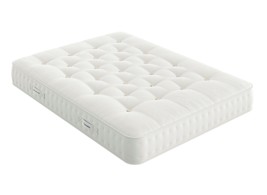
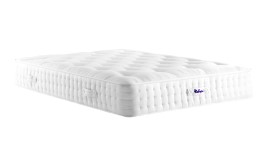
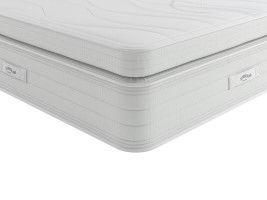
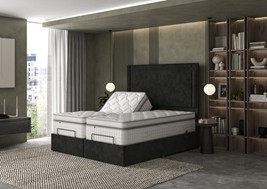
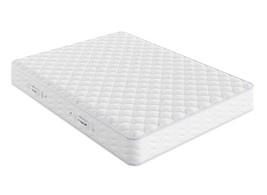
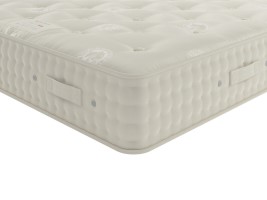
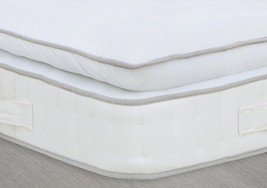
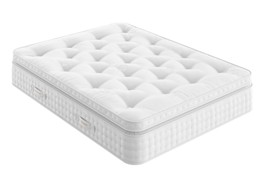

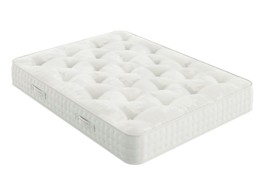
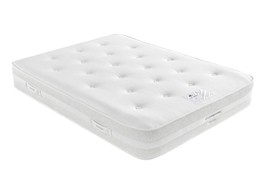
What a spring count is counting
All it counts is pockets. No published test method rates a mattress by how many springs are inside it, so two units carrying the same figure on the ticket can behave nothing like each other. What the number does track fairly well is what you'll pay, because a maker fitting more springs tends to fit better fillings at the same time.
That makes it a price tier rather than a measurement, fine enough as long as you know which one you're being sold. Ask a retailer what the count is quoted alongside, then watch how long the answer takes.
Does the pocket fabric make a difference?
Nobody's published anything that says. You'll meet two fabrics: calico, which is a plain woven cotton, and a bonded synthetic that's heat-welded instead of sewn. Calico turns up on hand-built beds and costs more to make.
Whether your hip can tell the two apart through a comfort layer is a question no test method's ever been pointed at. So read that word as a description of how the bed was made, not of how it'll feel. I'd not pay a penny more for calico until somebody publishes a measurement.
Will a pocket unit stop your partner waking you?
Partly, though the honest answer is more interesting than the sales one. Each spring takes the weight sitting on it and passes little of it sideways, so a movement arrives at the far side of the bed smaller than it started. Nobody argues with the mechanics of it.
The shaky part is the assumption underneath. You get told a partner's movement is wrecking your sleep, which is what every couples pitch in this category rests on.
What sharing a bed does to your sleep
When researchers put couples through overnight polysomnography, first sharing a bed and then sleeping apart, the shared nights came back with more limb movement, around 10% more REM sleep, and REM that was less broken up than any of them managed alone.2
Those were young, healthy couples in a sleep laboratory, so it settles nothing about your bedroom. What it does say is that the movement a pocket unit damps isn't automatically what's ruining your night. Snoring will beat it. So will a partner on shifts.
Tension is the UK word for firmness
Firmer is not the answer to a bad back, whatever the showroom tells you. UK retail sells this category on tension: soft, medium, medium firm, firm, extra firm. Mention your back in a shop and you'll be walked up that ladder. Pulling together 39 published articles, one review came down on medium firm instead.3
How you sleep moves the target from there, further than the label on the bed does. On your back, the job is keeping your hips level with your shoulders, because a surface that lets them drop leaves your lower back arched all night. Side sleeping wants more give, since your hip and shoulder have further to travel before the surface catches them. Face down, less again.
What goes on top of the springs?
Fillings, and that's the half of the mattress you'll be lying on. Wool, cotton, silk, cashmere, mohair, lambswool and polyester fibre all turn up there. Natural fibres cost more and give way more slowly. Polyester's cheap and settles faster, which is one reason low price and high count share a ticket.
Synthetic filling isn't an allergy fix, whatever you get told, because fibre type isn't the mechanism. NHS advice on allergic rhinitis runs on washing your bedding at 60°C and above, damp dusting and fitted covers.4 Hot washing and a zipped cover are what get rid of house dust mite allergen, not the fibre under the ticking. You can't wash what's inside a mattress, so buy a protector you can strip off and boil.
Can you turn one over?
Some of them, though that's rarer than it used to be. Traditional sprung mattresses are tufted through both faces, so they're built to be flipped as well as rotated. Bonded fillings on a no-turn build sit on the top face only. Flip one of those and you put the cheap side under your shoulder.
Look for the tufts. Those are the tapes or cords running right through from one face to the other, finished with a tag or washer. They hold the fillings where they were laid rather than letting them wander inside the case. Quilting stitches the top panel to a thin layer and compacts nothing.
Rolled units, and what compressing one costs
A pocket unit can be rolled, and plenty you'll see online are. What compression rules out is height. A tall spring won't be squashed flat for a fortnight and come back the same, so boxed sprung mattresses tend to run shorter springs than the showroom version.
Shorter isn't automatically worse for you, though it does mean the unit in the box and the unit in that brand's shop model may not be the same unit, where the listing rarely says which. Spring height is the one specification I'd chase here, because it's the thing that changes and the thing nobody prints. Ask that before you order a boxed mattress, because it has a straight answer.
Sizes, and the one that catches people out
The small double, every time. Doubles measure 135 cm across (4 ft 6 in), small doubles 120 cm (4 ft). Both are 190 cm long, so what you give up is 15 cm of width and not a centimetre of length. In a box room that's the difference between walking round your bed and edging round it.
Length is the other trap, and it catches tall buyers rather than small rooms. King and super king both run 200 cm rather than 190, which you'll care about if you're tall enough to find the end of a bed with your heels. Euro sizes reach 200 cm too, so they take Continental bedding rather than British.
Who should skip pocket springs
Anyone after an enclosing, sink-in surface. Springs push back at you, and that resistance is the point of the build, so no count on earth will buy you the sensation of being wrapped up. Foam does that job instead, or a foam layer over the unit.
Heavier buyers should read the build rather than the number. Past roughly 16 st (102 kg), what decides how long a unit lasts is wire thickness rather than the number of pockets, since a heavier gauge takes more load before a spring bottoms out, and pockets added to a unit built from thin wire change nothing about the day it dips. None of us here sits in that band, which is why the heavy-load shortlist goes on build rather than on anybody's say-so.
What should you ask before you order?
Start with the comfort layer: what it's made of, and how many centimetres deep it runs. Then ask which of that maker's own tensions sits closest to the bed you're replacing, since your reference point is the mattress you've slept on.
Spring feel's one of the harder things to judge off a specification sheet. Where a showroom near you stocks the model, spend ten minutes lying on it in the position you sleep in, which settles more than any listing can. Treat the ranked shortlist as a way of deciding which ten minutes to spend. This page included.
None of this is medical advice, and a back that hasn't eased in a few weeks needs a physiotherapist or a GP rather than a new mattress.
Common questions
What is a pocket sprung mattress?
A block of individual springs, each one sewn into its own fabric pocket, so a spring answers to the weight sitting on it and leaves the ones beside it more or less alone. Over the top goes a comfort layer of fillings, then the ticking you can see. Open coil and continuous coil mattresses use one long wire wound into every spring instead, which is cheaper to build and moves as a single surface, so you'll feel your partner get up. Pocket sprung and pocket spring mean the same thing, and you'll see both on listings.
How many pocket springs do I need?
There isn't a figure you have to hit. Retail bands run 800 to 1,199, then 1,200 to 1,999, then 2,000 and up, and those work as price tiers as much as anything, since a higher count usually arrives with better fillings and a better cover rather than with more support on its own. Two units at 1,500 can feel nothing like each other depending on what's stitched over them. Settle your tension and your comfort layer first, then let the count be whatever it turns out to be.
Are pocket sprung mattresses noisy?
Generally not, because the springs never touch each other. A spring sits inside its own sleeve, so you get none of the metal-on-metal contact that an open coil's helical lacing starts to give you as it ages. Where a sprung bed does creak, the noise usually comes from underneath: a slat that's slipped, a divan castor, a joint gone loose in the frame. Check your base before you blame your mattress. One of those is a five-minute fix and the other's a new bed.
Is a pocket sprung hybrid a different thing?
Same spring unit, different word on the label. A hybrid is a pocket unit with a named foam or latex layer over it, so every hybrid is a pocket sprung mattress even though plenty of pocket sprung mattresses never get called one. The word tends to appear when a maker would rather talk about the layer than the springs. Wool and cotton on top and it sells as pocket sprung. Memory foam on top and it's a hybrid. What you're buying underneath is the same either way.
What sits behind the ranking?
Published manufacturer specifications, plus review text pooled from the retailers that stock each model. Nobody here has slept on one, no editor's handled one, and no badge on this site has ever suggested otherwise. That puts a limit on what you're reading: it's solid on the things you can check before you buy and no use at all on how a spring unit feels in year six, because a review written in the first fortnight can't see that far. The rubric is published in full.
References
- 1. E S Skarpsno and others, ‘Sleep positions and nocturnal body movements based on free-living accelerometer recordings: association with demographics, lifestyle, and insomnia symptoms’, Nature and Science of Sleep, vol. 9 (2017), pp. 267–275, doi:10.2147/NSS.S145777.
- 2. H J Drews and others, ‘Bed-sharing in couples is associated with increased and stabilized REM sleep and sleep-stage synchronization’, Frontiers in Psychiatry, vol. 11 (2020), pp. 583, doi:10.3389/fpsyt.2020.00583.
- 3. G Caggiari and others, ‘What type of mattress should be chosen to avoid back pain and improve sleep quality? Review of the literature’, Journal of Orthopaedics and Traumatology, vol. 22, no. 1 (2021), pp. 51, doi:10.1186/s10195-021-00616-5.
- 4. NHS, ‘Allergic rhinitis’, nhs.uk (2026) <https://www.nhs.uk/conditions/allergic-rhinitis/> [accessed 9 August 2026].