
Pillows
BedBoy earns a commission on outbound retailer links. Editorial scoring is independent of commission rates. How this works →
Last updated:
Lie on your side and put a hand in the space between your ear and the mattress. That gap is what a pillow has to fill, sized by your shoulder width and the weight of your head rather than by your sleeping position alone. Fill it badly and your neck spends the night bent. Get it right and you'll stop noticing the pillow, which is the whole job.
We couldn't find a British or ISO standard for pillow dimensions, so every figure you'll see quoted is trade convention. The National Bed Federation puts a UK pillow at 71 to 74 cm by 46 to 48 cm, which is 28 to 29 inches by 18 to 19.4 Square Continental pillows run 65 by 65 cm, or 26 inches each way, so measure your own bed before you order six of anything.
Pillow shopping isn't anybody's favourite twenty minutes.
I'd start from that gap and not from anybody's chart of sleeping positions. Retailers send side sleepers to firm and high, back sleepers to medium, front sleepers to flat, which only works because shoulder width tends to track position.
Put two side sleepers on the same mattress and they'll still want different pillows, one broad across the shoulders, one narrow. Buy the loft that suits somebody taller than you and you'll spend the night off axis. Body geometry is why the side sleeper shortlist divides the way it does.
There's a good deal less evidence under all this than the packaging suggests. One 2021 systematic review pooled nine trials and 555 people between them. It found small improvements in waking neck pain and in neck disability, with latex the best supported of the fillings tested. Sleep quality it didn't move at all.1
So a better pillow is a modest lever on how your neck feels at seven in the morning. On how well you slept getting there, it's close to nothing.
UK clinical guidance is blunter than anything you'll read on a pillow page: NICE tells GPs to advise a single, firm pillow for ordinary neck pain.2 NHS advice runs the same way, asking for something low and firm with your head at the same height as the rest of your body. Plenty of people stack two, and that's the habit both are arguing against.
Cooling covers are the feature I'd skip. One changes how the surface feels for the first few minutes, then it's at body temperature like everything else in your bed. Unless you wake up too warm and know the pillow is why, you're paying for somebody else's problem. Heat is a room question or a duvet question first, so start there. Let the hot sleeper shortlist take you back to the mattress rather than to whatever sits under your head.
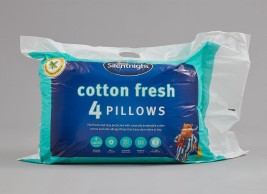
Beside each card sits a BedBoy Score. Use it to sort your options, then set it aside, because it can't settle anything about your neck. How it's built lives on the scoring page, though the number to read carefully here is the review count. Four-packs bought for a spare room gather them faster than one pillow bought for one difficult neck.
40 products compared from live retailer data. Scored under our published rubric; curated by Monika Sharma. Corrections via our corrections policy.
Browse categories
Browse all brands
- Bodyshape
- Dunlopillo
- Emma Mattress
- Ergomotion
- Eve
- Flaxby
- Furniture Village
- Harrison Spinks
- Horizon
- House Beautiful
- Hyde & Sleep
- Hyde and Sleep
- Hypnos
- iGel
- Jay-Be
- Julian Bowen
- Little Big Dreams
- Luna
- Millbrook Beds
- Relyon
- Rest Assured
- Romantica
- Sealy
- Silentnight
- Simba
- Simply Bensons
- Sleepeezee
- Sleepmasters
- Sleepmotion
- SleepSoul
- SleepyTime
- Slumberland
- Snooze
- Sophie Conran
- Staples & Co
- Tempur
- The Dream Team
- The Dreams Workshop
- TheraPur
- Welcome
- WIEMANN
- X Rocker
- healthopaedic
- birlea
- hypnos
- sareer
- orignal-bedstead-company
- nora
- intex
- symple-stuff
- visco-therapy
- house-additions
- home-loft-concept
- clima-control
- kally-sleep
- viva
- healthbeds
- clima-comfort-latex
- feather-and-black
- sleep-science
- spink-and-edgar
- hypnia
- dreamcloud
- revived
- airsprung-beds
- bestway
- disney
- h-living
- bodyshape
- bed-butler
- sprungland
- stompa
- protect-a-bed
Did you know?
Putting your phone down an hour before bed helps you fall asleep faster and wake up less.


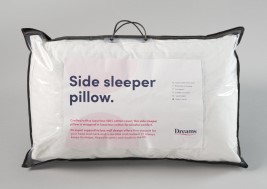

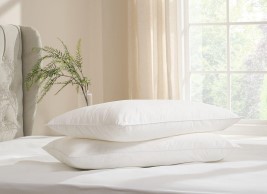
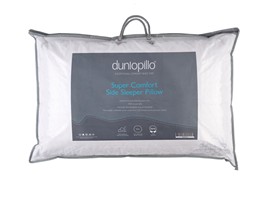
How high should a pillow be?
High enough to fill the gap under your neck. No higher. Loft moves the angle your neck sits at more than filling does, which is the one point where the trial evidence and the clinical advice agree.1
Centimetre figures you'll see quoted come from somewhere else entirely: a much smaller radiographic study of sixteen young healthy adults lying flat on their backs. It won't support a number per sleeping position.
Get somebody to look at you from behind while you're lying on your side. Your chin dropping toward your chest means too much loft, while tipping the other way, toward the mattress, means there isn't enough. Ten seconds of that'll tell you more than any firmness grade printed on a wrapper.
Fillings, and what each one trades away
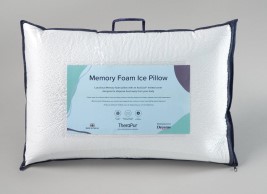
Memory foam keeps the shape your head presses into it, which suits a fixed position and which is also why it sits warmer than an open structure. Nobody's measured a pillow for heat, so take that as a fact about how it's built and not as a measurement. Mattresses built from it behave the same way.
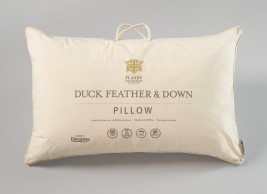
Feather and down compress under your head and want shaking out each morning, which some people find soothing and others can't be doing with. Both sit under a proper standards family, so a composition figure such as 85/15 down to feather means something specific under BS EN 12934. Fill power has its own standard in BS EN 12130.
Hollowfibre springs back well, costs least and flattens first, whereas latex is springy, heavy, expensive and the filling the pooled trials treated most kindly. Wool is the one that settles rather than springs back, so the loft you buy in the shop isn't the loft you'll be sleeping on a few months later. Lanolin sensitivity is the documented problem with wool, a skin reaction rather than a heat one.
The hypoallergenic claim doesn't survive checking
There's no legal definition of hypoallergenic in the UK, so the word on a wrapper commits the maker to nothing. I'd take it off your shortlist.
Pore size is the mechanism the aisle quotes, the idea being that synthetic fibres are woven tight enough that mites can't get through. Measurement doesn't point that way. Studies that found any difference in dust-mite allergen found more of it in synthetic pillows than in feather ones, though one didn't find a difference at all.
Temperature's the part with evidence behind it: NHS advice on allergic rhinitis is synthetic bedding and covers, washed regularly at 60C and above.3 Sixty degrees is the mechanism there rather than the fibre, since a washable pillow washed hot beats an unwashed pillow of any filling.
So a machine-washable core and a cover you can strip and boil count for more than the label on the front. Share the bed with a dog or a cat and washability stops being a footnote, so treat anti-allergy bedding as the hygiene and comfort product it is. And if an allergy is bad enough to be costing you sleep, see a GP about the allergy rather than shopping for a pillow.
Does a new pillow fix a sore neck?
Sometimes, and by less than you'd want. The pooled trial evidence cited above puts the effect on waking symptoms in the small-but-present band, which makes a pillow one input rather than a treatment.
When a new one changes nothing, look underneath it, because if the mattress won't let your shoulder sink your neck sits crooked whatever you put on top. No pillow fixes a mattress.
That bit of extra travel for your shoulder is what a pillow-top surface is buying. Work through the side sleeper shortlist or the wider mattress comparison before you spend on a second pillow. Firmer doesn't mean better for a bad back, whatever the orthopaedic aisle implies, which is what the back pain hub works through.
See a GP if neck pain runs past a few weeks, or sooner with pins and needles, a cold or weak arm, fever, unexplained weight loss, or pain that wakes you. Same again where there's a history of trauma, cancer or neck surgery.
When has a pillow stopped working?
When it stops springing back. Fold yours in half and let go. Filling with something left in it opens out, while filling that's gone stays folded and your neck has been paying for that.
Waking stiff and easing off over the first hour tells you the same thing.
Bed Advice UK says pillows want replacing at least every two or three years. Natural and polyester fills want washing at least three times a year, and foam pillows cleaning every two to three months.4 Published replacement figures don't agree with one another, so read any single one as convention rather than as fact.
Memory foam cores don't go in a machine, so the cover comes off and washes while the core just gets aired. Much the same split runs through duvets.
Anti-snore, copper and lavender
Positioning devices, the lot of them. Snoring advice from the NHS includes buying a special pillow or a bed wedge to keep you on your side. That's a claim about where your body ends up, not about your airway. No pillow stops snoring, so anybody selling one that does is over the line.
Lavender in a pillow has been measured against dust-mite allergen and didn't do a thing. Copper infusion and bamboo cooling haven't got pillow-specific evidence in either direction, so read them as formats on the shelf rather than as benefits you're buying.
Snoring with witnessed pauses in breathing, gasping or choking, or heavy daytime sleepiness on top of it, points at sleep apnoea. Book the GP, not the pillow.
When the pillow is not the problem
Front sleepers won't get much from this page. Sleeping face down is what NHS prevention advice on neck pain tells you to avoid, so the flattest pillow here is damage limitation.
It's also the position I can't speak to, and saying so beats writing a paragraph that pretends otherwise.
Anyone shopping for a baby under twelve months should stop here. NHS safer-sleep guidance says to keep a baby's cot clear of anything that could cover their face and head. Do not use pillows, duvets, cot bumpers, loose blankets or soft toys. Nothing to keep a baby in place either, so no pods and no nests.
Cot safety isn't a shopping question at all: it belongs with a midwife or a health visitor, and the kids range is separate again.
Loft in centimetres decides more of this than any other number, though almost no listing prints it. That's the question to put to a retailer before any other. Anything here that turns out to be wrong ends up on the corrections page.
Common questions
What size pillow do I need for a king or super king bed?
Pillow size doesn't change with the bed, though the number you fit across it does. The long side of a standard UK pillow runs 71 to 74 cm, so two of them together span 142 to 148 cm and cover a 150 cm king. A 180 cm super king is left with roughly 30 cm bare down the middle. Squeeze a third pillow in and you're past 210 cm, wider than the bed itself. Continental squares don't rescue it either: at 65 cm each they span 130 cm as a pair, which is narrower again.
Can a memory foam pillow go in the washing machine?
No, and it's the care question people get wrong most often. A memory foam core is one solid piece, so a wash cycle soaks it right through, tears at the cell structure and leaves damp trapped where nothing can reach it. Strip the cover off and wash that instead, then spot-clean the core with a damp cloth and a little mild detergent. Let it dry flat and all the way through before the cover goes back on. Damp sitting in the middle of foam is what'll make a pillow smell.
Is there a tested badge on these pillows?
No, and there never has been one. Nothing on this site has ever carried a tested badge of any kind, because not one of us has slept on a pillow, unpacked one or put a tape measure near one. Rankings come out of published specifications and out of the reviews owners leave with each retailer stocking a product. You can read the weightings in full on the scoring page. Being blunt about it costs nothing, since a fortnight under somebody else's neck wouldn't tell you much about your own.
How many pillows should I sleep with?
One, and the UK guidance is unusually specific about it. One firm pillow that leaves your head level rather than propped is what the clinical advice on ordinary neck pain comes down to. Two stacked rarely manage it. Plenty of people sleep on two and feel fine, so this isn't a rule with a penalty attached. If you wake stiff and you're on two, dropping to one costs you nothing and it's the cheapest change on offer.
Is a pillow protector worth buying?
Yes, on hygiene grounds rather than allergy ones. It gives you a layer to take off and wash hot every few weeks, which counts for more when the core underneath can't go in a machine at all. Memory foam, latex and anything with a bonded structure all fall under that. What a protector won't do is treat an allergy, because reviews of mite-avoidance measures haven't found a reliable clinical benefit. Buy one because it keeps your pillow cleaner for longer, not because a packet says anti-allergy.
References
- 1. J C Y Pang and others, ‘The effects of pillow designs on neck pain, waking symptoms, neck disability, sleep quality and spinal alignment in adults: a systematic review and meta-analysis’, Clinical Biomechanics, vol. 85 (2021), pp. 105353, doi:10.1016/j.clinbiomech.2021.105353.
- 2. National Institute for Health and Care Excellence, ‘Neck pain - non-specific’, cks.nice.org.uk (2023) <https://cks.nice.org.uk/topics/neck-pain-non-specific/> [accessed 9 August 2026].
- 3. NHS, ‘Allergic rhinitis’, nhs.uk (2026) <https://www.nhs.uk/conditions/allergic-rhinitis/> [accessed 9 August 2026].
- 4. National Bed Federation, ‘Pillow advice’, Bed Advice UK (2026) <https://bedadvice.co.uk/bed-buyers-guide/pillow-advice/> [accessed 9 August 2026].