
Pillow top mattresses
BedBoy earns a commission on outbound retailer links. Editorial scoring is independent of commission rates. How this works →
Last updated:
Work out what a pillow top costs you in five years, rather than judging it on how it feels in the shop. The padding is stitched permanently onto one side of the mattress, so the bit that softens first is the bit you can never turn out of the way. You can rotate it head to foot, and you should, but the dip will still form where your hips go.
What you're really buying is a topper that never comes off. Underneath it, the spring unit is doing all the work of holding you up. The idea makes sense, because most of us do sleep on our side: one study strapped accelerometers to 664 adults and found they spent 54.1% of their time in bed on their side, against 37.5% on their back.1
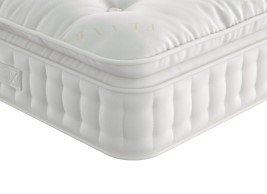
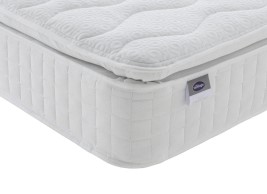
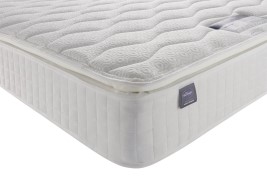
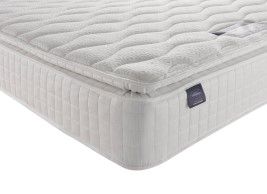
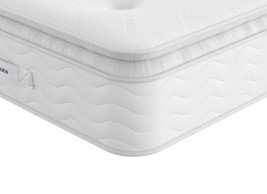
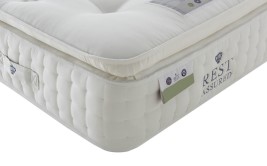
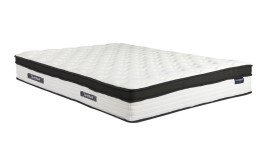
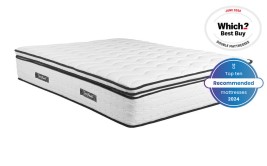
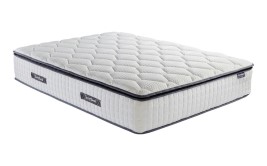
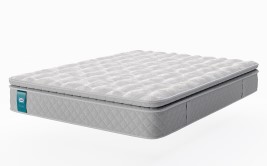
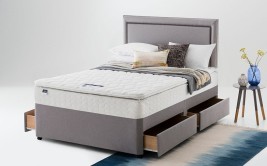
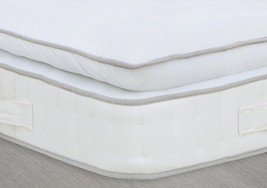
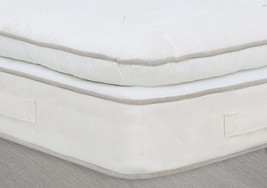
Euro top and box top are the same seam in a different place. Run your hand down the side panel and you'll feel which one you've got. A Euro top sits flush with the edge, a box top squares it off, and a pillow top leaves the stitched border standing proud.
None of those three words tells you anything about quality. A thin bonded pad can be sold as a pillow top just as easily as a hand-teased wool one, so it's the filling you need to ask about rather than the name.
A dip where you sleep isn't a fault. The National Bed Federation says any mattress with a decent depth of filling should be expected to show body impressions, because that's simply what the fillings settling into your shape looks like.2
You'll notice it most on a big bed. A king is 150 cm across and a super king 180 cm, and nobody sleeps up the middle, so the strip down the centre stays plump while the areas either side of it settle.
That's why it pays to read the guarantee before you read the specification, although hardly anyone does it in that order. Every sprung mattress warranty has an impression clause tucked away in it somewhere. There's no official industry standard for deciding when settlement has gone too far, so an inspector works from a measuring system tied to the type of filling, and the padded top itself rarely gets measured at all.2
Pillow tops argue with themselves, and it's worth knowing which side of that argument you're on. If you're light and you sleep on your side, the extra give at the surface is exactly what you need. If you overheat, that same layer wraps more material around you, which is the last thing you want.
Natural fibre or a soft latex top will give you the first without much of the second. A deep foam one won't, whatever the cooling badge on the ticket says.
The premium buys you padding you can never replace. Put that same money into the pocket unit underneath and you're buying the part that outlasts everything above it, which on the under £500 shortlist is nearly always the better trade.
The BedBoy Score on each card will get you down to a shortlist and not much further. What actually separates two pillow tops sits inside the top layer, where no photograph has ever shown it.
The photographs are lovely, mind. Somebody works hard on that corner-turned-back shot.
One thing a pillow top can't do is turn a firm mattress into a soft one. Put a shallow pad over a rigid unit and your shoulder will stop in the same place, only more politely. Sort the support out first, then treat the surface as your second decision.
17 products compared from live retailer data. Scored under our published rubric; curated by Giselle Green. Corrections via our corrections policy.
Browse categories
Browse all brands
- Bodyshape
- Dunlopillo
- Emma Mattress
- Ergomotion
- Eve
- Flaxby
- Furniture Village
- Harrison Spinks
- Horizon
- House Beautiful
- Hyde & Sleep
- Hyde and Sleep
- Hypnos
- iGel
- Jay-Be
- Julian Bowen
- Little Big Dreams
- Luna
- Millbrook Beds
- Relyon
- Rest Assured
- Romantica
- Sealy
- Silentnight
- Simba
- Simply Bensons
- Sleepeezee
- Sleepmasters
- Sleepmotion
- SleepSoul
- SleepyTime
- Slumberland
- Snooze
- Sophie Conran
- Staples & Co
- Tempur
- The Dream Team
- The Dreams Workshop
- TheraPur
- Welcome
- WIEMANN
- X Rocker
- healthopaedic
- birlea
- hypnos
- sareer
- orignal-bedstead-company
- nora
- intex
- symple-stuff
- visco-therapy
- house-additions
- home-loft-concept
- clima-control
- kally-sleep
- viva
- healthbeds
- clima-comfort-latex
- feather-and-black
- sleep-science
- spink-and-edgar
- hypnia
- dreamcloud
- revived
- airsprung-beds
- bestway
- disney
- h-living
- bodyshape
- bed-butler
- sprungland
- stompa
- protect-a-bed
Did you know?
Putting your phone down an hour before bed helps you fall asleep faster and wake up less.


How quickly will it flatten under you?
Slower than the internet will tell you, if you're on the lighter side. You're putting less weight through the same padding every night, so the impression forms over years rather than months, and most of the horror stories you'll read about pillow tops simply won't apply to you.
Put an eighteen-stone sleeper on the identical mattress and they'll arrive inside a year or two, on the same padding, at the same price. A five-star review is worth very little unless you know what the person writing it weighs. It's why the shortlist for heavier sleepers puts the spring unit ahead of the surface.
What's inside the padded layer
Cotton, wool, latex, polyester or foam, and what's in there matters far more than the words on the ticket. Wool and cotton handle moisture as well as warmth, which is why a hand-teased natural top feels nothing like a bonded pad of the same depth. Latex gives way without wrapping around you, because it pushes back rather than moulding.
Polyester and hollowfibre are the cheap options and they'll compress first. Foam is the one to watch, because it gives you the softness you came for and brings the heat along with it. Ask what the filling is and you've answered the temperature question before you've read a single cooling claim.
Is the problem heat, or is it damp?
Damp, mostly. Heat gets all the attention, but it's damp that actually wakes you up. Humid warmth disturbs sleep more than dry warmth does, and the conditions right around your body measurably change how your night is structured.3 A deep quilted top puts insulation between you and the air moving through the springs, then holds the moisture you give off against your skin.
Which is why pressing your hand on one in a shop tells you nothing. Wool in that layer will move damp air out of it, where a bonded foam pad keeps it exactly where it is. If you tend to wake up damp rather than just warm, that's the difference to shop on, and it's where the hot sleeper shortlist starts.
How firm can a pillow top get?
Soft to medium-firm covers most of what gets made, because a soft layer stitched over the springs is working against a firm surface from the start. The retailers don't agree on this in print. One lists everything from soft to firm, another says the padding caps you at around medium-firm, and the way they're built says the second one is right.
Before you take either at face value, it's worth knowing what a firmness label is. BS EN 1957 sets out how a mattress gets rated, and the standard says in its own scope that the rating can't be used to show the comfort or quality of a mattress or a complete bed.4 It's a test result rather than a verdict, so soft-medium from one maker won't feel like soft-medium from another.
Why not buy a cheaper mattress and a separate topper?
Often you should, though the shops would rather you didn't ask. A topper does the same job in the same way, laying a soft layer over a support unit so it changes what you're touching without changing what's holding you up. It's year six where the two part company.
Your topper comes off, goes out with the rubbish and gets replaced for a fraction of what the mattress cost. Stitched padding can't, so it goes to the tip with the mattress still attached to it.
The catch is that a topper slides about, needs tucking in and leaves a ridge where it stops short of the edge. If you're planning to keep the bed less than about five years, buy the topper.
What the premium buys as the price climbs
Better padding, mostly. Down at the bottom of the market that top layer is a thin bonded pad and the rest of your money went on the price ticket, which is how the category got its reputation. Spend more and the fillings turn into wool, cotton and horsehair, laid in and hand-teased rather than glued.
Tufting is the thing to look for up there, because the ties run right through the padding and slow down the shifting that makes the dent. On the under £1,000 shortlist your money still buys more spring unit than surface, so that's the trade to take at those prices.
One face, one direction
Flip one over and you're lying on the spring unit, so nobody does it twice. Turning it end for end is all you've got. Do that every few months and the load moves along the length of the mattress instead of parking in one spot for years.
The National Bed Federation's advice is to follow whatever care instructions came with your mattress.2 Most people never see them. They arrive folded in the bag with the guarantee, go straight in a drawer, and that's usually where the rotation schedule stays.
What should you ask a retailer before you order?
Four things, and you won't find any of them on the listing. How deep the comfort layer is in centimetres. What it's filled with. Whether the top is tufted or only quilted. And what depth of impression your guarantee will actually pay out on.
Get that last one in writing, because the guarantee runs for years and that clause decides whether any of those years are worth anything to you. An emailed answer you can keep beats a chat on a shop floor. If a figure on a card here turns out to be wrong, it gets written up on the corrections page.
The buyers this build works against
Anyone after a firm bed, first. Padding and firmness pull against each other, so a pillow top spends your money undoing the thing you came in for. Orthopaedic ranges are usually where that shopper ends up instead.
Then there's you, if you wake up damp and someone's showing you a deep foam top with a cooling cover stitched over it. That's your money going straight into the part of the bed causing the problem. Something thin and natural over a pocket unit will do what the badge is claiming, for less.
Common questions
Can the pillow top be replaced once it flattens?
No. It's stitched through the border into the mattress, so there's no seam to unpick and nothing to swap out, and that's the whole difference between a pillow top and a topper you bought separately. What people do instead is lay a topper over the settled padding, which works up to a point. It lifts the sleeping surface again and puts one more layer between you and the spring unit, so if you run warm you'll solve one problem and buy another. Rotating from new is the only thing that slows the dip down.
How long should a pillow top last?
The National Bed Federation costs a bed out over seven years when it works out what one is worth per night, which is a fair planning figure rather than a guarantee. The fillings decide where you land inside it. A tufted natural top keeps its loft longer than a bonded pad, because the ties stop the fillings shifting out of the zone you sleep in. Your weight moves it too. Replace on how the bed feels rather than on a date, and read the guarantee terms before you assume a dip is covered.
Will your fitted sheets still fit?
Check the depth printed on the sheet packaging against the mattress depth with the pillow top counted in, because the padded layer is part of the total and retailers quote the total. Deep-fill sheets exist for this and cost very little. The stitched border also takes more of the corner than a flat-sided mattress does, so a sheet that only just went on the old bed will ride up on the new one. Measure at the border rather than at the middle, since the quilted seam is the deepest point and that's what the corner has to clear.
Does a mattress protector change how a pillow top feels?
A quilted protector adds another padded layer over one you've already paid for, so it deepens the same enclosure and holds more moisture against you. If surface softness is why you chose a pillow top, that's fine. If you run warm, it works against the thing you were worried about in the first place. A thin cotton or Tencel protector keeps the padding clean without adding loft, and it washes at a temperature that means something. Protectors are also the cheapest layer in the bed to change your mind about.
Is any of this based on sleeping on the mattresses?
No. Nothing on BedBoy has been slept on, handled or measured by an editor, and there's no badge or tier anywhere claiming otherwise, because there's no testing programme behind one. Rankings come from published specifications and from review text pooled across the retailers stocking each product, and the method sits on the scoring page. One more thing about this category: no trial has ever compared a pillow top against the same mattress without one, so everything above is reasoned from construction or borrowed from next-door research and labelled as borrowed.
References
- 1. E S Skarpsno and others, ‘Sleep positions and nocturnal body movements based on free-living accelerometer recordings: association with demographics, lifestyle, and insomnia symptoms’, Nature and Science of Sleep, vol. 9 (2017), pp. 267–275, doi:10.2147/NSS.S145777.
- 2. National Bed Federation, ‘FAQs’, Bed Advice UK (2026) <https://bedadvice.co.uk/faqs/> [accessed 9 August 2026].
- 3. K Okamoto-Mizuno and K Mizuno, ‘Effects of thermal environment on sleep and circadian rhythm’, Journal of Physiological Anthropology, vol. 31, no. 1 (2012), pp. 14, doi:10.1186/1880-6805-31-14.
- 4. British Standards Institution, BS EN 1957:2012 Furniture. Beds and mattresses. Test methods for the determination of functional characteristics and assessment criteria (2012).