
Blanket boxes
BedBoy earns a commission on outbound retailer links. Editorial scoring is independent of commission rates. How this works →
Last updated:
Two blanket boxes at the same price can differ by a single part: the hinge. Butt hinges let the lid fall shut under its own weight, where a lid stay holds it wherever you let go. Furniture standards draw the line by weight and height: a horizontal hinged lid of 0.25 kg or more, sitting 1,000 mm or less above the floor, is meant to carry a support mechanism, written in to stop children's heads and necks being trapped.1
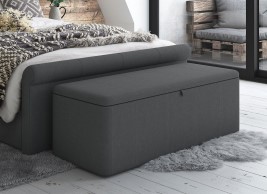
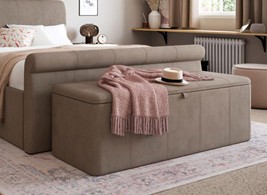
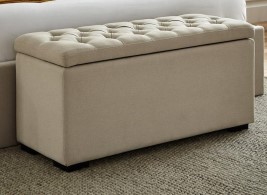
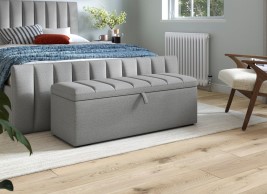
This category splits in two, though nothing on a product page marks the divide. Half of it is upholstered boxes sold to pair with a fabric bed frame in the same cloth, bought as an accessory to your bed rather than on their own. Solid timber and painted chests make up the other half, none of which ever had a bed to match. Which half you're shopping in changes nearly every decision underneath.
There's no way of saying blanket box out loud that doesn't sound like 1974.
Width is where the two halves part company. A matching box is cut to stand at the foot of a bed, so it lands close to double-bed width, while a chest bought on its own runs both narrower and deeper because there's nothing holding it to a size. So measure the gap at the foot of your bed before you fall for a photograph.
External width is the figure every listing hands you, while lid clearance decides where the box can stand at all. Push a box flat against a footboard and the lid won't rise past the point it touches. Then you're holding it up with one hand and reaching in with the other. Give it room to pass its own vertical, or you'll be propping it with a knee whenever you want a spare pillow.
Your money in this category goes into the carcass and the hinge before the colour, which is the order I'd spend it in every time. You'll stop noticing a shade you've gone off by about March, whereas a lid that drops on your knuckles keeps introducing itself.
Matching is the pitch. It's also the part of this I don't buy, because same fabric means same specification and not same shade. Treat the box as one more piece of bedroom furniture instead of a component of your bed, and the question gets far easier to settle.
Lid weight is the first thing I look for on a listing, which is a bias more than a rule. Whoever opens it one-handed with an armful of duvet isn't usually the one who chose it.
A blanket box makes an obvious toy box, which is exactly where the trouble starts. Two European standards were written on the assumption that a child will climb inside one, though neither reaches a box sold as bedroom furniture.
You'll find a score on each card below that'll shorten a long list, though it won't tell you a thing about the hinge. Open the listing and look for the words lid stay, because silence there is your answer.
11 products compared from live retailer data. Scored under our published rubric; curated by Giselle Green. Corrections via our corrections policy.
Browse categories
Browse all brands
- Bodyshape
- Dunlopillo
- Emma Mattress
- Ergomotion
- Eve
- Flaxby
- Furniture Village
- Harrison Spinks
- Horizon
- House Beautiful
- Hyde & Sleep
- Hyde and Sleep
- Hypnos
- iGel
- Jay-Be
- Julian Bowen
- Little Big Dreams
- Luna
- Millbrook Beds
- Relyon
- Rest Assured
- Romantica
- Sealy
- Silentnight
- Simba
- Simply Bensons
- Sleepeezee
- Sleepmasters
- Sleepmotion
- SleepSoul
- SleepyTime
- Slumberland
- Snooze
- Sophie Conran
- Staples & Co
- Tempur
- The Dream Team
- The Dreams Workshop
- TheraPur
- Welcome
- WIEMANN
- X Rocker
- healthopaedic
- birlea
- hypnos
- sareer
- orignal-bedstead-company
- nora
- intex
- symple-stuff
- visco-therapy
- house-additions
- home-loft-concept
- clima-control
- kally-sleep
- viva
- healthbeds
- clima-comfort-latex
- feather-and-black
- sleep-science
- spink-and-edgar
- hypnia
- dreamcloud
- revived
- airsprung-beds
- bestway
- disney
- h-living
- bodyshape
- bed-butler
- sprungland
- stompa
- protect-a-bed
Did you know?
Putting your phone down an hour before bed helps you fall asleep faster and wake up less.
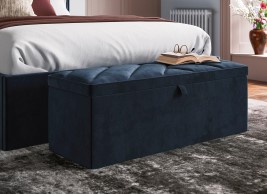
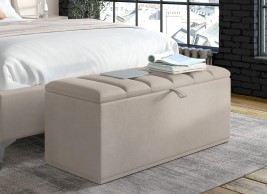
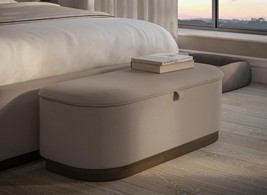
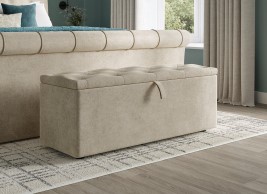
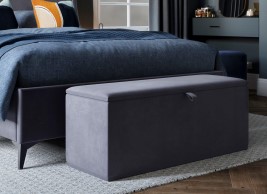
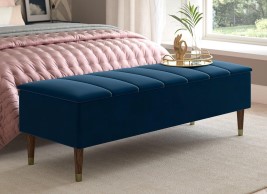
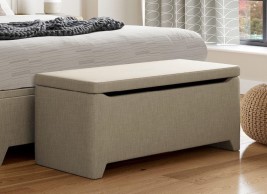
The hinge is most of the product
Hinge type decides how your box behaves, though it's the one specification retailers hardly ever list. BS EN 14749 covers the furniture side. A horizontal hinged lid of 0.25 kg or more, sitting 1,000 mm or less above the floor, needs a support mechanism: from 50 mm above closed, through an arc of up to 60 degrees, the lid must not drop more than 12 mm under its own mass.1
Both standards name the same hazard: a child leans into the box, the lid comes down on the back of the neck, and BS EN 71-1 calls the outcome asphyxiation.2 That's what the 12 mm is there to prevent.
Words to hunt for in a listing: lid stay, gas stay, soft-close. Find none of them and you're looking at a butt hinge, which is a hinge and that's all it is.
What the price actually buys
Cloth and finish are what the photographs sell, though they're near the bottom of what your money does. Your first few pounds buy board thickness and a carcass that'll stay square under a loaded lid. Above that you're paying for the hinge, the lining, then the name. Colour costs nothing.
Are they safe as a toy box?
Not by default. Blame a gap between two standards, not a fault in anybody's product. BS EN 71-1 covers toy chests, and it sets a minimum ventilation area that has to stay unobstructed with the box pushed into the corner of a room.
A child shut inside has to be able to push the lid open, and the support has to still hold after thousands of open-and-close cycles.2 The 2026 edition revised the ventilation requirements and added new test methods, so take the figures from the current standard rather than from any number a listing quotes at you.
All of it only applies where the product was placed on the market as a toy, which a box sold as bedroom furniture never was. So a box can clear every furniture requirement in force and still have no ventilation and no way out.
I won't tell you a given box is safe, because that'd be a verdict and we haven't handled one. What a safe one has is describable: lid support that holds anywhere in its travel, ventilation that works with the box in a corner, and a lid a child inside can push open. Check all three before it goes into a child's room, twice over second-hand.
Can you sit on a blanket box?
Mostly no. Domestic seating has its own standard, BS EN 12520, covering strength and durability for anything sold to sit on.3 Your blanket box counts as a storage unit unless its maker says otherwise, so the lid you're eyeing as a bench probably hasn't been tested as one.
Some are built for it and they'll say so, with a load rating on the spec, though where nothing's published, your lid is just a lid. I wouldn't perch on one that publishes no rating, not even the ones that look sturdiest. An unrated lid gives way at the hinge line, not in the middle where you'd see it coming.
How much fits inside one?
Internal volume is the figure you want, though it's the figure least likely to be printed. External dimensions won't stand in, since the carcass, the lining and the lid rebate eat it first.
There's a way round it that costs five minutes. Stack what you mean to store on the bed, measure the pile, then check it against the internal figure. Coats go in a wardrobe, because folding's what eats the volume.
Storing bedding so it doesn't come out musty
Put your bedding away clean and put it away fully dry. That one instruction covers most of what goes wrong in your blanket box, because a shut box preserves whatever state you put things away in.
Set a closed box against an outside wall in an unheated bedroom and you've built a cold pocket. Bedding that goes in slightly damp stays damp, so it's still damp when you open the lid in October. Lift your lid for an afternoon each season and turn the pile over.
Wool wants extra care, because clothes moth larvae feed on it, prefer soiled fibres to clean, and work in the dark undisturbed. Wash your blankets going in, not coming out.
Timber, board, or a padded lid
Oak and pine vary in grain from unit to unit, so a box and a chest of drawers bought as a set won't match. Painted board chips along the lid edge, because that's the only part of it anything ever hits.
Woven fabric goes grey along the top edge first, which is the edge you're looking straight down on. Faux leather sponges off in seconds, then creases where the lid folds down, which is where it splits in the end. Velvet shades with the nap, so your lid reads a different tone from the front panel.
None of that's a ranking. It's five ways for a box to look older than it is, so buy whichever of those failures would bother you least.
The label on a padded lid
UK law calls a padded box upholstered furniture. Britain's 1988 fire-safety regulations reach anything ordinarily intended for private use in a dwelling. No carve-out exists for a padded lid, so the cover, the filling and the labelling duties all apply.4
The permanent label is attached to the product itself, so you don't have to ask anybody. Bare timber isn't upholstered, so most of this passes it by. A padded lid with no label is a question worth putting before you pay.
Will it match a bed you bought last year?
Probably not exactly. Fabric is dyed in lots, so two lots of the same cloth can sit a tone apart. Across retailers it's worse, because nobody's matching to anybody else's standard.
That leaves you two honest options: order the pair together, or go neutral and let the headboard coordinate. Neutral also survives you changing the bed, which a box matched to an upholstered frame won't.
Do they arrive assembled?
Usually flat. A built box is mostly air to ship, which is why a board carcass nearly always turns up as panels. Ask before you order if you'd rather not build it.
On a board carcass the hinge screws land in a panel edge rather than its face. Panel edges are the weakest place in the box to sink a screw. Overtighten them and you've stripped the one fixing carrying your lid, so start by hand and stop when they bite.
Measure your bedroom doorway too. Blanket boxes don't come apart the way a divan base does, so whatever goes up your stairs must clear the door whole.
When a box will not solve it
Reach for it daily and it belongs in drawers, not under a lid you've got to clear first. Chests of drawers take a similar footprint and give you one-handed access. That's the swap. A bedside table covers whatever you want to reach at three in the morning.
Small rooms are the other case, where the trade is plain: a large box adds storage while making a small room look crowded. If floor space is the constraint, the volume under your bed costs you nothing. An ottoman base or a divan with drawers buys more litres for the same footprint.
Buy something sold as seating if seating's what you want. And if it's a toy box you're after, buy one sold as a toy, because the ventilation and the lid support arrive as requirements rather than luck.
Common questions
Do blanket boxes come with soft-close lids?
Some do, and it's rarely the headline on the listing. What you're after is a lid stay, a gas stay or a soft-close hinge, any of which stops the lid falling the moment you let go of it. A plain butt hinge is the default at the cheaper end and it doesn't hold the lid at all. Retailers often skip the detail, so read silence as a butt hinge until one of them tells you otherwise. Lid stays are sold separately, which makes this one of the few things on a blanket box you can put right after delivery.
Will a blanket box open fully if my bed has a footboard?
Not if you push it flat against one. The lid needs room to swing past vertical, so a footboard that's taller than the closed box will stop it partway and leave you holding it up. Measure your footboard height against the height of the box before you decide that's where it goes. Under a window, along a landing, or at the end of a wardrobe run all work, and a blanket box doesn't much care which room it ends up in.
Can a blanket box be used as a toy box?
It can, though not one you've bought without a look at the lid first. Boxes placed on the market as toys have to meet ventilation, lid-support and inside-opening requirements under the toy standard, while one sold as bedroom furniture isn't covered by that standard at all. That's how the same box can be entirely legal furniture and a poor toy chest at once. If it's going into a child's room, you want a lid that holds where you leave it and openings the box keeps when it's pushed into a corner.
Why does bedding come out of a blanket box smelling musty?
Because it went in slightly damp, or because your lid's been shut since spring. A closed box against an outside wall in a cold bedroom is an undisturbed cold spot, and that's where condensation collects. Wash it all and dry it right through before it goes away, then lift your lid for an afternoon each season and turn the pile over. A lining helps with snagging rather than with air, so don't expect it to fix this one.
Has anyone at BedBoy handled these boxes?
Nobody has. No editor here has lifted, loaded or opened one, and there's never been a tested badge on this site for anyone to lean on. The ranking runs on manufacturer specification plus the pattern in owner reviews across every retailer we list, with the weighting explained on the scoring page. So the hinge is the part of a blanket box this page can tell you least about. Hinges rarely come up in a first-week review, which is why your most useful ones come from somebody a couple of winters in.
References
- 1. British Standards Institution, BS EN 14749:2016+A1:2022 Furniture. Domestic and kitchen storage units and kitchen worktops. Safety requirements and test methods (2022).
- 2. British Standards Institution, BS EN 71-1:2026, clause 4.14 Safety of toys. Mechanical and physical properties (2026).
- 3. British Standards Institution, BS EN 12520:2024 Furniture. Safety, strength and durability. Requirements for domestic seating (2024).
- 4. UK Statutory Instruments, ‘The Furniture and Furnishings (Fire) (Safety) Regulations 1988 (SI 1988/1324)’, legislation.gov.uk (1988) <https://www.legislation.gov.uk/uksi/1988/1324/contents/made> [accessed 9 August 2026].