
Strutted headboards
BedBoy earns a commission on outbound retailer links. Editorial scoring is independent of commission rates. How this works →
Last updated:
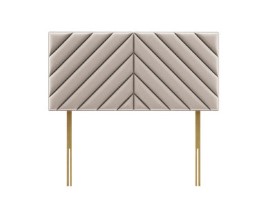
Your bed decides this, not the board in the photograph. Two wooden struts hang down the back of a strutted board and bolt into fixing points in the top panel of a divan base, so those fixings have to be there, sitting exactly where the struts do. Get that wrong and a lovely board's going straight back in its wrapping.
Struts themselves are the plain part of it. Each one's a flat pillar of timber screwed to the back of the board. It's drilled with a slot or a ladder of holes, so the height can be set before anything's tightened.
On a 4'6" double, 135 cm across, the fixings sit wherever the base maker's put them. Whatever gap they left is the number that decides whether your board goes on, and it's the one measurement nobody writes down.
Bed frames are the hard stop. Most wooden and metal bedsteads carry their own headboard or none at all, with nothing for a strut to bolt into, so a strutted board won't attach without an adapter. Ottoman bases fail on the same point, for the same reason.
When your bed isn't a divan, floorstanding boards are the ones that'll work, because they stand behind the bed rather than hanging off it.
Nothing in the phrase strutted headboard promises the holes will line up. Bases vary between makers, some arriving with the fixing positions marked but not drilled. Measure centre to centre between your bolt holes, then check that against whatever the listing says about strut spacing. Where it says nothing, that's a question for the retailer, and it's a fair one to ask before the order goes in.
Height is the thing I'd worry about most, because it moves after you buy. What you're measuring from is the top of the mattress, not the top of the base.
Add a 5 cm (2 in) topper and the board loses 5 cm of height above the pillows, while the gap behind them opens by the same amount. It's the same change that leaves a bedside table sitting low against the new bed.
I'd run the struts near the top of their slots before the bolts go tight, because a board that sits low reads low from the doorway. Dropping one later's easier than finding 5 cm that isn't there.
Upholstery is where the law takes a headboard seriously. Under the 1988 fire regulations a headboard counts as furniture, and while mattresses and bed-bases are let off the permanent labelling schedule, headboards aren't.1 So the divan base underneath doesn't carry a permanent fire label and the board bolted to it does.
I'd read that label before the colour name. The swing label that used to hang off the product in a shop came out of the rules on 30 October 2025. Its absence on new stock doesn't tell you anything either way.2
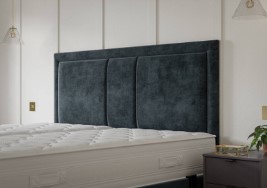
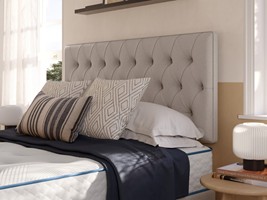
Fabric decides most of what you'll feel about this thing in three years, since it's at head height, where hair oil, make-up and somebody's hand land every night. Mid-tone flat weaves take that better than pale linen does. Deep buttoning gives dust a dimple to settle in that a cloth can't reach.
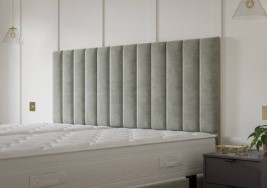
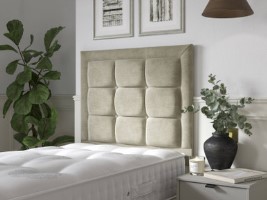
Every card below shows a score, built from a method published in full. Scores shorten a list, but they won't tell you whether the bolts on that board will reach yours. Headboard photography is a genre of its own: one lamp, one unopened book, one corner of a throw.
14 products compared from live retailer data. Scored under our published rubric; curated by Giselle Green. Corrections via our corrections policy.
Browse categories
Browse all brands
- Bodyshape
- Dunlopillo
- Emma Mattress
- Ergomotion
- Eve
- Flaxby
- Furniture Village
- Harrison Spinks
- Horizon
- House Beautiful
- Hyde & Sleep
- Hyde and Sleep
- Hypnos
- iGel
- Jay-Be
- Julian Bowen
- Little Big Dreams
- Luna
- Millbrook Beds
- Relyon
- Rest Assured
- Romantica
- Sealy
- Silentnight
- Simba
- Simply Bensons
- Sleepeezee
- Sleepmasters
- Sleepmotion
- SleepSoul
- SleepyTime
- Slumberland
- Snooze
- Sophie Conran
- Staples & Co
- Tempur
- The Dream Team
- The Dreams Workshop
- TheraPur
- Welcome
- WIEMANN
- X Rocker
- healthopaedic
- birlea
- hypnos
- sareer
- orignal-bedstead-company
- nora
- intex
- symple-stuff
- visco-therapy
- house-additions
- home-loft-concept
- clima-control
- kally-sleep
- viva
- healthbeds
- clima-comfort-latex
- feather-and-black
- sleep-science
- spink-and-edgar
- hypnia
- dreamcloud
- revived
- airsprung-beds
- bestway
- disney
- h-living
- bodyshape
- bed-butler
- sprungland
- stompa
- protect-a-bed
Did you know?
Putting your phone down an hour before bed helps you fall asleep faster and wake up less.
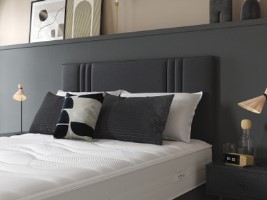

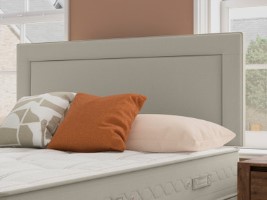
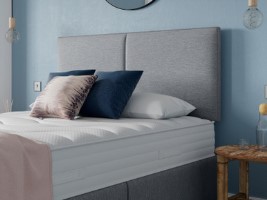

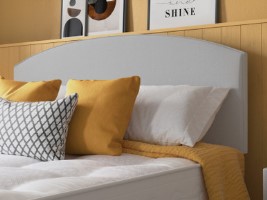



What a strut is, and what it does
It's a flat pillar of timber, screwed to the back of the board and hanging below its bottom edge. Each one's drilled with a slot or a ladder of holes, so a single board can sit at several heights.
The bolt passes through that slot into a threaded fixing in the divan top and pulls the strut tight. Nothing else carries the board. That's the whole mechanism, which is why the type name describes a fixing rather than a look.
Will it fit your divan base?
Only if the spacing matches, which isn't something the size label tells you. Divan bases carry threaded headboard fixings in the top panel, though where those sit varies between makers. Bed size is the coarse filter, so a 4'6" board is cut for a 135 cm bed while a 5'0" board at 150 cm overhangs it. Bolt spacing is the fine one, though it doesn't follow the size name in any way you can trust.
Measure yours before you shop. Keep the number in your phone.
Spacing is what I'd ask a retailer about before fabric, because that's the one that ends in a return.
What if the base has no headboard holes?
That depends which kind of base you've got. Some divans arrive with the positions marked but undrilled, so ask what drilling them does to the guarantee before anyone picks up a bit.
Others have nothing solid behind that panel to bolt into, which is a question for the retailer rather than something you'd want to discover with a drill. For those a floorstanding board is the sensible switch, since there's no base fixing to find and nothing to drill. Ask while the base is still in the shop, because once it's in your bedroom and the mattress is on it you're stuck.
How high should the board sit?
High enough that your shoulders meet padding rather than paint. Work from the top of the mattress you'll sleep on, because the struts adjust against the base while the mattress sits above it.
A tall board's the thing people look at when they walk in, while a low one vanishes behind the pillows once they're plumped. That part's taste. What's worth avoiding is a board set so low that its top rail catches you across the neck.
The gap behind your pillows
Bolt a board low against a deep mattress and a slot opens between the mattress top and the bottom edge of the board. Pillows go down it. So does a phone, and in a house with a toddler so does most of a toy box.
Slotted struts are the answer, since raising the board by 5 cm closes 5 cm of gap. Do it before the bolts are tight rather than after, because a loaded board's awkward to hold steady while somebody hunts for the spanner.
Strutted or floorstanding?
One thing separates them. Has the base got bolt fixings? With them, a strutted board sits tight to the divan and travels with it whenever the bed gets pushed about.
Without them, or where the divan might not be there in two years, a floorstanding board stands on its own behind the bed and doesn't care what it's standing behind. If I rented, I'd buy floorstanding and stop thinking about it, since a board that needs nothing drilled goes to the next flat with you.
Slatted, buttoned, winged, tall
They're looks rather than fixings, so a strutted board can wear any of them. Slatted means bars with gaps between them. Buttoned describes padding pulled into dimples by covered buttons sewn right through the panel.
On a winged board the sides come forward past the mattress, like the arms of a wing chair. Tall means what it says, plus more wall to look at than you'd think.
Slatted and strutted are the pair worth separating, because they sound like alternatives while they answer different questions. One describes the panel, the other describes how it's hung on your bed. Plenty of headboards carry both words in the same product title, which is where the confusion starts.
Fabric at head height, and the label sewn into it
An upholstered board takes a kind of wear no other bedroom surface takes, at the exact height a head rests against it night after night. Chenille, velvet and linen-look weaves hide that better than flat cotton does, while faux leather wipes clean in a second and keeps every crease it's ever had.
Legally an upholstered board is furniture, so its filling's got to pass a cigarette test and its cover a match test.1 A bare wooden or metal board with no padded panel sits outside those upholstery provisions, though it's still furniture. Headboards aren't on the list of baby and children's products the 2025 amendment took out of scope, so the duty on the board is unchanged.2 Guidance published alongside those changes sets out the full list of what did come out.3
What no listing tells you is whether a board and a separately bought base came off the same dye lot, so matching a fabric across two purchases is a gamble. Ask for a swatch.
Will it wobble once it's on?
A little, and less than people fear. Bolts through slotted struts make a rigid enough joint while they're tight, with the mass of the divan behind them holding the whole thing steady.
Bolts can loosen in the first few weeks, while the padding settles under the washer, so give them a turn after a month and then you're done. If it's still rocking, look for a missing washer or a strut standing proud of the base rather than blaming the design.
When to buy a different kind of headboard
Anyone without a divan. That covers bedsteads in wood or metal, ottoman bases, guest beds and most children's beds, all of which want a floorstanding board or a frame with the headboard built into it. Two smaller groups should walk past as well. Anyone who moves every year and doesn't want to drill anything. And anyone whose base fixings sit so far off the common spacings that the shortlist comes down to a handful of boards worth looking at.
Common questions
Can a strutted headboard fit a bed frame or an ottoman base?
No, not without an adapter. Strutted boards are built around threaded fixings in the top panel of a divan base, and a wooden or metal bedstead hasn't got that panel to bolt into. Ottoman bases generally carry no headboard fixing either, so there's usually nothing solid to reach. Some makers sell brackets that fix a board to a particular frame's side rails, and those are frame-specific rather than universal. Floorstanding is the category that works without modification when your bed isn't a divan.
How do I know the struts will line up with my divan?
Measure it. Take the distance from the centre of one fixing hole to the centre of the next on each side of the base, and note the height of the base while you're down there. Then check the listing for strut spacing or an adjustment range. Spacing doesn't follow the bed size in any reliable way, so a 4'6" board and a 4'6" base aren't automatically a pair. Where a listing gives no figures the retailer has the answer, and it's a fair question to ask before you buy rather than after.
Are the bolts and washers included, and what tool do I need?
Usually the board arrives with its own bolts and washers, and usually a spanner or an Allen key does the job. Neither's guaranteed, because fixings vary from one manufacturer to the next, so read the box contents on the listing. Two people make it easier on a king or super king, less for the weight than because somebody's got to hold the board square while the bolts start. Doing it single-handed on a wide board is how struts get cross-threaded.
Has anyone at BedBoy fitted one of these?
Nobody has. Nothing on this site carries a tested badge and there's never been one to carry, because we rank from listed specifications and from what buyers report after living with a product. That's why this page spends its time on measurements you can take yourself and on what the regulations require, both of which you can check without taking anybody's word for it. If a fitment detail can only come from the retailer, the listing is the authority and this page says so.
Can I take the board off and refit it to a different base when I move?
Usually, and that's one of the practical advantages of a bolted fixing. Undo the bolts and the board lifts away with its struts still attached. Whether it goes on the next bed is the same question you asked the first time, since the new base needs fixings the slots can reach. Bear in mind that holes in a strut are permanent, so a board that's moved twice may end up with more holes than it left the factory with. Tape the bolts and washers to the back before the van comes.
References
- 1. UK Statutory Instruments, ‘The Furniture and Furnishings (Fire) (Safety) Regulations 1988, regulation 3(1), regulations 5 and 8, and Schedule 7: definition of furniture, ignition tests and permanent labelling’, legislation.gov.uk (1988) <https://www.legislation.gov.uk/uksi/1988/1324> [accessed 9 August 2026].
- 2. UK Statutory Instruments, ‘The Furniture and Furnishings (Fire) (Safety) (Amendment) Regulations 2025, regulations 3 and 4: products removed from scope and removal of display labels’, legislation.gov.uk (2025) <https://www.legislation.gov.uk/uksi/2025/531/made> [accessed 9 August 2026].
- 3. Office for Product Safety and Standards, ‘Furniture and Furnishings (Fire Safety) (Amendment) Regulations 2025: guidance for businesses’, gov.uk (2025) <https://www.gov.uk/government/publications/furniture-and-furnishings-fire-safety-regulations/furniture-and-furnishings-fire-safety-amendment-regulations-2025-uk> [accessed 9 August 2026].