
TV beds
BedBoy earns a commission on outbound retailer links. Editorial scoring is independent of commission rates. How this works →
Last updated:
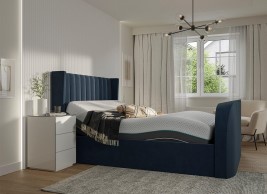
A TV bed is a frame with a television lift built into the foot end, sold in some places as a tech bed. Your screen drops down inside the footboard when it's off and rises on a motor or a gas strut when you want it. Whether a television comes in the box varies by model. Often it doesn't, so read the specification before you budget for the bed on its own.
Screens are sized on the diagonal. Beds are sized across the width, so the two numbers won't line up without a bit of arithmetic. At the standard 16:9 ratio a 55 in television measures roughly 122 cm across the picture.
Set that against your double at 135 cm, or a king at 150 cm, then take off the casing and whatever the lift needs either side. Foot ends on smaller frames run out of room before the picture does.
What you're buying is the lift.
Above it sits a normal upholstered or wooden frame, so a weak mechanism leaves you with an ordinary bed carrying an expensive fault at one end. Ask which mechanism is fitted. Don't let a fabric swatch do your thinking for you, because the fabric usually gets more words than the mechanism does.
Mains motors give you a button on the side rail or a handset, though they're dead when the power's out. Gas struts release by hand, ignore the electricity supply, then ask for a clear grip and a bit of shoulder behind them.
I'd want two figures before signing off on either kind. One is the load the lift is rated to carry. How long the motor's guarantee runs is the other, and it's often shorter than the guarantee on the frame. Neither turns up on a listing.
On the gas-strut versions I'm the wrong person to ask how heavy it feels. I sit in the average load band, with the weight and the leverage to put behind a lid, which makes my read on the effort worth nothing to anyone lighter. If you're the one who'll be raising it, put your hands on a showroom model before you commit, or take the motorised version and let the motor do the lifting.
Mattress depth decides more here than on any other frame. Because the screen rises from behind the footboard, the picture starts where the footboard stops. Put a deep hybrid on top and your eyes sit above that line. Measure the footboard height on the listing, then sit up in the bed you've got now, hold a tape at that height and see whether your eyeline lands above it or below.
Plenty of people want a screen in the bedroom and don't much care whether it disappears afterwards.
If that's you, a wall bracket above a plain bed frame does the same job for a small fraction of what the lift adds. Wall brackets also take a bigger television than any footboard will. I'd only pay the premium for the retract itself, because hiding the screen is the one job a wall mount can't do.
Every product here carries a BedBoy Score from published specifications and pooled review text, and it'll shorten a long list without settling it. Here it can't see the part that decides the purchase, because no one publishes a motor rating. Your remote ends up under the bed within a fortnight whatever you buy.
22 products compared from live retailer data. Scored under our published rubric; curated by Gary Ferguson. Corrections via our corrections policy.
Browse categories
Browse all brands
- Bodyshape
- Dunlopillo
- Emma Mattress
- Ergomotion
- Eve
- Flaxby
- Furniture Village
- Harrison Spinks
- Horizon
- House Beautiful
- Hyde & Sleep
- Hyde and Sleep
- Hypnos
- iGel
- Jay-Be
- Julian Bowen
- Little Big Dreams
- Luna
- Millbrook Beds
- Relyon
- Rest Assured
- Romantica
- Sealy
- Silentnight
- Simba
- Simply Bensons
- Sleepeezee
- Sleepmasters
- Sleepmotion
- SleepSoul
- SleepyTime
- Slumberland
- Snooze
- Sophie Conran
- Staples & Co
- Tempur
- The Dream Team
- The Dreams Workshop
- TheraPur
- Welcome
- WIEMANN
- X Rocker
- healthopaedic
- birlea
- hypnos
- sareer
- orignal-bedstead-company
- nora
- intex
- symple-stuff
- visco-therapy
- house-additions
- home-loft-concept
- clima-control
- kally-sleep
- viva
- healthbeds
- clima-comfort-latex
- feather-and-black
- sleep-science
- spink-and-edgar
- hypnia
- dreamcloud
- revived
- airsprung-beds
- bestway
- disney
- h-living
- bodyshape
- bed-butler
- sprungland
- stompa
- protect-a-bed
Did you know?
Putting your phone down an hour before bed helps you fall asleep faster and wake up less.
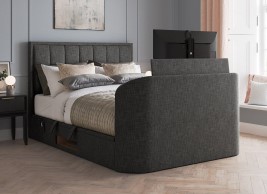
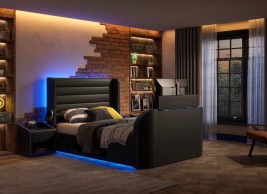
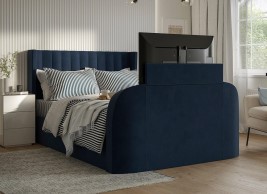
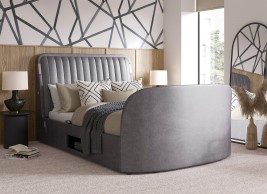
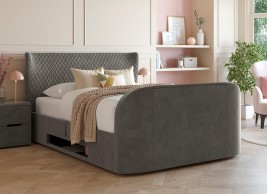
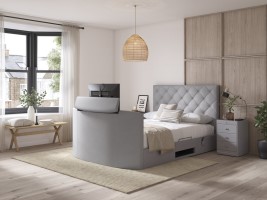
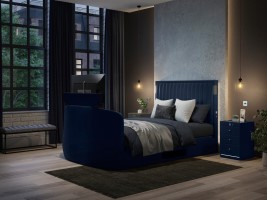

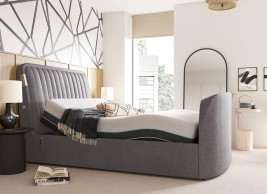
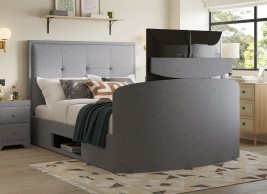
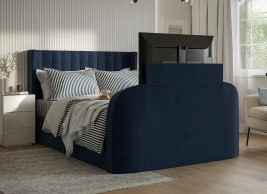
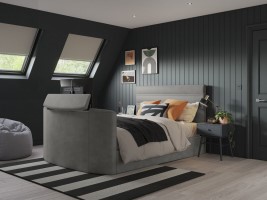

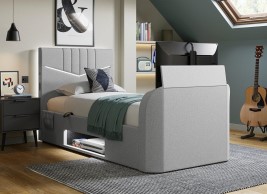

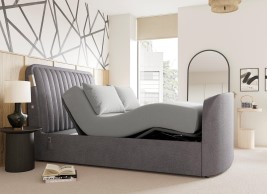

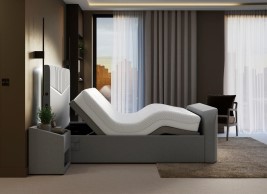

Will your television bolt to the bracket?
Check the VESA pattern first. It's the square of mounting holes on the back of your television, measured hole centre to hole centre in millimetres, so a set drilled at 400 by 400 won't reach a bracket built for 200 by 200. Some TV bed brackets take a range of patterns while others are fixed to one, though your listing rarely says which.
The retailer's customer service can usually get the figure from the supplier. Weight is the other half of the question. Every bracket has a weight it's rated for, and that number changes from model to model, which is why a photograph settles nothing.
The base under your mattress is a separate specification
Whatever's going on at the foot end, the base under you is the same as any other bed's. You sleep on slats or a platform, so slat gap and base type are the two specifications to chase. Listings built around a mechanism rarely print either, which is how you end up with a memory foam or hybrid mattress sagging between slats set too far apart.
Most foam guarantees name a maximum gap. The figure hides in the paperwork that arrives in the box rather than on the page you bought from, so ask before you order. Void that guarantee and it's worth nothing by the time the dip turns up.
Where the plug goes, and how much slack the cable needs
Your socket is always behind the bed and always the wrong one.
These beds want mains power at the foot end rather than the head end. Add whatever feeds the picture: an aerial lead, or a streaming box that needs a socket of its own. Then there's the travel. Every rise and drop moves the screen through its own height, and the cables need that much slack coiled inside the footboard.
Taut cable is what pulls a connector out six months later. Running an extension lead under a bed you can't lift is a miserable afternoon, and you'd rather know that now.
Why is the size range so narrow?
Because the foot end houses the whole mechanism. Screen, bracket, lift and housing all sit inside the width of the bed, so a frame has to be wide enough to swallow them before it's wide enough to sleep two of you.
That constraint comes from the machine rather than from fashion. What it won't tell you is what's in stock. A seller carries whatever slice of the range suits its buyers that season, so the sizes on offer move without anything changing inside the footboard. Go by the size filter above rather than by anything you'll read on a page like this one.
Where the range doesn't suit your room, the wider bed frame shortlist isn't built around a mechanism at all.
Storage underneath means a second mechanism
A TV bed with drawers or a lifting base carries two mechanisms in one frame, at opposite ends of it. Getting both isn't a given, since the housing at the foot end takes room that a lid needs to swing through.
If storage is the bigger of your two problems, an ottoman bed or a divan with drawers gives you more of it for less money. Gas-lift mechanics live on the ottoman page.
Getting it into the room
Measure before you order.
TV beds carry a motor, a bracket and a reinforced footboard, so they're among the heaviest frames sold and the foot end is the heavy part.
Check the narrowest point on the route, which is more often the half-landing than the door frame itself. Metal frames weigh a fraction of one of these, if that's what decides it. Then ask whether the footboard unbolts from the side rails, since that's the heavy end and the part that won't turn a corner.
A frame that arrives in pieces goes up in pieces, and one that doesn't may not go up at all.
Delivery and disposal are the retailer's terms, not the bed's
They're set by whoever you buy from and they change without notice, so check them on the retailer's own page on the day you order. Look for whether delivery includes carrying a heavy frame up to your bedroom, because plenty of them don't. Taking your old bed away is normally a paid add-on. It appears at checkout, not on the product page.
We don't deliver, collect or assemble anything, so you won't get a promise about any of it from us. How the scores below are put together is on the scoring page, and our mistakes end up on the corrections page.
What the research says about a screen in the bedroom
Less than you'd hope, and none of it about TV beds. The closest measurement comes from 2,048 American schoolchildren, where sleeping in a room with a television was associated with 18.0 fewer minutes of weekday sleep, on a 95% confidence interval running from 8.1 to 27.9 minutes.1 That's an association, not a cause. Cross-sectional, self-reported and about children, so it isn't a reading of what a TV bed will do to you.
Light is where the evidence is better. In a laboratory, ordinary room lighting before bed suppressed melatonin onset and shortened its duration by roughly 90 minutes against dim light.2 When a tablet's night mode was measured against its brightness, brightness was the setting that moved the result.3 Nobody has studied a screen that vanishes into a footboard when it's off, which is the one feature of this bed that might have changed the answer.
How noisy is it, and what happens when the lift fails?
No decibel figure is published anywhere, so treat any claim of a silent mechanism as marketing until a specification backs it. Motors driving a screen through its own height make the noise you'd expect, which is fine at nine in the evening and less so at two in the morning when somebody beside you is asleep.
Failure's the more useful question. Gas struts that have lost their charge are replaceable where the maker still lists the part, while a dead board on a discontinued frame turns your foot end into furniture. It's the same electronics question over any powered bed, an adjustable frame included. Ask how long they're supported before you assume your bed will outlive them.
Common questions
What does TV-ready mean on a listing?
It means the frame is built to take a television, not that one's included. Housing, lift and usually a bracket come already fitted. You supply the screen. Some ranges do sell a bed and a television together as a package, which is a separate line on your order rather than a property of the bed. If a listing shows a picture with a screen in it and quotes you one price, ask which of the two you're paying for before you pay it.
Is a TV bed worth buying if you rent or move often?
Probably not. These are among the heaviest frames sold, with the motor and the bracket both at the foot end. Moving one means stripping it down and finding a socket at the foot end of your next room. Landlords tend to have views about drilling and cable runs, which is the other half of the problem. If you move every year or two, a light metal frame with a screen on a stand costs less and travels better. Buy the mechanism once your room's settled enough to build around it.
Can you fit your own bracket to a TV bed?
Usually yes, as long as the mounting pattern and the weight sit inside what the lift was built for. Both figures change from model to model and neither is reliably printed, so ask the retailer or the maker before you order rather than after it arrives. Buy a screen that only just clears the housing and it'll foul on the way down, which is the fault people notice about a week in. Where a bed ships with no bracket at all, count the cost of one into your price.
Is a screen in a child's bedroom a bad idea?
That's a parent's call rather than a comparison site's, though there's published guidance worth reading first. Above, the schoolchildren study came out of a survey rather than a controlled trial. It tells you something about rooms with televisions in them and nothing about your own child. NHS sleep advice is the sensible place to start.4 Nothing here is an assessment of anyone, and a sleep problem that has run on for weeks belongs with a GP.
Has anyone at BedBoy tried one of these lifts?
No. Nobody here has raised one of these, wired one up or slept in one. BedBoy has never carried a tested badge, because there's no testing programme here and never was. What a rank is built on is the published specification for each frame plus whatever owners wrote about it wherever it's sold, and the scoring page sets out the weighting. That limit bites harder here than in most categories. Motor and bracket decide whether you'll still like your bed in three years, and nobody writes up either one.
References
- 1. J Falbe and others, ‘Sleep duration, restfulness, and screens in the sleep environment’, Pediatrics, vol. 135, no. 2 (2015), pp. e367–e375, doi:10.1542/peds.2014-2306.
- 2. J J Gooley and others, ‘Exposure to room light before bedtime suppresses melatonin onset and shortens melatonin duration in humans’, The Journal of Clinical Endocrinology & Metabolism, vol. 96, no. 3 (2011), pp. E463–E472, doi:10.1210/jc.2010-2098.
- 3. R Nagare, B Plitnick and M G Figueiro, ‘Does the iPad Night Shift mode reduce melatonin suppression?’, Lighting Research & Technology, vol. 51, no. 3 (2018), pp. 373–383, doi:10.1177/1477153517748189.
- 4. NHS, ‘Sleep and tiredness’, nhs.uk (2022) <https://www.nhs.uk/live-well/sleep-and-tiredness/> [accessed 9 August 2026].