
Velvet bed frames
BedBoy earns a commission on outbound retailer links. Editorial scoring is independent of commission rates. How this works →
Last updated:
Velvet's a finish, not a frame type. What you're really choosing is upholstery wrapped round an ottoman, a divan or a sleigh base you could've had in a flat weave. Get the catch straight before you fall for a swatch, because velvet is the warmest of the frame finishes and it shows every mark pressed into it. Fibre content in that cover also decides which fire test it had to pass.
That last one's the part nobody selling a velvet bed brings up. Permanent covers on upholstered furniture have to pass a match test unless there's an interliner beneath them. Interliners are only allowed where the cover runs to at least 75 per cent cotton, flax, viscose, modal, silk or wool by weight.1 Polyester velvet doesn't qualify, so a polyester cover has to pass on its own, which is a legal difference nobody prints beside the colour swatches.
Bed-bases and mattresses are written out of that same requirement, so the velvet divan base under you isn't held to the test the velvet headboard behind you is. The permanent label sewn into the frame carries that evidence. Descriptions hardly ever repeat it, which makes that label the one piece of paper on a velvet bed worth reading before the styling photographs.
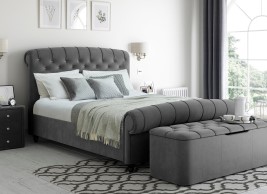
Now the word itself. Crushed velvet has had its pile pressed in several directions, so the shading's designed in and the dent where you perch to fasten your shoes disappears into the pattern. Plush velvet keeps the pile upright and holds a mark like a footprint in fresh snow. Velour's knitted rather than woven, costs less and flattens sooner. Listings offering nothing but the words velvet fabric have told you nothing.
Heat's the trade-off the listings skip.
Dense pile behaves more like a blanket than a woven cotton does, so a padded headboard parks that blanket right behind your head for eight hours at a stretch. I'd still choose velvet. What I won't have is a listing calling it breathable, because it isn't, and no weight of polyester pile makes it so.
If you already wake up hot, your duvet and your mattress carry far more of that than the frame does. Start with your bedding, then the hot sleepers shortlist, before you blame a fabric.
Pile's a dust trap as well, which is where I stop arguing for it. If your dog sleeps on the bed, don't buy velvet, whatever the room looks like afterwards. Woven pile grabs hair, buttoning and piping hand it more places to settle, and a lint roller ends up living in the bedside drawer.
One thing I'd flag before you order the ottoman version. Lifting effort scales with whatever's sitting on the lid, so a dense latex or natural-fibre mattress turns an easy one-handed lift into something you brace for. Work out who in the house is doing that at seven in the morning. Seven in the morning is nobody's strongest hour.
Against a metal frame, though, velvet buys one thing I do rate. Upholstery doesn't creak as its joints loosen. That's worth more to you than the colour, if you're slow to drop off and your partner turns over a lot.
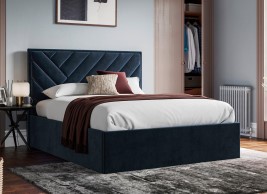
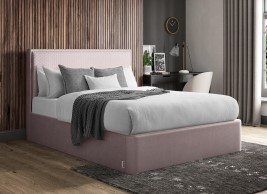
Colour's where the rest of it gets settled, and neither direction is the practical one. Dark pile soaks up light in a small room and shows dust along the top rail, while a pale one hides the dust and shows every scuff at ankle height. Neither's a sleep decision.
Each card below carries a score, and the method behind it shortens a long list rather than settling a colour.
11 products compared from live retailer data. Scored under our published rubric; curated by Giselle Green. Corrections via our corrections policy.
Browse categories
Browse all brands
- Bodyshape
- Dunlopillo
- Emma Mattress
- Ergomotion
- Eve
- Flaxby
- Furniture Village
- Harrison Spinks
- Horizon
- House Beautiful
- Hyde & Sleep
- Hyde and Sleep
- Hypnos
- iGel
- Jay-Be
- Julian Bowen
- Little Big Dreams
- Luna
- Millbrook Beds
- Relyon
- Rest Assured
- Romantica
- Sealy
- Silentnight
- Simba
- Simply Bensons
- Sleepeezee
- Sleepmasters
- Sleepmotion
- SleepSoul
- SleepyTime
- Slumberland
- Snooze
- Sophie Conran
- Staples & Co
- Tempur
- The Dream Team
- The Dreams Workshop
- TheraPur
- Welcome
- WIEMANN
- X Rocker
- healthopaedic
- birlea
- hypnos
- sareer
- orignal-bedstead-company
- nora
- intex
- symple-stuff
- visco-therapy
- house-additions
- home-loft-concept
- clima-control
- kally-sleep
- viva
- healthbeds
- clima-comfort-latex
- feather-and-black
- sleep-science
- spink-and-edgar
- hypnia
- dreamcloud
- revived
- airsprung-beds
- bestway
- disney
- h-living
- bodyshape
- bed-butler
- sprungland
- stompa
- protect-a-bed
Did you know?
Putting your phone down an hour before bed helps you fall asleep faster and wake up less.

What you're paying for in the pile
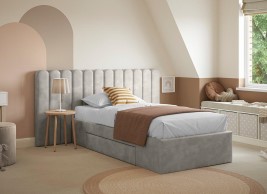
Two things decide how your velvet frame ages and only one of them's in the description. First is the pile fibre. Cotton and viscose velvets look deeper and they mark more easily, while polyester pile springs back better and goes shiny where a sleeve keeps rubbing it.
Second is the cloth the pile's woven into, which is what stops a panel going baggy round a corner after a few years, and you won't see that named anywhere. A retailer who tells you the fibre content has handed you something to compare against the next frame. One who writes "velvet fabric" and stops has handed you a mood.
The fire label won't help you here, because it covers ignition rather than wear.
Which frames come in velvet?
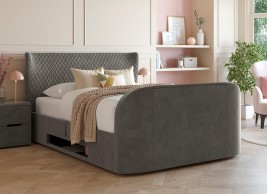
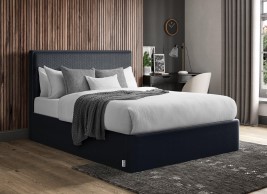
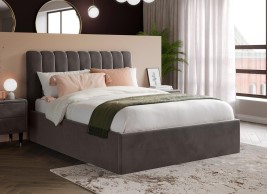
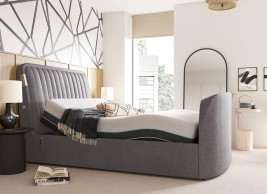
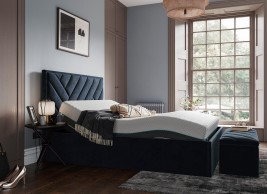
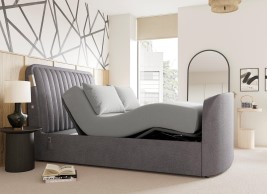
Most of them, because velvet gets applied to frames that already exist rather than forming a range of its own. Expect it on ottoman lids, divan bases, sleigh frames, TV beds and adjustable bases.
Pick the mechanism first and the fabric second. A gas lift you resent is harder to live with than a colour you've gone off, and only one of the two can be fixed with a throw.
Does velvet mark where you sit?
Yes. That's the whole objection to the category, and it deserves a straighter answer than the word durable. Pressure lays the pile over. Flattened pile catches the light differently from upright pile, so a patch reads as a stain when nothing's been spilled on it.
Crushed velvet hides the effect because its pile already runs several ways by design, which is the practical argument for it over plain plush. Plush shows the marks most, on the end of your bed and along the top of a headboard where you lean back to read.
Brushing a mark out
Most of it brushes out.
Work a soft-bristle brush along the nap in one direction, give it five minutes, then see where you are before deciding your frame's ruined.
Colour, and how it wears
Screens aren't a good guide to velvet, because pile direction changes the shade as the frame turns while a photograph fixes one angle and holds it there. Order a swatch where a retailer offers one, then look at it in your own room at night, under the bulb you've got rather than in daylight. Showrooms do that job better where there's one near you and the range is on the floor, which is the oldest way of doing this and still the one that works best.
Ink, forest and charcoal hide marks while showing dust and lint along the top rail. Blush, silver and beige do the exact reverse.
Neither's more practical than the other. They fail differently, so working out which of those two failures would annoy you less is most of your decision.
Will it fade against a sunny wall?
Somewhat, and unevenly. Dyed pile in direct sun loses depth the way a curtain does, fastest on the face taking the light, so a frame that ends up darker on one side isn't a scare story. Put the headboard on the wall away from the window and you've dealt with it, which is where your bed probably goes anyway. Where a bay window leaves you no choice, a mid tone shows the change less than a saturated one will.
Light-fastness figures don't get published on bed frames, so treat that paragraph as reasoning about dye rather than a specification anybody can look up, because that's the honest state of it.
Sizes, and the one that's hard to find
Velvet follows the ordinary UK ladder, since it's a finish over a standard frame: single (3ft, 90 x 190 cm), double (4ft 6in, 135 x 190 cm), king (5ft, 150 x 200 cm) and super king (6ft, 180 x 200 cm).
Small double is your gap. At 4ft and 120 x 190 cm, it's the width upholstered ranges skip, so you'll hunt harder for a 4ft velvet frame than a 4ft 6in one. Plenty of those searches finish in wooden or metal instead.
Will it get up the stairs?
Measure before you order a super king. An upholstered headboard comes as one rigid panel that won't flex round a bannister, so your doorway and the turn at the top of the stairs are the two dimensions worth a tape measure. Get that wrong and a delivery stops being the courier's problem and becomes yours.
How often does an upholstered bed need cleaning?
More often than the marketing implies. There's a measurement under that rather than an adverb. Vojta and colleagues sampled carpet, bed and upholstery dust in homes carrying high house dust mite levels, then treated them. Intensive vacuuming and dry steam cleaning each cut allergen significantly in the upholstered furniture samples.2
Read the next part carefully, because the interval was measured on carpet rather than on upholstery. Levels in the intensive-vacuuming group had climbed back near their starting point by four weeks, while steam plus vacuuming held the reduction out to eight. Carrying that across to a padded headboard is reasoning by analogy, not quoting a result. Treat a monthly pass over your velvet frame as a sensible default on that basis, and start with the headboard, because it's the part everybody forgets.
NHS advice on house dust mite allergy fills in the rest: wash bedding at 60°C or above, dust with a damp cloth, vacuum with a HEPA filter, keep the room ventilated, and keep pets out of the bedroom.3 Those are allergen-reduction measures rather than treatment. Symptoms that are worse at night, or worse than they were last year, are a conversation for your GP rather than a shopping decision.
The people this is wrong for
An animal on the bed is the clearest case. So is waking up hot and blaming the room for it. Moving flat every twelve months is the third, because a velvet frame that's been through two vans looks exactly like a velvet frame that's been through two vans.
Metal's cool to the touch and wipes clean, at the cost of the creak. Wooden frames on sprung slats give you the same give underneath with far less surface to look after. Flat-weave upholstered keeps most of the padding with a shorter pile to mark. Strutted headboards put the fabric on the one panel you touch and nowhere else, which is the cheapest version of the whole idea.
Buying velvet because your room needs it is a defensible reason on its own. What isn't defensible is a listing calling the fabric breathable, hypoallergenic or dust-resistant, because it's none of the three. Where a spec on one of our bed frame cards turns out wrong, it goes on the corrections page.
Common questions
Does velvet mark or crush where you sit?
Yes, and every velvet does it to some degree. Pressure lays the pile over, flattened pile catches the light differently from upright pile, so a patch reads as a stain when nothing's been spilled there. Crushed velvet hides it, since the pile already runs in several directions by design. Plain plush shows it most. A soft-bristle brush worked along the nap lifts the pile back up most of the time, so give that five minutes before you decide your frame's ruined.
Is polyester velvet or cotton velvet better?
They fail in opposite directions, so pick the failure you'd mind less. Polyester pile recovers well from being sat on, though it tends to go shiny where it rubs. Cotton and viscose velvets look deeper, feel softer and mark more easily. There's a legal difference behind your choice too, covered above. Whether a cover can lean on an interliner instead of passing the match test itself turns on fibre content, and polyester loses that one. Your label carries the answer where the description doesn't.
Is a velvet bed a bad idea with a cat or a dog?
Broadly, yes. Woven pile holds hair rather than letting it brush off, and a claw snags cut pile and pulls threads in a way it doesn't on a flat weave. Buttoning and piping add seams for hair to collect along. None of that makes velvet unusable with a pet, though it does turn it into a weekly job with a lint roller and an upholstery attachment. If your animal isn't negotiable, a wooden or metal frame costs you far less of your evening.
How do you clean a velvet bed frame?
Vacuum first with the upholstery attachment, working with the nap rather than across it, then brush the pile back into line with something soft-bristled. Dab spills with a barely damp cloth and a little diluted mild detergent. Never rub them. Rubbing's what breaks the pile for good. Skip solvents, and skip anything sold as a stain remover unless your care label names it. Then put it in the diary for a month's time rather than for the spring clean.
Has anyone at BedBoy slept on these beds?
No, and there's no badge anywhere on the site that suggests otherwise, because there has never been a testing programme behind one. Rankings come from published specifications and from owner reviews pooled across the retailers this site covers. You'll find the method on the scoring page if you'd like to check it. That's a genuine limit on what this page can tell you about a fabric. Pile wear is something you only learn after a couple of years of living with it, so read the owner reviews that mention a second winter.
References
- 1. UK Statutory Instruments, ‘The Furniture and Furnishings (Fire) (Safety) Regulations 1988, regulation 8: permanent covers’, legislation.gov.uk (1988) <https://www.legislation.gov.uk/uksi/1988/1324/made> [accessed 9 August 2026].
- 2. P J Vojta and others, ‘Effects of physical interventions on house dust mite allergen levels in carpet, bed, and upholstery dust in low-income, urban homes’, Environmental Health Perspectives, vol. 109, no. 8 (2001), pp. 815–819, doi:10.1289/ehp.01109815.
- 3. NHS, ‘Allergic rhinitis’, nhs.uk (2026) <https://www.nhs.uk/conditions/allergic-rhinitis/> [accessed 9 August 2026].