
Hybrid mattresses
BedBoy earns a commission on outbound retailer links. Editorial scoring is independent of commission rates. How this works →
Last updated:
Every hybrid is two components doing two different jobs. Underneath sits a spring unit that carries your pelvis and stops it dropping below your ribcage. Above that, foam or latex fills the hollow at your lower back that springs on their own can't fill. Some sellers call the same build a combination mattress. Sleep on your back and you'll want both halves working at once, which is why a hybrid suits that position better than either parent type does on its own.
The word itself doesn't promise you anything beyond that. BS EN 1957 sets out how firmness and functional characteristics get tested, BS EN 1725 covers safety and durability, BS EN 1334 covers dimensions.1 Not one of them defines a hybrid, sets a minimum comfort-layer depth, or says a word about the spring unit underneath.
So an open-coil base under 2 cm of foam and a 2,000-pocket-spring unit under 5 cm of foam both go on sale lawfully under the same word, though your shoulder reaches the springs through one of them and not the other. Price is the only clue you'll get on most listings. It isn't a reliable one.
What a hybrid buys you is spring support beneath a foam surface. That isn't the same as foam behaving like a spring where your skin touches it. Only one controlled trial has ever changed sleep by changing a mattress surface. It did that by altering the thermal capacity of the top 2 cm, which on a hybrid is foam.2 Air moves through a coil unit, but the coil unit sits below the layer that's touching you.
Which leaves the comfort layer setting the firmness you feel. That's the one variable the trials did test. Researchers randomised 313 adults with chronic low back pain across two bands, medium-firm against firm, then tracked them for 90 days, at the end of which pain in bed and disability had both come out better on the medium-firm side.3
Those were people who'd been in pain a long time already. What differed between the groups was a firmness band rather than a construction, so the trial doesn't tell you a thing about springs.
Each card below carries a BedBoy Score. It'll get you to a shortlist and no further, because what separates two hybrids after that sits under the cover, where it never turns up in a photograph.
Front sleepers are the one group this build doesn't do much for. A comfort layer deep enough to fill your lumbar curve lets the pelvis settle below the ribs instead, so your lower back arches and the muscles carry it all night. Firmer is the sensible direction. There's a shortlist for front sleepers if that's you.
Running cold changes the answer again, though not in the direction most pages assume, because pocket units are mostly air and there's no cooler core you can buy.
Put a thin layer above them and a hybrid can feel draughty rather than fresh, though that's how the build works and isn't a fault in it. If you wake up cold, you'll want that comfort layer for warmth as much as for pressure.
15 products compared from live retailer data. Scored under our published rubric; curated by Gary Ferguson. Corrections via our corrections policy.
Browse categories
Browse all brands
- Bodyshape
- Dunlopillo
- Emma Mattress
- Ergomotion
- Eve
- Flaxby
- Furniture Village
- Harrison Spinks
- Horizon
- House Beautiful
- Hyde & Sleep
- Hyde and Sleep
- Hypnos
- iGel
- Jay-Be
- Julian Bowen
- Little Big Dreams
- Luna
- Millbrook Beds
- Relyon
- Rest Assured
- Romantica
- Sealy
- Silentnight
- Simba
- Simply Bensons
- Sleepeezee
- Sleepmasters
- Sleepmotion
- SleepSoul
- SleepyTime
- Slumberland
- Snooze
- Sophie Conran
- Staples & Co
- Tempur
- The Dream Team
- The Dreams Workshop
- TheraPur
- Welcome
- WIEMANN
- X Rocker
- healthopaedic
- birlea
- hypnos
- sareer
- orignal-bedstead-company
- nora
- intex
- symple-stuff
- visco-therapy
- house-additions
- home-loft-concept
- clima-control
- kally-sleep
- viva
- healthbeds
- clima-comfort-latex
- feather-and-black
- sleep-science
- spink-and-edgar
- hypnia
- dreamcloud
- revived
- airsprung-beds
- bestway
- disney
- h-living
- bodyshape
- bed-butler
- sprungland
- stompa
- protect-a-bed
Did you know?
Putting your phone down an hour before bed helps you fall asleep faster and wake up less.
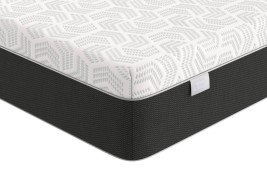
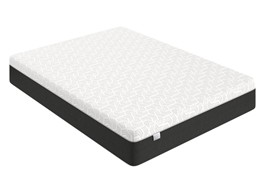
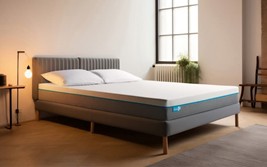
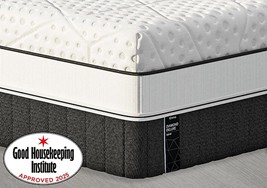
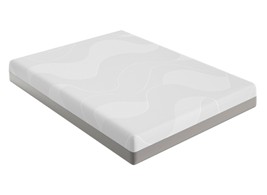
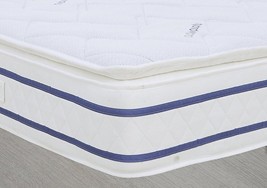
Spring counts are quoted for one size and printed on every size
Spring counts are size-specific numbers. They're sold to you as a property of the mattress. Makers count the unit in a king size, then print that same figure on the double, the single and the small double. Those are narrower beds, so at the same spacing they can't hold as many springs.
Buy the double and you'll get the king's number on your label. Spacing, wire gauge and how much of any of it your comfort layer lets you feel all change the result, though you won't find any of that printed anywhere. Read a spring count next to the size it was measured in.
How much foam sits above the springs?
Rarely more than a few centimetres. It's that depth, not the name of the material, that tells you how a hybrid will feel. Two centimetres of memory foam over a pocket unit gives you a sprung mattress with a soft finish, while five gives you a foam mattress with a sprung base. The label won't tell you which one you've got.
Retailers print total depth, which counts the springs, so a 30 cm hybrid can hold less comfort foam than a 24 cm one. Ask a retailer for the comfort-layer depth instead, because memory foam, latex and gel don't behave the same up there. None of them differ as much as 2 cm and 5 cm of the same material do, mind.
Pocket or open coil, and what the price gap means
Two hybrids at very different prices are usually two different spring units. Pocket units wrap every spring in its own sleeve, so each one compresses where the load is and leaves its neighbours alone. An open coil is a single continuous wire wound into all of them. Move one side of the bed and the whole surface moves with you, which is why it's a fraction of the price to build.
Neither side of the trade puts that in a headline, so both builds go on the shelf as hybrids. Where a listing won't name the unit inside, assume open coil, because pocket builds say so. Given the choice I'd take the pocket unit every time and live with a thinner layer over it.
Why does the same firmness label feel firmer to some people?
Because firmness gets rated around the average load band, the range mainstream UK mattresses are built for. Somebody in the middle of that band compresses the comfort layer about as far as the maker intended, so the stated firmness isn't far off. If you're lighter you don't sink as far in, so the same bed feels a notch firmer than the label says.
We'd sooner name that limit than write around it. Advice written from the middle of the band under-states how firm a bed will feel to you if you sit below it. A firmness rating is still a steer from the people who designed the thing, though what it won't survive is being carried across to another brand. So compare medium against medium-firm inside one range before you compare across two.
Depth, and whether your sheets and frame will cope
Hybrids run deep, because a spring unit and a comfort layer stack rather than share the space. Most standard fitted sheets are cut for around 25 cm to 30 cm (10 in to 12 in) of mattress, with deep-fill sheets going further. Check that before you assume what's in your airing cupboard still fits.
Frames have a version of the same problem, because taller mattresses lift the sleeping surface, which can leave a low headboard sitting behind your shoulders when you sit up. On a bed frame with side rails you'll also get less lip holding the mattress in place. Measure from the floor to the top of the mattress, not to the top of the base.
Is motion isolation worth paying for?
Not if you sleep alone. Motion isolation and edge support are worth nothing if you're on your own in a bed and a great deal to the half of readers who share one. You shouldn't have to guess which side of that split a recommendation came from.
Share a bed and the pocket unit is what does it, because each spring compresses under the load directly above it and passes less sideways than a continuous wire can. Comfort foam damps what's left of it by the time it reaches your side. Edge support decides whether the outer few centimetres are sleepable or only sittable, which is what the couples shortlist weights alongside motion.
Does the base underneath change how a hybrid feels?
Yes, and by enough that it's been modelled. Verhaert and colleagues predicted lateral spine shape to within 11.9 ± 6.1 mm RMS by measuring load-deflection of the mattress and the bed base together, because both deform as one system under a body.4 Change your base and you've changed your mattress.
In practice that's your slat gap and your base type. Wide gaps let the underside sag, which is why most hybrid and foam warranties set a maximum gap. You'll find it in the warranty document rather than on the listing. Divan tops go the same way: a platform top firms the result up, a sprung edge softens it.
Nobody has ever enjoyed reading a warranty document. Read the slat clause anyway.
What a hybrid does for a bad back, and what it doesn't
It changes the surface you lie on, and that's the whole claim. No trial isolates hybrid construction, so anything defensible about hybrids and back pain has to come out of firmness research. Put a non-hybrid at the same firmness and you'd get the same result, which is the basis the back pain shortlist works from.
Back sleepers still want the two-part behaviour: your pelvis held level, the curve behind it filled rather than propped up by muscle all night. Orthopaedic isn't a regulated word in UK bedding: in practice it means firmer and nothing else.
Any bad back that isn't easing after a few weeks belongs with a GP or a physiotherapist, not a mattress listing. Go earlier for fever, weakness in both legs, or any loss of bladder or bowel control.
Is a hybrid heavier than a sprung mattress of the same size?
Usually, because two components weigh more than one does. Super king hybrids are a two-person lift in most households, so you'll want that settled before you commit to a bed that needs turning.
Almost all of them are one-sided, with comfort foam bonded to the top and nothing equivalent below it, so turning one over puts the hard half where your shoulder goes. Rotating it head to foot is all the maintenance you've got. Do that on a super king and it's a job for two people and a free afternoon.
When a hybrid isn't worth the premium
When one of the two halves does nothing for you. Sleep alone, run warm and want a firm surface, and you're paying for a comfort layer that adds heat and softness you didn't ask for. Pocket-sprung does the support half on its own for less.
Second case is the thin one, where two centimetres of foam over a cheap open coil is a sprung mattress with a topper glued on. You're paying the price the word carries rather than the price the build justifies. Check comfort-layer depth first and spring type second, then the premium either explains itself or it doesn't. The ranked hybrid shortlist starts from those same two checks.
Treat all of this as general information, not medical advice.
Common questions
What is a hybrid mattress?
Springs underneath carry your weight and stop your pelvis dropping, while the comfort layer on top fills the hollows they leave under your waist and lower back. It's all sold to you as one mattress, though some retailers call the same build a combination mattress. That layer is usually memory foam, latex or a gel-infused foam. What the word won't tell you is which spring unit is inside or how deep the layer runs, though those two decide nearly everything. Ask a retailer for both, because the listing won't say.
Which firmness suits which sleeping position?
Side sleeping wants soft or soft-medium as a rule, because your shoulder and hip both have to drop while your waist stays carried. On your back, medium to medium-firm: enough to fill the lumbar curve without letting the pelvis drop through it. On your front, firmer still, since anything soft arches the lower back. Weight moves all three bands. Heavier bodies sink further into the same comfort layer and reach the springs sooner, so the same bed feels a step softer than its label says it'll be.
Do hybrids sleep cooler than an all-foam mattress?
Slightly, and it's less than the marketing suggests. Air gets through a coil unit where an all-foam core gives it nowhere to go, so a hybrid has an escape route for heat. That route runs underneath the comfort layer, so it never reaches the part that's touching your skin. A thick memory foam top on a spring base doesn't behave much differently at the surface from a foam mattress. If it's overheating you're trying to fix, change the top layer first: the hot sleeper shortlist is filtered on exactly that.
Can two people with different firmness needs share one hybrid?
Up to a point, by one of two routes. Split tension gives each side of one mattress its own spring tension, which works while you're both on your half. Zip and link goes further: two singles of different tensions fastened together on one base, which is how most made-to-order king and super king sets handle a genuine mismatch. Both leave a seam down the middle that some notice and others don't. Where the gap between you is two bands or more, zip and link is what solves it.
Can a hybrid go on an adjustable base?
Often not, because a pocket unit inside a rigid border rod resists the bend an adjustable base makes at the hip and knee. Either your mattress won't let the base move or the base wrecks your mattress. Makers who build a hybrid for an adjustable base say so on the listing and give it a flexible border. Foam and latex bend without help, so most adjustable sets come with one or the other. Check the listing, not the category, and don't forget the frame maker's maximum depth.
Has anyone at BedBoy slept on these?
No. There's no badge on a card claiming otherwise, because there's no testing programme behind one. We rank these from what manufacturers publish and from review text gathered across the retailers that stock them, which is good for comparing what you can know before you buy and useless for telling you how a bed feels after four years. Most reviews get written in the first month of ownership. Workings are on the scoring page if you're interested.
References
- 1. British Standards Institution, BS EN 1957:2012 Furniture. Beds and mattresses. Test methods for the determination of functional characteristics and assessment criteria (2012).
- 2. K Kräuchi and others, ‘Sleep on a high heat capacity mattress increases conductive body heat loss and slow wave sleep’, Physiology & Behavior, vol. 185 (2018), pp. 23–30, doi:10.1016/j.physbeh.2017.12.014.
- 3. F M Kovacs and others, ‘Effect of firmness of mattress on chronic non-specific low-back pain: randomised, double-blind, controlled, multicentre trial’, The Lancet, vol. 362, no. 9396 (2003), pp. 1599–1604, doi:10.1016/S0140-6736(03)14792-7.
- 4. V Verhaert and others, ‘Modeling human-bed interaction: the predictive value of anthropometric models in choosing the correct bed support’, Work, vol. 41, no. Supplement 1 (2012), pp. 2268–2273, doi:10.3233/WOR-2012-0450-2268.