
Wardrobes
BedBoy earns a commission on outbound retailer links. Editorial scoring is independent of commission rates. How this works →
Last updated:
A wardrobe won't help you sleep, whatever the tidy-bedroom pitch on furniture pages implies. There's no study behind that claim, which makes it copywriting rather than a finding. What you're buying is floor space traded for hanging space, so a tape measure settles more of this than the photographs ever will.
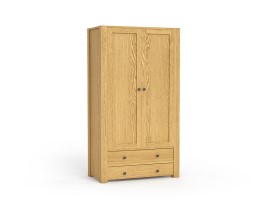
Door swing is where I'd start, because it removes more options than your budget does. Hinged doors sweep an arc as wide as the door itself, so a pair of 50 cm leaves on a metre-wide carcass wants 50 cm of clear floor, near enough 20 inches, standing empty in front of them. Check that against where your bed sits. Not where you've been meaning to move it.
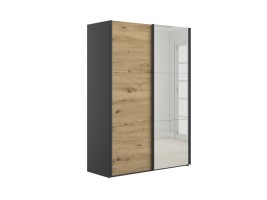
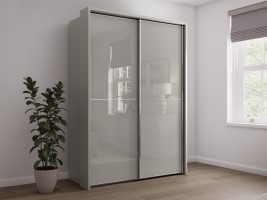
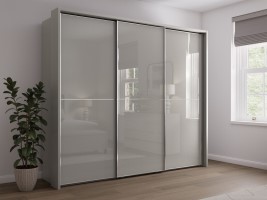
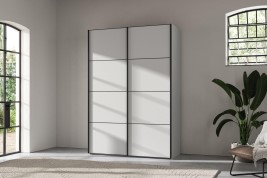
Sliding doors never leave the footprint of the carcass, which is the whole argument for them. In a room that can spare the floor I'd take hinges anyway. Open a hinged bay and the whole rail's in front of you at once. Sliders only ever show you half a wardrobe, so you're forever shoving one door along to reach the other half.
On a slider the money goes into the running gear, which is the part nobody itemises for you. Bottom-rolling doors carry their weight on wheels in a floor track, which fills with carpet fluff, hair and grit until what the showroom called smooth is what you'd call sticking by year three, and the cure is a vacuum nozzle rather than a new door. Top-hung doors hang the load from a rail above, so they cost more to make. You'll rarely see either arrangement named on a listing, so ask.
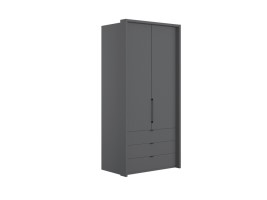
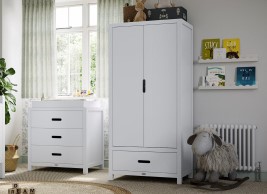
Between two wardrobes at similar money, the one with the thicker carcass and better hinge stays square, while finish is what the photographs sell you. One tall unit with a drawer bank in the base can stand in for a wardrobe and a chest of drawers, which is worth pricing against buying both. I'd sooner send a narrow room to two slim pieces than to one unit that fouls the door.
These furniture cards are ordered on what owners said after living with them, weighed against the published rubric. That's a decent guide to whether the parts matched the diagram, and a poor one to how your doors hang in year four.
Wardrobes get photographed half open with three identical white shirts hanging in them. That's a styling prop rather than a wardrobe, so yours is never going to look like it. Start with the one-star assembly reviews, because they name the step that went wrong.
24 products compared from live retailer data. Scored under our published rubric; curated by Giselle Green. Corrections via our corrections policy.
Browse categories
Browse all brands
- Bodyshape
- Dunlopillo
- Emma Mattress
- Ergomotion
- Eve
- Flaxby
- Furniture Village
- Harrison Spinks
- Horizon
- House Beautiful
- Hyde & Sleep
- Hyde and Sleep
- Hypnos
- iGel
- Jay-Be
- Julian Bowen
- Little Big Dreams
- Luna
- Millbrook Beds
- Relyon
- Rest Assured
- Romantica
- Sealy
- Silentnight
- Simba
- Simply Bensons
- Sleepeezee
- Sleepmasters
- Sleepmotion
- SleepSoul
- SleepyTime
- Slumberland
- Snooze
- Sophie Conran
- Staples & Co
- Tempur
- The Dream Team
- The Dreams Workshop
- TheraPur
- Welcome
- WIEMANN
- X Rocker
- healthopaedic
- birlea
- hypnos
- sareer
- orignal-bedstead-company
- nora
- intex
- symple-stuff
- visco-therapy
- house-additions
- home-loft-concept
- clima-control
- kally-sleep
- viva
- healthbeds
- clima-comfort-latex
- feather-and-black
- sleep-science
- spink-and-edgar
- hypnia
- dreamcloud
- revived
- airsprung-beds
- bestway
- disney
- h-living
- bodyshape
- bed-butler
- sprungland
- stompa
- protect-a-bed
Did you know?
Putting your phone down an hour before bed helps you fall asleep faster and wake up less.
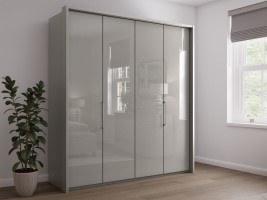
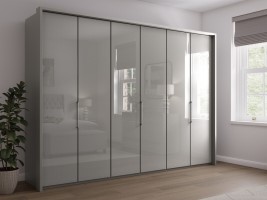
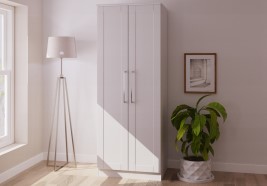
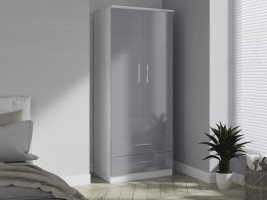
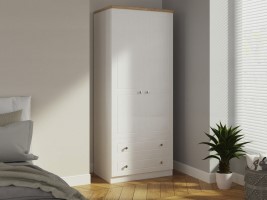
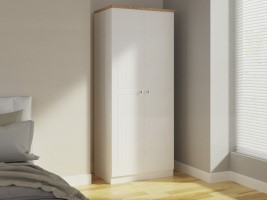
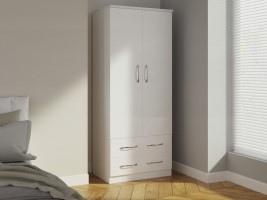
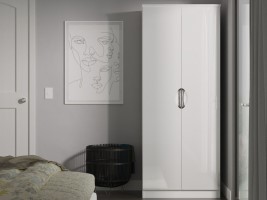
Four numbers to take before you shortlist anything
You won't find them on a listing, because all four describe your room, not the wardrobe. Start with the width of wall you can hand over, then the depth of floor you'll lose, then height from skirting to ceiling, since floors in older houses aren't level. Last is the tightest point between your front door and the bedroom.
Nobody's measuring that one. Your wardrobe arrives flat in boxes and leaves the room a rigid box, so one built downstairs may never turn your staircase. Build it where it's going to stand, because raising a finished carcass swings it through its own diagonal, which is longer than its height.
How deep does a wardrobe need to be to hang clothes?
Deep enough for a hanger to sit square, which is more room than you'd think. Coat hangers run shoulder to shoulder, so in a shallow box every garment turns at an angle and your doors press on the sleeves. Measure your widest hanger with a winter coat on it, then add clearance for the rail bracket.
Front-to-back rails rescue a shallow carcass, though they'll cost you a lot of rail length. Half-hanging suits shirts and jackets. Full-length is what a coat or a floor-length dress needs, so I'd rather you counted your long items now than found out after the doors are on.
Hinged, sliding or bi-fold?
Your room picks for you more than taste does. Hinged doors are cheapest, and a dropped one's a few pounds to put right. Sliding buys the floor back, though it'll only ever show you half an interior at a time.
Bi-fold doors fold back on themselves, so they return most of the floor a hinge costs you without hiding half the rail. Corner units exist for rooms with no clear wall run, though that's usually fitted territory.
Mirrored doors, and what they cost you
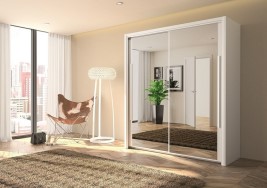
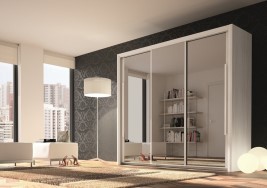
Mirrored fronts bounce daylight around, which means you're not buying a separate full-length mirror, though they add weight the rollers feel first on a surface that shows every fingerprint. That's a fair trade in a dark room, though it isn't a reason to say a wardrobe makes the room bigger. Your room's the size it was.
Inside the carcass: rail, shelf, drawer
Audit your clothes first, because the split between hanging and folding decides the interior. Count your long items, then the folded piles you're keeping in a chest of drawers.
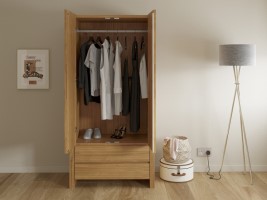
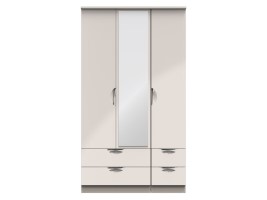
If more than half of what you own folds, drawer banks beat rail length, which is what combination units are for. Handing catches people out. Put the drawers on the wrong side and they end up behind your bedroom door, where no photograph's going to show you.
The other way round, a plain double with one long rail costs less and wastes nothing.
Solid wood, veneer, board: what each does over years
Differences show in the back panel and the shelves, not in the doors you're looking at. Solid wood costs most, takes a knock, then sands back the way a wooden bed frame does. Real wood veneer lays a thin layer of the species over board, so it looks the part but won't survive sanding. Painted or foil-coated chipboard is the volume tier. Its weak point is the thin hardboard back.
I'd let the wardrobe pick the wood and have your headboard follow, since the wardrobe outlives it by years.
Formaldehyde, E1 and the limit that binds Northern Ireland
Formaldehyde earns a section, since a wardrobe is usually the largest piece of engineered board you'll own and the panels give it off. Board is graded for that release under EN 13986, with class E1 capping it at 0.124 mg/m³ on the chamber test in EN 717-1.
From 6 August 2026 a tighter EU limit of 0.062 mg/m³ applies under Commission Regulation (EU) 2023/1464. It binds Northern Ireland and goods exported to the EU rather than Great Britain. E1 is a grade, not a health guarantee.
Should a wardrobe be fixed to the wall?
Always. Yours is likely the tallest, shallowest and most top-heavy thing in the room, with nothing else half as easy to pull over. Open a hinged door with coats hanging off it, so the centre of mass travels forward past the front edge of the base. The safety standard for domestic storage units designs the wall attachment in, then tests how strong it has to be.1 That bracket in the box isn't a courtesy.
Those fixings suit the carcass rather than your wall, since plasterboard, dot-and-dab and lath take different anchors, so if you can't tell which you've got, ask a fitter. Treat anything tall in a child's room the same way, since drawer fronts sit at rung height to somebody small.
What does BS EN 14749 test for?
Stability, strength and durability, including the strength of the wall attachment. Domestic storage units are tested to BS EN 14749:2016+A1:2022, which draws its methods from BS EN 16122:2012, the test standard for loaded storage furniture with doors or extensions open. Both describe how a unit behaves in a laboratory, though neither tells you what'll happen once your top shelf holds suitcases.
Conformity is per-product. A standard existing doesn't mean this wardrobe was tested to it, so unless the maker says otherwise, treat it as unknown.
Where it stands, and the wall behind it
Push a deep carcass flat against a cold external wall, so the air stops moving behind it. Surface temperature drops, which builds a condensation site with your clothes on the other side of it. Leave a gap. An internal wall's the better home in any room that already smells musty in February.
Only one part of this decision has sleep evidence near it, and it's about the house, not the furniture. Wang and colleagues, in a European cohort study, found dampness and mould at home associated with the onset of insomnia symptoms, snoring and excessive daytime sleepiness.2 An association, in work about buildings.
Persistent damp or black mould is a building question rather than a shopping one, and renters have a route through the government's guidance for rented housing.3 No wardrobe you buy will touch any of it.
Do wardrobes arrive assembled?
Mostly not. Free-standing wardrobes ship flat because a built carcass costs a lot to move and doesn't travel well. Expect several heavy boxes, two people and an afternoon, though it's the doors and the rail that'll take it.
Whether a seller builds it, takes the packaging or carries it upstairs varies by retailer and by week, which puts none of it in BedBoy's hands. Check the retailer's delivery page before you order and again at checkout, since terms change.
Assembly is where the review scores concentrate, which makes the complaints unusually useful: missing fixings, holes drilled a few millimetres out, instructions with no words in them.
When not to buy a wardrobe at all
Narrow rooms with the bed already in them. Take out carcass depth and door swing, then a corridor is what's left. Try a hanging rail behind a curtain, or a low run of drawers with a rail above it. An ottoman base swallows the bulky end of the job with no extra footprint.
Renting and moving every year's the case nobody plans for. Take a wardrobe apart and rebuild it twice, then you've got soft screw holes, which flat-pack board doesn't forgive.
If it's the whole bedroom you're furnishing, bedside tables and blanket boxes are compared on their own pages, with the furniture hub holding all four. Anything this site has got wrong on a card sits on the corrections page.
Common questions
How much clear floor does a hinged wardrobe door need?
As much as the door is wide. Each leaf swings through a quarter circle, so a metre-wide two-door unit wants 50 cm of empty floor in front of it, and a single 60 cm door wants 60. Measure from the face of the wardrobe, not from the wall it's standing against. Because that sweep curves rather than running straight, a bed corner or a radiator sitting inside it will stop your door short. If your floor's already spoken for, you're looking at sliding or bi-fold doors instead.
Will a flat-pack wardrobe fit through the door once it is built?
Often not, which is why you build it in the room it'll stand in. Flat boxes go anywhere, though once it's assembled it doesn't. Raising a finished carcass upright swings it through its own diagonal, which is longer than its height, so a sloped ceiling or a loft conversion can defeat a wardrobe that measured fine across your floor. Check the doorway, the turn on your stairs and the room diagonal before you order. It isn't a problem you can fix once the boxes are in the hall.
What is the difference between a fitted and a free-standing wardrobe?
A free-standing wardrobe is furniture. It arrives, it stands where you put it, and it's yours when you move. Fitted wardrobes are built into the room, usually up to the ceiling and often around a chimney breast or a slope, which is why they stay behind when you sell. What they win on wasted space, they give back on cost, lead time and flexibility. Everything compared here is free-standing, so a quote that turns up with a survey and a fitter isn't pricing the same thing.
Are sliding doors more trouble than hinges?
Different trouble rather than more. Dropped hinges adjust with a screwdriver, or swap out for a few pounds, while a bottom track full of grit needs cleaning out, and sometimes the door won't come free until you lift it off. Vacuum the track when you vacuum the room and most of that won't start. The bigger difference is what you can see, because a slider only ever shows you half its interior. Nobody minds that in a showroom, though it's every morning afterwards that wears.
Has anyone at BedBoy built one of these wardrobes?
Not one of them, and nobody here has ever claimed otherwise. No badge on this site says tested, because that programme was never built. Nothing on the page has been screwed together, lifted or handled by an editor. Card order comes off maker specifications and the pooled sentiment in owner reviews, weighed by the method set out on the scoring page. Wardrobes are a category where the honest verdict arrives around year four, which is the part a review pool can't reach.
References
- 1. British Standards Institution, BS EN 14749:2016+A1:2022 Furniture. Domestic and kitchen storage units and kitchen-worktops. Safety requirements and test methods (2022).
- 2. J Wang, C Janson, E Lindberg and others, ‘Dampness and mold at home and at work and onset of insomnia symptoms, snoring and excessive daytime sleepiness’, Environment International, vol. 139 (2020), pp. 105691, doi:10.1016/j.envint.2020.105691.
- 3. Ministry of Housing, Communities and Local Government, Department of Health and Social Care and UK Health Security Agency, ‘Damp and mould: understanding and addressing the health risks for rented housing providers’, gov.uk (2026) <https://www.gov.uk/government/publications/damp-and-mould-understanding-and-addressing-the-health-risks-for-rented-housing-providers> [accessed 9 August 2026].