
Bunk beds
BedBoy earns a commission on outbound retailer links. Editorial scoring is independent of commission rates. How this works →
Last updated:
Whatever mattress is on your child's bed probably won't fit the top bunk. Frame instructions set a maximum mattress height up there, because a deeper mattress lifts the sleeping surface towards the guard rail and leaves less of it standing above. Buy the frame first and you'll find that out on the landing, halfway through the build.
BS EN 747-1:2024 is the current British Standard for bunk beds and high beds. Its scope is any bunk bed where the upper surface of the top bed base is 600 mm or more above the floor.2 High sleepers fall under the same standard. Its strength and durability requirements represent use by one occupant per bed, which is the plain answer if you're wondering whether two children can share the top.
Meeting that standard isn't automatic, which the Office for Product Safety and Standards showed in June 2024 by recalling a bunk bed and trundle set. Missing rails weren't the hazard. Entrapment through the size of accessible gaps was, and the mattress alongside it failed flammability requirements.1 What settles a frame is gap size, rail height above the fitted mattress and whether it needs bolting to a wall.
Compliance is a claim the manufacturer makes, which you'll find on the permanent marking on the frame. That marking has to carry the warning that high beds and the upper bed of bunk beds are not suitable for children under six years due to the risk of injury from falls. It also gives the recommended mattress length, width and height where no mattress is supplied, plus whether the bed must be fixed to the wall.
Six isn't a recommendation, then. It's the age below which the standard requires that fall warning printed on the bed. Wall fixing rarely reaches a product description, so you'll have to go looking for it in the instructions. The frame underneath is a separate question from the bunk above it, so a four-year-old on the bottom bunk and a four-year-old on the ladder aren't the same decision at all.
There's one contraindication that isn't about the frame. NHS guidance on sleepwalking says plainly that a child who sleepwalks shouldn't sleep in the top of a bunk bed.3 Nor is it rare: a meta-analysis of 51 studies put a sleepwalking episode in the previous year at 5 per cent of children.4 So ask whether either parent sleepwalked as a child, because family history raises the odds sharply.
I'd give each bunk its own duvet, for a reason that has nothing to do with safety. Warm air collects at ceiling height, so the top bunk's the warmest place in the room. If the child up there's the one kicking the covers off by midnight, a lower tog above and a heavier one below sorts it. Two children sharing a room don't have to have matching bedding.
Weight limits get ignored more than any number on these frames. They cover the adult perched on the edge reading a bedtime story, not only the child asleep up there. One occupant per bed is the basis the strength tests use, so a parent and a child up there at once is more than the frame was built around. I'd treat the top as a one-person space, story time included.
The cards below carry a score from the published rubric, built from listed specifications and pooled owner reviews. What I can't tell you is how the top bunk feels at two in the morning, because nobody here has been up there. In this category the buyer and the sleeper are different people anyway.
12 products compared from live retailer data. Scored under our published rubric; curated by Giselle Green. Corrections via our corrections policy.
Browse categories
Browse all brands
- Bodyshape
- Dunlopillo
- Emma Mattress
- Ergomotion
- Eve
- Flaxby
- Furniture Village
- Harrison Spinks
- Horizon
- House Beautiful
- Hyde & Sleep
- Hyde and Sleep
- Hypnos
- iGel
- Jay-Be
- Julian Bowen
- Little Big Dreams
- Luna
- Millbrook Beds
- Relyon
- Rest Assured
- Romantica
- Sealy
- Silentnight
- Simba
- Simply Bensons
- Sleepeezee
- Sleepmasters
- Sleepmotion
- SleepSoul
- SleepyTime
- Slumberland
- Snooze
- Sophie Conran
- Staples & Co
- Tempur
- The Dream Team
- The Dreams Workshop
- TheraPur
- Welcome
- WIEMANN
- X Rocker
- healthopaedic
- birlea
- hypnos
- sareer
- orignal-bedstead-company
- nora
- intex
- symple-stuff
- visco-therapy
- house-additions
- home-loft-concept
- clima-control
- kally-sleep
- viva
- healthbeds
- clima-comfort-latex
- feather-and-black
- sleep-science
- spink-and-edgar
- hypnia
- dreamcloud
- revived
- airsprung-beds
- bestway
- disney
- h-living
- bodyshape
- bed-butler
- sprungland
- stompa
- protect-a-bed
Did you know?
Putting your phone down an hour before bed helps you fall asleep faster and wake up less.
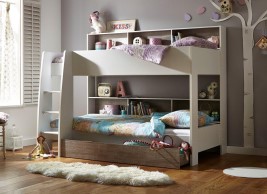
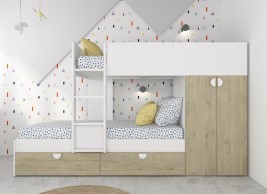
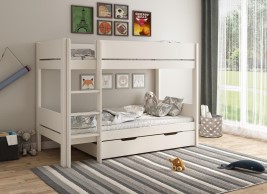
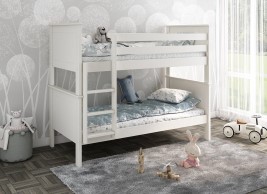
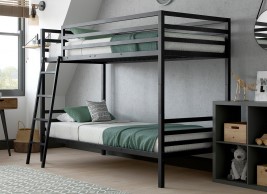
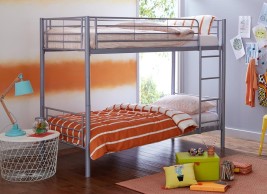
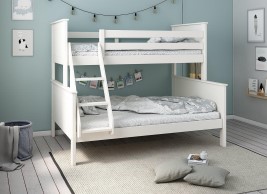
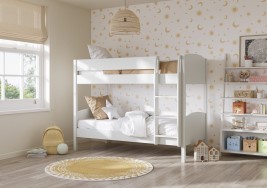
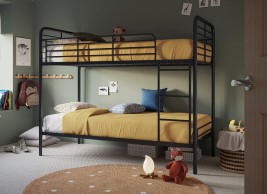
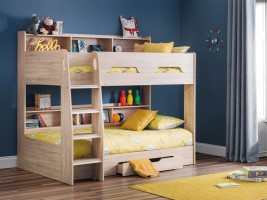
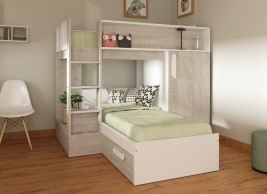
Ladder position, and what it costs you
Ladders bolt on where the maker put them, so check the listing before you plan the room around one, because reversible ones aren't the norm. Get it wrong and you've got a climbing child stepping straight over a radiator, or into the swing of the door. Given the choice I'd pay the difference for a reversible one.
Rung shape's the other half of it. Flat rungs with a lip take a bare foot better than round tube does, as the child coming down in the dark finds out first. No child has ever used a bunk ladder purely for getting into bed.
What mattress does each bunk take?
A single on both, at 3 ft or 90 x 190 cm. Triple sleepers break the pattern, since the bottom is usually a small double at 4 ft, 120 x 190 cm, so you're buying two different mattresses rather than a matching pair.
Depth's where people come unstuck, though the limit belongs to the top bunk alone. Your frame's instructions give a maximum height for the mattress that goes up there, a ceiling that exists to keep the guard rail at its stated height once the mattress is in. It's a hard limit rather than a guide, so measure the mattress you already own before you assume it will go up. Underneath, fit whatever the slats will carry.
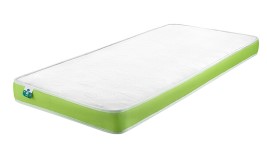
So a deep pocket-sprung mattress is at home on the bottom bunk and usually wrong on the top, which is the reverse of how most people shop for a pair. Rolled singles are the easiest to get onto a top bunk, because a cylinder goes up a ladder and a flat single doesn't.
Wood or metal?
Wood, if there's a light sleeper in that room. Metal wipes clean and it's lighter to carry, though the joints work loose over a few years until every turn up top is audible below. Wooden frames creak as well, only they take longer to start and do it more softly.
Where metal wins is weight, and that's what shows on the day the boxes arrive. It wins on repair too, since a scratched tube takes a touch-up better than a chipped painted finish. Neither material tells you a thing about gap size or rail height, which are what make a frame safe. Wood's what I'd take in a shared room every time, and the creak is the whole reason.
Does it split into two single beds?
Sometimes. It's worth asking before you buy, because the answer is the difference between one purchase and two. Detachable bunks are built as two complete single frames joined by a connector, so each half stands on its own legs once the set comes apart. A one-piece frame with a shared upright won't do it, whatever gets attempted in the garage.
It's the same fact that decides resale. A frame that separates goes on to a second child, or out of the house to somebody else's. One that doesn't goes to the tip on a Saturday, which is worth counting against a cheaper price tag.
Ceiling clearance, and how to measure for it
Measure floor to ceiling, then take off the frame height that's printed in the listing. What's left is the space your child sits up into.
Then check that against your child rather than against a published number, because a sitting eight-year-old needs more headroom than a five-year-old does. Any single clearance figure you see quoted is convention rather than fact, so where your frame's instructions give one of their own, follow theirs. Sloped ceilings and loft rooms need the tape held at the spot the bed will stand, not in the middle of the room where measuring's easy.
Pendant lights over the top bunk are their own problem. Moving the bed is your cheapest answer.
Triple sleepers, mid sleepers and high sleepers
Triple sleepers put a single over a double and sleep three children in the floor space of one bed, which also makes them the heaviest frames in the kids' range to put together. Novelty frames shaped like buses and campervans are bought on the paint, though the specification underneath raises exactly the same questions. Your seven-year-old goes off a fire engine. That frame won't wear out for years.
With only one child, a high sleeper usually does the job better. Up goes the bed, with a desk or a set of drawers underneath. Safety questions don't change either way, because one standard covers bunk beds and high beds together. Mid sleepers sit lower again, which suits a child who isn't ready for a full-height climb.
Is assembly a two-person job?
Yes. That second pair of hands stops being optional the moment the top frame goes on. Bunk beds arrive in several long, heavy boxes, which is what catches buyers who've measured the bedroom and forgotten the route to it. Measure the landing and the doorway before you order, because the courier won't do it for you.
Assembly isn't a side issue here, because rail height and gap dimensions both depend on getting it right. Leave one bolt half-turned and it'll be the one holding a guard rail at its stated height. Where a retailer offers assembly, read what the service covers and what it leaves to you, rather than what a delivery page implies.
Storage, and the bunk nobody sleeps in
Order the drawers with the frame if you want them to match, because under-bunk drawers are cut for one model and rarely swap between makers. Check whether they run on castors or straight on the floor, since a deep-pile carpet turns a floor-runner drawer into a wrestle. One blanket box at the foot of the bed does much the same job, with nothing to measure first.
If your child has the room to themselves, the bottom bunk turns into the most useful surface in it. It stays a bed for the sleepover. There's nothing in the furniture range that does both. That's the argument for a bunk in a single-child bedroom, and it's a better one than most retailers make.
When bunks are the wrong answer
Start with the child who sleepwalks, because that one isn't a preference. Second is a room with a ceiling low enough that your child can't sit up under it. Then there's the household that moves every year, since a bunk frame dismantled twice never goes back together as tightly as it arrived.
Under six, the bottom bunk's available and the top isn't, so a bunk bought early is a bed with half its capacity switched off for a couple of years. Two low singles cover that stretch. I'd rather you spent the money once at the right moment than bought a frame twice. Anything on a card below that contradicts a frame's own instructions belongs on the corrections page. The instructions win.
Common questions
Can an adult sleep on the top bunk?
Check the frame's stated weight limit, because that's the only number that answers it. Kids' bunks are designed around a child's load, and a frame sold for adults carries its own figure, so the two aren't interchangeable even where they look alike. Reading a bedtime story from up there is where it usually happens, because nobody notices going over a limit they never read. Sitting on the ladder, or on the bottom bunk with the child leaning down, avoids the question entirely.
How wide can the gaps on a bunk bed be?
Narrow enough that a head, an arm or a leg can't get trapped, which is what the entrapment requirements in BS EN 747-1 exist to control. The exact dimensions sit inside the standard, which is a paid document, so a listing won't usually print them. What you can do is check the marking for a stated conformity claim, then look at the frame in front of you for gaps between the guard rail and the mattress, and between the rail and the end panel. Don't use US guardrail figures found online. They belong to a different regulatory system and are not UK guidance.
Does a bunk bed have to be fixed to the wall?
Some do. Stability is checked as part of the standard, and a frame that doesn't stand up to it on its own has to carry a wall-fixing requirement on the product and in its instructions. That's a specification rather than a suggestion, so a bracket left in the box means the bed isn't finished. Second-hand frames and anything that's been moved between houses are where this gets missed. If your instructions call for a fixing and the wall is plasterboard, use fixings rated for plasterboard rather than the masonry plugs in the bag.
How much movement carries between the two bunks?
More than two separate beds, less than most people fear. A bunk is one rigid structure, so a child turning over on top sends a little movement down the uprights to the bunk below. Wooden frames damp it better than tube steel does. What turns a faint transfer into a noticeable one is bolts loosening over a couple of years, so a spanner twice a year does more here than any mattress choice will. Nobody publishes a measurement for this, so a page that prints a figure has made it up.
Has anyone at BedBoy assembled or slept in these bunk beds?
No. There's no tested badge anywhere on the site and there's never been one, because there has never been a testing programme behind it. Rankings here come from listed specifications and from owner reviews pooled across the retailers this site covers, and the method sits on the scoring page if you want to check it. In a child-safety category that's a limit worth stating rather than dressing up. What decides whether a frame is sound is printed on its marking and in its instructions, and both are documents you can read before you buy.
References
- 1. Office for Product Safety and Standards, ‘Product recall: Noah Bunkbed and Trundle Bed and Matsen Mattress’, gov.uk (2024) <https://www.gov.uk/product-safety-alerts-reports-recalls/product-recall-noah-bunkbed-and-trundle-bed-and-matsen-mattress> [accessed 9 August 2026].
- 2. British Standards Institution, BS EN 747-1:2024 Furniture. Bunk beds and high beds. Safety, strength and durability requirements (2024).
- 3. NHS, ‘Sleepwalking’, nhs.uk (2026) <https://www.nhs.uk/conditions/sleepwalking/> [accessed 9 August 2026].
- 4. H M Stallman and M Kohler, ‘Prevalence of sleepwalking: a systematic review and meta-analysis’, PLoS ONE, vol. 11, no. 11 (2016), pp. e0164769, doi:10.1371/journal.pone.0164769.