
Floorstanding headboards
BedBoy earns a commission on outbound retailer links. Editorial scoring is independent of commission rates. How this works →
Last updated:
Legs are what separate this type from every other headboard. They run down behind the bed, the base gets pushed back against them, so the weight of everything on top pins the panel flat to the wall. Free standing's the same product under another name. It doesn't bolt on the way a strutted board does, which is why this one will follow you to your next bed.
Height's quoted from the floor, which is where the arithmetic starts working against you. Put a 25 cm mattress on a 30 cm divan base and your sleeping surface sits at 55 cm, before you add a topper. Subtract that from the quoted figure, because what's left is the only part of the board anybody sees above your pillows.
Divan owners get the easy version, because a solid base pushed back against the legs loads them evenly and nothing moves after that. Slatted wooden and metal frames on tall feet weigh less and meet those legs higher up, so the board's free to rock when somebody leans on it. Read the listing for that, because the category name won't say.
Then there's the wall, which is never as flat as it looks. Skirting keeps the board off the plaster by a fraction, a radiator by a lot. Boxed pipes in one corner will push a super king panel off at one end while the other end sits flush, which is what tips a board forward at an angle you'll spot from the doorway.
Measure the deepest thing on that wall before anything else. Tape measures live in the kitchen drawer, which has never once been the room anybody needs one in.
I'd take the taller board. If you read sitting up, the panel behind has to clear your shoulders, or a deep mattress leaves you propped against painted plaster from the neck up. Tall boards cost more and they photograph worse in a small room. That's a trade I'd make anyway.
Scores on the cards below shorten a list, though the rubric behind them has no way of knowing where your radiator is.
Now the gap under the panel, which is the part I'd stop apologising for. Boards stand on legs, so a strip of carpet shows below the upholstery and it catches people out. Government damp guidance asks landlords to talk to tenants about leaving a gap between furniture and external walls. It names the walls behind sofas and wardrobes as where condensation forms.3
Set one against an external wall and you've built that arrangement: a wide padded panel held at head height against the coldest surface in the room, eight hours a night. So the skirting that won't let it sit flush is doing you a favour nobody asked for. Damp's a building fault rather than a furniture one, though, so visible mould in a rented room is the landlord's problem or the council's, never a retailer's.
One thing I won't write is that a padded board supports your neck. Nothing published shows that it does, so the retailers who claim it are describing a cushion rather than reporting a finding. Leaning on fabric is softer than leaning on wood, and that's all anyone can honestly say for it. The rest is upholstery.
27 products compared from live retailer data. Scored under our published rubric; curated by Giselle Green. Corrections via our corrections policy.
Browse categories
Browse all brands
- Bodyshape
- Dunlopillo
- Emma Mattress
- Ergomotion
- Eve
- Flaxby
- Furniture Village
- Harrison Spinks
- Horizon
- House Beautiful
- Hyde & Sleep
- Hyde and Sleep
- Hypnos
- iGel
- Jay-Be
- Julian Bowen
- Little Big Dreams
- Luna
- Millbrook Beds
- Relyon
- Rest Assured
- Romantica
- Sealy
- Silentnight
- Simba
- Simply Bensons
- Sleepeezee
- Sleepmasters
- Sleepmotion
- SleepSoul
- SleepyTime
- Slumberland
- Snooze
- Sophie Conran
- Staples & Co
- Tempur
- The Dream Team
- The Dreams Workshop
- TheraPur
- Welcome
- WIEMANN
- X Rocker
- healthopaedic
- birlea
- hypnos
- sareer
- orignal-bedstead-company
- nora
- intex
- symple-stuff
- visco-therapy
- house-additions
- home-loft-concept
- clima-control
- kally-sleep
- viva
- healthbeds
- clima-comfort-latex
- feather-and-black
- sleep-science
- spink-and-edgar
- hypnia
- dreamcloud
- revived
- airsprung-beds
- bestway
- disney
- h-living
- bodyshape
- bed-butler
- sprungland
- stompa
- protect-a-bed
Did you know?
Putting your phone down an hour before bed helps you fall asleep faster and wake up less.
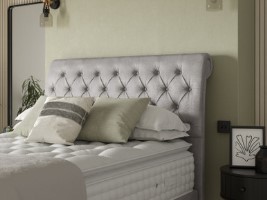
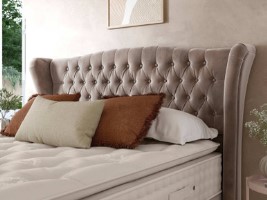
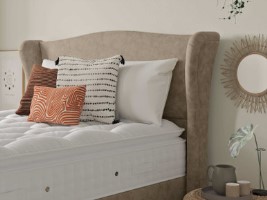
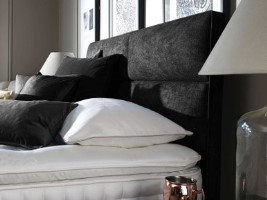
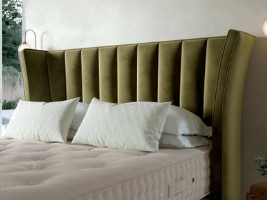
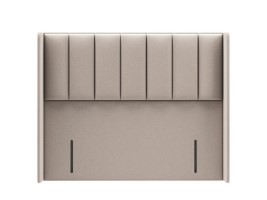
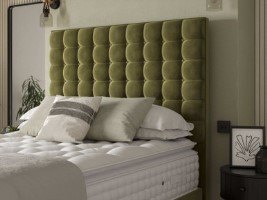
Will it work with a bedstead or an ottoman bed?
Often. What decides it is the fixing rather than the type of bed, so start there. Two arrangements cover most of what's on sale. Either legs behind a divan with the base pushed back against them, or a bolted fixing through the rail at the back of that base. Bolting is tidier, since it stops a board walking sideways over the years.
Slatted bedsteads don't offer either, so the panel leans on the wall and depends on your frame to stop it sliding forward. Tall feet move the contact point up the leg, which hands the board a lever it never had on a divan. An ottoman base is heavy enough to anchor a panel, as long as the lid clears it at full lift.
Look for the words bolt, fixing or bracket in the description before you assume anything. Where a listing doesn't carry one of them, you're buying a board that stands on its own and trusts your bed to keep it there.
Sizing, where the name belongs to the bed
Headboard sizes name the bed they fit, not their own measurements. King boards won't go on doubles. That mismatch isn't a couple of centimetres either: king runs 150 cm across against a double's 135 cm, so you'd be hanging 7.5 cm of board over each side.
Six widths cover the whole UK market, though a listing usually leads with the imperial name. Small single 2'6" is 75 cm, single 3'0" is 90 cm, small double 4'0" is 120 cm, double 4'6" is 135 cm, king 5'0" is 150 cm, super king 6'0" is 180 cm. Width's the only figure there that has to match, though height's left to you.
That same arithmetic catches a bedside table bought to suit a shallower bed, since a deep pillow top raises everything you're reaching for from it.
The label the fire regulations require
UK fire-safety law names headboards outright. Category pages selling them rarely mention it. The 1988 regulations on furniture and furnishings define furniture to take in beds and divans, then spell out that the bases and headboards of both are covered.1 An upholstered board therefore carries a permanent label, with the law setting out what has to be on it.
Schedule 7 sets out seven items for that label: the words CARELESSNESS CAUSES FIRE, the manufacturer or importer's name and postcode, a batch number, the date. Then a description of the filling, a description of the covering, plus whether an interliner's fitted.1 That label also has to be durable and securely attached, which is worth checking before the packaging goes out. Second-hand boards have to pass the ignition tests too, so a marketplace bargain isn't outside the rules.
What changed in the fire labelling rules?
One requirement went recently, so a buying guide older than that will point you at something that isn't there. Regulation 10 and Schedules 6 and 8 were omitted on 30 October 2025, and with them went the display label, the swing tag on the shop floor.2 Permanent labels survived. Guides written before that date still send you looking for a tag nobody has to attach.
Does it slide on laminate or lean on thick carpet?
Both, given long enough. Deep pile lets the legs settle unevenly as the fibres compress underneath them, so a board that stood square on arrival won't be square a few months later, which photographs as a wonky wall. On laminate it's the opposite, with the feet creeping forward every time somebody sits back hard against the panel.
Felt pads under the feet deal with the second one, while your bed deals with the first, which is the whole reason for pushing it back against the legs.
Materials, and where the wear goes
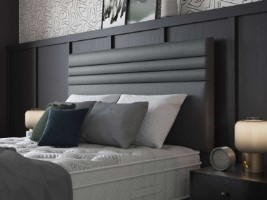
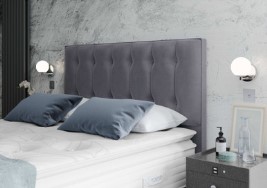
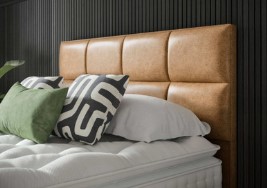
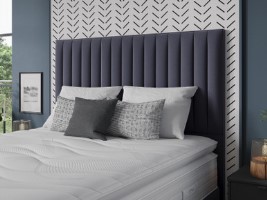
Upholstery dominates this category, so the maintenance question is really a fabric question. Wear happens in one stripe, at the height your shoulders reach, where hair oil and whatever's in it goes into the fabric. Flat cotton shows that first, as a darkened patch across the middle of the board. Faux leather shows it as a shine, then cracks along a fold line while a fabric panel's still only looking tired.
Woven chenille and slubby linen disguise it longest, because the texture breaks up the edge of the patch. Velvet's the opposite: pile shows pressure, not dirt.
Is wood or metal easier to live with?
Yes, if nobody in the house reads in bed. Wood and metal skip the wear problem entirely and hand you a different one. They're cold and hard to lean on, so a cushion ends up doing the job the padding would have done. Dust doesn't gather on them the way it settles into the weave of a padded panel. Wipe one down and you've finished, which is not true of a fabric board with two winters of hair oil in it.
Fixings, and what the listing leaves out
Fixings are what a headboard listing routinely omits. Boards held up by the bed's weight need nothing in the box at all, because there's nothing to attach. A board that bolts through a divan rail needs bolts, though whether they're supplied varies by manufacturer rather than by type. Ask before the van is booked, because that's a question a retailer answers in one line.
Can one person get a super king board into place?
I wouldn't try it. Super king panels run 180 cm in one piece with nothing in them that folds, so the difficulty's span rather than weight. Holding one square while somebody walks the bed backwards is a two-person job at 180 cm and a one-person job at 90 cm. In between sits the 135 cm double, which most people manage alone and slightly regret.
Clear the floor before it comes out of the packaging, because a panel set face-down picks up whatever's on the carpet. Your stairs decide more than your doorway does, so measure that turn against the box rather than against the bed.
Floorstanding or strutted?
Ask what your bed is already offering. Fixings decide this more than looks do. Strutted boards bolt to a divan and go nowhere without one, which makes them the cheaper and lower answer if you've got a divan and mean to keep it. Floorstanding boards carry their own legs, so they outlive a change of bed, sit higher and cost more for the extra material.
If you'll change the bed inside five years, buy the one that isn't married to the base.
When a floorstanding board will not fit
Bay windows and chimney breasts are where you'll struggle first, since a flat panel and an uneven wall never agree on where the middle is. Rooms where the bed can't be pulled forward come second, because a floorstanding board has to move before anybody hoovers behind it. Renting, with a move every twelve months, is third: a board on legs takes van space a strutted panel doesn't. They're fit problems, not quality ones.
Wanting the padding without the floor space points you back at strutted. If protecting the wall is all you're after, paint does it and so does an upholstered frame with the board already built on. Wrong specs on the cards here get logged on corrections.
Common questions
Are floorstanding and free standing headboards the same thing?
Yes, it's one product with two names. Retailers use both spellings interchangeably, which is why you'll miss stock listed under the other one. Floor standing as two words turns up as well. A type name tells you nothing about what's holding the board upright, so read the description instead. Legs down the back with the bed pushed against them, sometimes with bolt holes into a divan rail as a second fixing.
How high above the mattress should a headboard sit?
High enough that the panel clears your shoulders once you're sitting upright, which is a figure no listing gives you, because retailers quote height from the floor. Add base height to mattress depth, add a topper if you've got one, then take the total off the quoted figure. Say the board measures 120 cm from the floor and your bed's surface sits at 60 cm: that leaves 60 cm of visible panel. Deep mattresses eat into that faster than you'd think.
Can a floorstanding headboard be fixed to the wall instead?
Some can, though most listings don't say either way. No British or European standard on headboard fixing load appears to exist, which leaves nothing to check the board or the wall against. A board designed to stand takes its weight through the legs, not through the back, so taking them off changes what the panel was built to do. It may void the guarantee too. Make it a phone call to the manufacturer rather than a gamble with a drill.
Will the fabric match a divan base bought separately?
Assume not, unless a retailer's selling the two as a pair and says the cloth is the same. Dye lots move between production runs, so a fabric name guarantees nothing about the shade. Two years of daylight fades a base to a shade you can't judge from a screen. Samples are worth requesting, though the honest fallback is to stop chasing a match: charcoal over grey reads as a decision, grey over a slightly different grey reads as a mistake. That's what most people end up living with.
Has anybody at BedBoy stood one of these against a wall?
No, not one. Nobody here has lifted one, leaned on one or unbolted one, and no page on this site carries a tested badge. None ever did. Position comes from the published specification, the price record and what buyers write after a year or two with a board, weighed against the scoring method. Headboards are where the method's thinnest, because leg length and fixing type almost never reach a listing.
References
- 1. UK Statutory Instruments, ‘The Furniture and Furnishings (Fire) (Safety) Regulations 1988: regulation 3 (interpretation of 'furniture'), regulation 11 and Schedule 7 (permanent labelling)’, legislation.gov.uk (1988) <https://www.legislation.gov.uk/uksi/1988/1324/made> [accessed 9 August 2026].
- 2. UK Statutory Instruments, ‘The Furniture and Furnishings (Fire) (Safety) (Amendment) Regulations 2025, regulation 4: omission of regulation 10 and Schedules 6 and 8’, legislation.gov.uk (2025) <https://www.legislation.gov.uk/uksi/2025/531/made> [accessed 9 August 2026].
- 3. Department of Health and Social Care, Office for Health Improvement and Disparities, ‘Understanding and addressing the health risks of damp and mould in the home’, gov.uk (2026) <https://www.gov.uk/government/publications/damp-and-mould-understanding-and-addressing-the-health-risks-for-rented-housing-providers/understanding-and-addressing-the-health-risks-of-damp-and-mould-in-the-home--2> [accessed 9 August 2026].