
Duvets
BedBoy earns a commission on outbound retailer links. Editorial scoring is independent of commission rates. How this works →
Last updated:
Duvets are the category on this site I've got least to say about. You're better served by that admission than by an invented preference. What I'd push on instead is the care label, because a duvet you can't wash is a duvet you throw away.
Tog's a measurement, not a marketing word. One tog is 0.1 m²·K/W of thermal resistance, measured on a plate rig under BS 4745, with the duvet method set out in BS 5335. So the number on the packaging tells you how slowly your own heat leaves you, and nothing else.
UK bedding ranges run 4.5, 7.5, 9, 10.5, 13.5 and 15 tog, though there's hardly a retailer stocking all six. For a normally heated house and a cupboard with room for one duvet, 10.5 is what you're after. Treat 4.5 as a second duvet for July rather than a compromise, since a summer weight isn't a lesser product, just a different one.
One study earns the space here. Twelve adults slept under six duvets of measured thermal resistance, from 3.81 to 8.93 clo. Sleepers under the highest-resistance duvet stayed comfortable across an ambient range of 8.2 to 17.7 °C, where the lowest managed only 16.4 to 22.2 °C.1
Warmth therefore buys you tolerance of a bedroom you can't control. It doesn't buy you better sleep, because the same twelve-person study found the upper and lower limits of that comfort zone made no significant difference to sleep quality. What that study does pin down is bed climate, at 30 to 33 °C, which is the temperature your duvet manages rather than the one on your thermostat.
Weight isn't warmth.
Fill weight in grams tells you how much is in there, which is a different question from how hard each gram of it works. Fill power is the specification I'd chase hardest, since it measures the volume a fixed mass of down takes up, tested under BS EN 12130.2 Higher fill power traps more air per gram, so a light duvet reaches the same tog as a heavy one with less of it lying on you.
Back to the drum. Synthetic fill washes at home and dries in hours. Feather and down clumps once it's soaked, then holds damp in the middle long enough for mould to start inside your duvet.
I'd rule out any care label that won't take a machine wash, which rules out most of the good natural fills. That's an expensive way to shop. I'll take it for bedding that comes out of a drum clean.
If overheating's your problem, stop reading tog charts and start reading the casing, because a lower tog in a breathable cover does more for a hot sleeper than any cooling badge stitched to a synthetic quilt. What sits underneath you counts too, since 13.5 tog over a memory foam mattress traps heat from both sides.
Scores narrow your list and stop there. Nothing in how the scoring works reaches fill power, because there's hardly a UK listing that prints the figure.
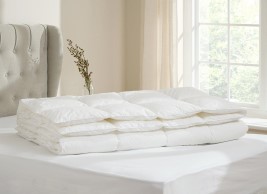
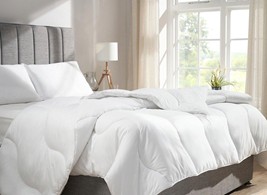
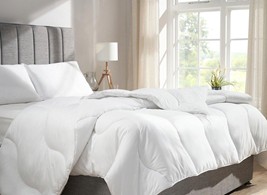
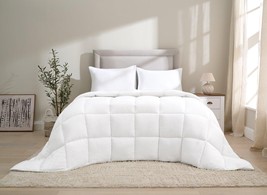
Duvet photography's a peculiar art, all that diagonal folding for a thing that spends its life crumpled. Get the care label and the fill weight in front of you before you get to the photograph.
9 products compared from live retailer data. Scored under our published rubric; curated by Monika Sharma. Corrections via our corrections policy.
Browse categories
Browse all brands
- Bodyshape
- Dunlopillo
- Emma Mattress
- Ergomotion
- Eve
- Flaxby
- Furniture Village
- Harrison Spinks
- Horizon
- House Beautiful
- Hyde & Sleep
- Hyde and Sleep
- Hypnos
- iGel
- Jay-Be
- Julian Bowen
- Little Big Dreams
- Luna
- Millbrook Beds
- Relyon
- Rest Assured
- Romantica
- Sealy
- Silentnight
- Simba
- Simply Bensons
- Sleepeezee
- Sleepmasters
- Sleepmotion
- SleepSoul
- SleepyTime
- Slumberland
- Snooze
- Sophie Conran
- Staples & Co
- Tempur
- The Dream Team
- The Dreams Workshop
- TheraPur
- Welcome
- WIEMANN
- X Rocker
- healthopaedic
- birlea
- hypnos
- sareer
- orignal-bedstead-company
- nora
- intex
- symple-stuff
- visco-therapy
- house-additions
- home-loft-concept
- clima-control
- kally-sleep
- viva
- healthbeds
- clima-comfort-latex
- feather-and-black
- sleep-science
- spink-and-edgar
- hypnia
- dreamcloud
- revived
- airsprung-beds
- bestway
- disney
- h-living
- bodyshape
- bed-butler
- sprungland
- stompa
- protect-a-bed
Did you know?
Putting your phone down an hour before bed helps you fall asleep faster and wake up less.

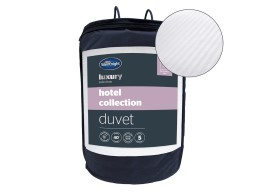
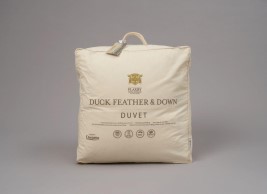

What is a 4.5 tog duvet for?
July, and not much else. At 4.5 tog you're under a third of the thermal resistance of a 13.5, which in a British summer is the difference between sleeping under something and kicking it off at two in the morning. It's the one tog that gets advertised in page titles and never explained in the copy underneath.
Owning two is a storage question before it's a comfort one. Together a 4.5 and a 13.5 cover more of your year than a single 10.5 does, so if there's shelf space in your wardrobe, the pair beats the compromise. Plenty of houses haven't got it, which is the whole argument for 10.5.
Down, feather and everything sold as an alternative
Down isn't feather. Retailers use the two words as if they're the same thing. Beneath the outer feathers of geese and ducks sits a fine cluster with no quill in it, which is down. Gram for gram it traps more air than anything else you'll put on a bed.
Feather has a quill, so it's heavier, cheaper and audible when you turn over. Affordable natural duvets usually blend the two, with EN 12934 forcing the label to declare the mix. Responsible Down Standard is the other mark to look for, though it certifies farm traceability and animal welfare rather than anything you'll feel in the bed.
Down alternative and microfibre are two names for one thing: fine synthetic filaments spun to imitate the loft of down. They wash at home and dry fast, though they'll flatten sooner than any natural fill. Hollowfibre's the coarser, springier synthetic underneath them, common in bedding sold as anti-allergy. Wool and silk sit apart from all of it, being heavy, moisture-buffering and usually dry clean only, so they're a commitment rather than a purchase.
Why does the filling drift towards the edges?
Because the box it's sitting in has no walls. Stitch the top layer straight through to the bottom and you've got a quilted grid with thin cold seams and fat pockets between them. Tolerable in a cheap synthetic, wasteful in down. Baffle box construction puts a fabric wall between the two layers, so every box holds its full depth of filling right out to the corner.
Channel construction runs long tubes head to foot instead, so there's no cross-wall anywhere. You can shake the fill down towards your feet in July and back over your chest in January. Where your bedroom swings that far, it's the pick of the three. Look for the word baffle in the specification, because nobody's photographing the inside of a duvet.
The allergy advice is back to front
Most duvet pages send allergy sufferers away from feather and towards synthetic, which the published bedding literature doesn't support. A review of that literature found synthetic bedding associated with asthma, rhinitis and eczema, with feather bedding appearing protective. Higher house dust mite allergen in the synthetic items is the suggested mechanism.3 What's blocking the mite is tightly woven down-proof ticking rather than anything in the feathers. That's the fabric, not the bird.
It still isn't a recommendation, so I'd stop short of telling you to buy feather on the strength of it. Most of that research was done on pillows, which get washed, squashed and slept on face-down. Nothing in it establishes cause, which is why its own conclusion is that the intervention studies still haven't been run.
I'd drop hypoallergenic from a duvet listing altogether, since it describes a sales tier rather than your response to one. With a diagnosed allergy in the house, that's a question for the clinician treating you, not for a category page.
Can you wash a duvet hot enough to kill dust mite?
Usually not. Allergy advice for bedding is built around a 60 °C wash, which is hotter than most duvet labels allow. Natural fills often say dry clean only, which isn't a wash at all. So the wash that'd help your allergy is the wash that voids the care instructions on your own duvet.
Go by your label, for a reason that's physical rather than legal: soaked down clumps, dries unevenly, and can go mouldy in the middle of a domestic drum. Buy a washable synthetic and there's no argument left. Wherever the spare one lives between seasons, it'll keep drier in a blanket box or an ottoman base than on the floor of your wardrobe.
What size duvet fits your bed?
Work it from the overhang rather than from the label, because that's what decides whether it fits. UK bed widths are fixed at 90 cm for a single, 135 cm for a double, 150 cm for a king and 180 cm for a super king. Duvet widths aren't standardised the same way, so two double duvets from different makers can differ by several centimetres across.
A 200 cm duvet on a 135 cm double divan leaves you 32.5 cm hanging each side. Comfortable for one sleeper, marginal for two. Size up where you share, since the extra width'll all go into the drop rather than onto the bed. Measure the duvet where a retailer's size table disagrees with that arithmetic, then flag it on the corrections page if this one has it wrong.
On an upholstered frame with a deep side rail, measure from the top of your mattress rather than the top of the rail. That rail eats drop you thought you'd got, which is how a double duvet ends up looking mean on a bed it technically fits.
Babies get no duvet at all
Not at any tog, not in the first year. NHS guidance on sudden infant death syndrome says to keep a baby's cot clear of pillows, duvets, cot bumpers and loose blankets, and to keep the room at 16C to 20C.4 Cot duvets exist as a product, with BS EN 16779-1 covering them. That's a safety standard, not a permission slip.
Where a cot size turns up in a filter here or anywhere in the kids section, read it as a product for an older child. Check the age guidance printed on the packaging, the same way you'd check it on a bunk bed. This is the one line on the page that isn't a preference.
Two buyers this page can't help
Two people sharing one duvet at different temperatures should stop shopping for a tog and buy two singles. No number on a shared duvet fixes a mismatch. Two duvets on one bed look odd for about a week, then they're just how the bed looks. If you're buying for a bed you share, settle that before you read a word about fill.
I'd skip the cooling premium too, unless overheating's a problem you already know you have. A cooling finish feels cool on contact, then saturates within a few hours, so it's a delay rather than a solution. You'll see the same premium on gel mattresses, for the same reason. For a sleeper who runs neither hot nor cold, there's nothing in it at either end of the year.
When what's keeping you awake is your neck rather than your temperature, the fix is a pillow, because loft is set by your shoulder width and the weight of your head. Side sleepers get that wrong most often, since a tall person's pillow pushes a shorter head off axis.
Common questions
Does BedBoy sleep under the duvets it ranks?
No. Nothing here's been slept under, washed or handled by anybody on the team. There's never been a tested badge on a BedBoy page implying otherwise. The ranking runs on published specifications and on what owners wrote in their own reviews, which is decent evidence for what fails after six months and none at all for how a duvet drapes over your shoulder. Be wary of any site telling you it can do that from a listing.
How often should a duvet be replaced?
There's no evidence base for the two-or-three-year figure you'll see quoted. It's a retailer number rather than a study finding. Test it yourself instead: lay your duvet flat, look at it side-on, and see whether the fill lofts back up after a shake. Trapped air is the whole mechanism behind a tog rating, so a duvet that's gone limp isn't performing at the number on its label. Filling drifting to the edges is the other tell, and it usually shows first.
What can you do with an old duvet?
Textile recycling points and animal rescue centres will often take a clean duvet, though plenty of them won't, so ring before you drive anywhere with one in the boot. Wash it first where your label allows, because a duvet nobody can wash is a duvet nobody'll take. If it's past all that, cut it open: the fill still works as stuffing for a pet bed, which beats what landfill will do with it.
Is an all-seasons duvet worth buying?
Usually yes, provided you've somewhere to keep the halves. An all-seasons duvet is two duvets poppered together, typically a 4.5 and a 9. You get three weights from one purchase: 4.5 through summer, 9 for spring and autumn, 13.5 with both clipped on. The catch is the poppers. Count them along the long edge before you buy, because a sparse row'll let the halves slide about inside your cover.
Do duvets have to meet UK fire safety regulations?
No, and that's a definition rather than a loophole. The 1988 furniture fire-safety regulations, SI 1988/1324, define furniture so that bedding falls outside them, which puts your duvet beyond the scope covering your mattress. There's a voluntary ignitability test, BS 7175, used mostly in contract and hospitality supply rather than on the high street. Treat fire retardant or meets UK safety standards on a duvet listing as a claim needing an explanation.
References
- 1. F Yan, Q Zheng and Y Ke, ‘Effect of quilt thermal resistance on bedding system and sleep thermal comfort’, Journal of Thermal Biology, vol. 117 (2023), pp. 103713, doi:10.1016/j.jtherbio.2023.103713.
- 2. British Standards Institution, BS EN 12130:2018 Feather and down. Test methods. Determination of the fill power (massic volume) (2018).
- 3. R W Siebers and J Crane, ‘Does bedding affect the airway and allergy?’, International Journal of Occupational and Environmental Medicine, vol. 2, no. 2 (2011), pp. 65–75.
- 4. NHS, ‘Sudden infant death syndrome (SIDS)’, nhs.uk (2026) <https://www.nhs.uk/baby/caring-for-a-newborn/sudden-infant-death-syndrome-sids/> [accessed 9 August 2026].