
Adjustable beds
BedBoy earns a commission on outbound retailer links. Editorial scoring is independent of commission rates. How this works →
Last updated:
An adjustable bed is a motorised base that hinges under your shoulders and under your knees, so a handset lifts your torso or your legs while the frame holds whatever shape you stop at. That's the whole trick. Massage motors, USB sockets and a lit plinth all sit on top of one hinge and one lift mechanism, though they're the parts you'll use least.
Sizes follow the standard UK ladder. Widths run 90 x 190 cm for a single, 135 x 190 for a double, 150 x 200 for a king, 180 x 200 for a super king. You'll see small single at 75 x 190 cm and small double at 120 x 190 cm far less often here, because the mechanism costs about the same to build whatever width it's going under.
Work out how one gets into the room before you fall for it. Powered bases turn up in more than one box, with the deck section as the heavy half, so a staircase with a turn in it isn't a one-person job.
Mains power is the bit everybody forgets. Measure from your bed head to the nearest socket and check the transformer lead reaches, because an extension trailing under a bed you can't shift is a nuisance for years.
Then there's the mattress, which is where the money usually goes wrong. Extra firm is out.
Put a rigid spring unit on a moving deck and the two fight each other every time the motor runs. Guess which of the two loses. Memory foam, latex and hybrids built to bend are what fits, so I'd buy the base and the mattress as a pair or buy neither.
Reflux is the best case this category has, though it's the one the sales pages under-sell. NHS advice is to raise the head end of your bed by 10 to 20 cm so your chest and head sit above your waist. Stacking extra pillows instead presses on your belly and can make the symptoms worse, which is why the same guidance tells you not to. 1 Raising the deck lifts your torso in one piece, which is the geometry that advice describes.
If the head end is never going up, put the money into the mattress and buy a flat frame instead. You'd be paying a premium for a hinge nobody in the house intends to press. Bought for a job, it does something a flat base can't. That's the only honest reason I know of to own one.
Underneath, each product carries a BedBoy Score, and it'll cut a long list down fast. What it won't tell you is whether the mattress already on your bed is going to bend.
29 products compared from live retailer data. Scored under our published rubric; curated by Gary Ferguson. Corrections via our corrections policy.
Browse categories
Browse all brands
- Bodyshape
- Dunlopillo
- Emma Mattress
- Ergomotion
- Eve
- Flaxby
- Furniture Village
- Harrison Spinks
- Horizon
- House Beautiful
- Hyde & Sleep
- Hyde and Sleep
- Hypnos
- iGel
- Jay-Be
- Julian Bowen
- Little Big Dreams
- Luna
- Millbrook Beds
- Relyon
- Rest Assured
- Romantica
- Sealy
- Silentnight
- Simba
- Simply Bensons
- Sleepeezee
- Sleepmasters
- Sleepmotion
- SleepSoul
- SleepyTime
- Slumberland
- Snooze
- Sophie Conran
- Staples & Co
- Tempur
- The Dream Team
- The Dreams Workshop
- TheraPur
- Welcome
- WIEMANN
- X Rocker
- healthopaedic
- birlea
- hypnos
- sareer
- orignal-bedstead-company
- nora
- intex
- symple-stuff
- visco-therapy
- house-additions
- home-loft-concept
- clima-control
- kally-sleep
- viva
- healthbeds
- clima-comfort-latex
- feather-and-black
- sleep-science
- spink-and-edgar
- hypnia
- dreamcloud
- revived
- airsprung-beds
- bestway
- disney
- h-living
- bodyshape
- bed-butler
- sprungland
- stompa
- protect-a-bed
Did you know?
Putting your phone down an hour before bed helps you fall asleep faster and wake up less.
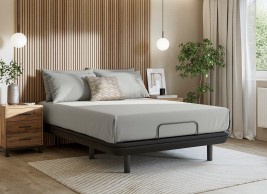
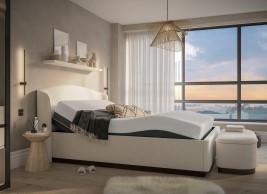
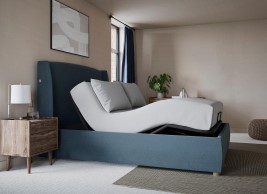
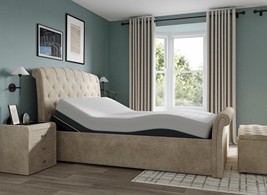
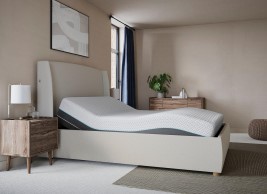
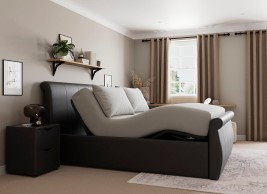
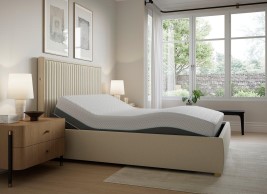
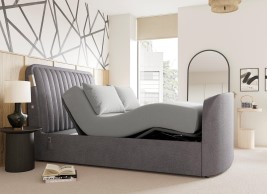
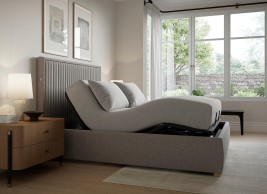
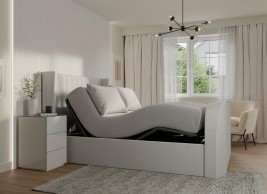
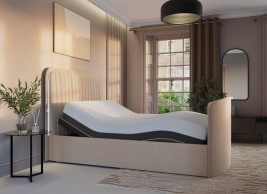
How the deck bends
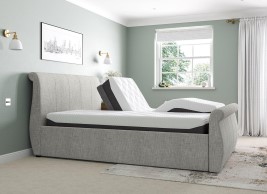
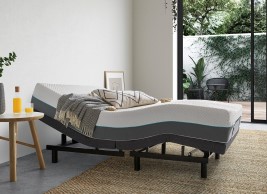
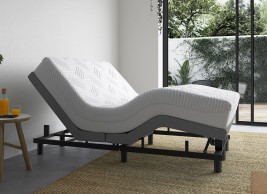
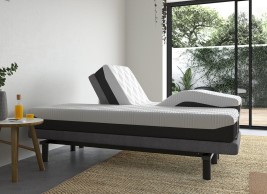
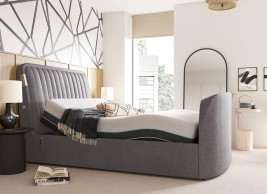
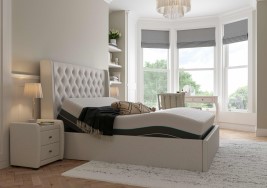
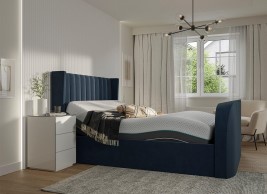
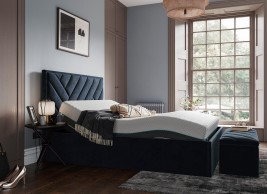
At two hinges, in most cases. Your deck splits under the shoulders and again under the thighs, each section driven by its own motor, so head and foot travel independently. Cheaper bases run a single motor and raise the head only, which is most of the price difference. Some decks split into five sections instead, adding a knee break and a small lumbar panel under the lower back.
Your handset will end up under the bed at some point, which seems to be a tradition of its own.
Maximum user weight, and where to find it
On the specification sheet, or from the retailer in writing where the listing doesn't carry it. Every lifting mechanism has a rated capacity that's set by the motors and the deck below rather than by the mattress on top. That ceiling has to cover the sleeper, the mattress and whoever's sitting on the edge to pull their socks on.
Ask for it before you ask anything about the handset or the massage settings. I'd chase that number down before I looked at anything on the features list.
Which mattresses survive the movement?
Foam, latex and hybrids built to flex. Rigid sprung units are the failure case here. Border wire and coil tension resist the bend, so your mattress either lifts off the deck at the hinge or takes the strain through its own edge.
That's why extra firm gets ruled out here rather than discouraged, and why an orthopaedic label is worth reading twice before you order.
Depth is the other constraint, which nobody thinks about until the mattress is on the bed. Very deep mattresses bend into a shallower curve than the deck is making, so you lose part of the travel you've paid for. Check the maximum depth your base manufacturer states, and check it before you fall for a mattress, not after you've paid for one. Pocket-sprung isn't automatically out, since some units are built with a flexible border for exactly this.
What the evidence says about snoring and apnoea
Less than the packaging implies, more than nothing. Forty-five patients with obstructive sleep apnoea were measured flat, then again at 30 degrees of head and trunk elevation. Mean AHI fell from 23.8 to 17.7, while the share of events that were full apnoeas dropped from 55 per cent to 44. 2 Velum and lateral wall collapse improved, though tongue base and epiglottis collapse didn't.
Read the arithmetic before you read the headline on the box. An AHI of 17.7 is still moderate sleep apnoea, so what you're looking at is a reduction rather than a fix. Pooling eight trials and 323 participants, the Cochrane review of positional therapy found people stay with it more reliably than with CPAP, while CPAP cuts AHI further. 3
If you snore and also stop breathing, gasp, or find yourself dropping off during the day, that's a GP appointment and not a furniture decision.
Do you need two mattresses for a split base?
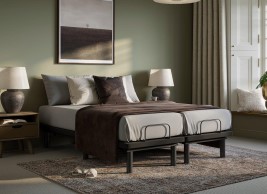
On a split-tension base, yes, and it's the cost most people forget when they price the bed. Two mattresses means two sets of fitted sheets, plus a gap down the centre of your bed that a bridging strip or a full-width topper has to cover. Zip-and-link pairs give you one surface to look at, though you're still buying two units and paying for both.
I'd argue the couples case from the mechanics rather than from anybody's habits. The mechanics settle it. Two people who want different angles need two decks, because one motor can't hold two shapes at once. Where you and your partner turn in at different hours, a split deck lets one side move while the other stays still, which is the point the couples shortlist keeps coming back to.
What happens in a power cut?
Most bases will return to flat without mains power. Usually that's a battery backup driving the deck down once, though some use a manual release instead and a few have neither.
Find out which one you're getting, because a deck stuck at thirty degrees with somebody lying on it is a problem no sales page will raise. Asking costs nothing, so settle it before any deposit goes down.
Massage motors, USB sockets and the rest
Extras, priced as features. Massage is a vibration unit bolted to the frame, so it does nothing for the hinge you're paying for. Rank it last.
USB sockets and under-bed lighting are cheap to fit and useful at three in the morning. Footboard televisions make the frame heavier, date faster than the bed does, and pin the whole thing to one wall. Look at the TV bed pages if that's what you're after.
Fabric and colour are cosmetic here rather than structural, so if the finish is what you're buying for, the upholstered and velvet pages cover more ground.
Is zero gravity worth paying for?
It's a preset, not a technology. Zero gravity names a body angle with the legs raised, so the button on the handset is a shortcut rather than a mechanism of its own. Any base that lifts the head and the legs will reach the same position, whether or not the handset's got those words on it. You don't need the sticker to get there.
How long will one take to arrive?
Longer than a flat frame. A powered base is built to the size, the fabric and the split the buyer picks, so it can't be pulled off a shelf the way a flat frame can. Several weeks is normal for anything built that way, and the wait isn't your retailer being slow.
Delivery terms differ by retailer and they don't stay put for long, so read the retailer's own page rather than anybody's summary of it. Room of choice, unpacking and removal of the old bed are usually charged as extras. Those charges are easier to find before you order than after. You'll want them in your total before you weigh one base against another.
Where a specification on this page disagrees with the retailer's own listing, the retailer is the one to believe, and the fix belongs on the corrections page.
Where a wedge pillow beats a motor
Buy the wedge if all you want is a raised head for reading. Think of it as a shaped foam block that belongs with the pillows rather than with the bases, at a fraction of the cost of a powered one. No socket, no mattress restriction, no lead time. On reflux the wedge is the weaker tool, since the NHS advice points at the bed rather than at your body, though for reading it wins outright.
Not everyone should be on this page. You'd be better off with a rigid firm mattress on a divan than softening things up to keep the motor happy. And a systematic review of position change and snoring names the limitation the sales pages leave out, which is that some people can't tolerate prolonged head elevation. 4 You'll find that out once the bed is already in the room.
Common questions
Can you keep the headboard you already own?
Sometimes, and it's down to how the headboard fixes. Divan-style headboards bolt to two points at the head of the base, so an adjustable base with the same spacing will usually take one. Bases with an integrated or upholstered surround won't. Easiest way round it is a floorstanding headboard, which stands on its own legs behind the bed and doesn't care what the deck underneath is doing. Check the fixing arrangement on the product page before you assume either way, because improvising a bracket on a moving deck isn't a job worth taking on.
How noisy is the motor?
Quiet enough in a showroom, though you won't find a decibel figure on any listing. Retailers describe motors as quiet, and buyers score their beds for satisfaction rather than for sound, so there's nothing here that can rank beds by how loud they are. Tolerance is personal too. A hum that disappears in daylight carries at two in the morning next to somebody asleep. Ask the retailer for a decibel rating in writing, or work the mechanism yourself in a shop. Don't read quiet on a listing as a measurement, because it isn't one.
Has anyone at BedBoy slept on these beds?
No, and there's no badge on this site that says otherwise. There never was one. Nobody here's lain on an adjustable base, worked a handset or listened to a motor run, and no page will imply it. What we do is read the specifications, aggregate the review data and apply a published rubric, which you can read in full on the how we score page. That'll get you a shortlist and a decent set of questions to ask. What it won't tell you is how a deck sounds at midnight, and where that's the deciding factor a showroom still beats a website.
Is an adjustable bed the same thing as a hospital bed?
No. A profiling bed used in care has side rails, variable height, castors and a specification written against clinical need. An adjustable divan raises your head and your feet, and that's the whole of what it does. Treating the two as equivalent is where this category gets into trouble, because furniture isn't assessed against your condition or anybody else's. If the bed's being bought around reduced mobility or a diagnosis, get an occupational therapy or GP assessment first and shop afterwards, rather than the other way round.
What does the whole thing cost once the mattress is included?
More than the price on the card, because the mattress isn't optional here. A rigid one you already own won't bend with the deck, so the purchase usually arrives as a pair, and on a split-tension base it's three items once the second mattress is counted. Delivery into a room of your choice, unpacking and taking the old bed away are commonly charged on top. Add those in before you weigh a powered base against a fixed frame, or you'll be flattering the wrong bed.
References
- 1. NHS, ‘Heartburn and acid reflux’, nhs.uk (2026) <https://www.nhs.uk/conditions/heartburn-and-acid-reflux/> [accessed 9 August 2026].
- 2. G Iannella and others, ‘Head-Of-Bed Elevation (HOBE) for Improving Positional Obstructive Sleep Apnea (POSA): An Experimental Study’, Journal of Clinical Medicine, vol. 11, no. 19 (2022), pp. 5620, doi:10.3390/jcm11195620.
- 3. P R Srijithesh and others, ‘Positional therapy for obstructive sleep apnoea’, Cochrane Database of Systematic Reviews, vol. 5, no. 5 (2019), pp. CD010990, doi:10.1002/14651858.CD010990.pub2.
- 4. A Moffa and others, ‘The Potential Effect of Changing Patient Position on Snoring: A Systematic Review’, Journal of Personalized Medicine, vol. 14, no. 7 (2024), pp. 715, doi:10.3390/jpm14070715.