
High sleeper beds
BedBoy earns a commission on outbound retailer links. Editorial scoring is independent of commission rates. How this works →
Last updated:
A high sleeper is a bunk bed. Not in the catalogue, where it sits under kids' beds, but in UK law. The definition there is a height, not a name. Any bed whose sleeping surface, or the under-surface below it, would be 800 mm or more above the floor counts.1 Put a desk and a chair underneath and your platform clears that line several times over.
So the rules covering a top bunk cover this frame too, whatever the listing calls it. It's a bunk bed for one, with the top berth kept and a desk, a chest, a wardrobe or a sofa underneath.
Called a loft bed, it's the same product under an American name, and that word won't turn up again here. Mid sleepers and cabin beds sit lower, so they're a different decision. You'll find both over in kids' beds.
Parents measure the floor, because that's the dimension a small bedroom hurts on. Your ceiling only comes up once the frame's standing. No UK standard sets a minimum gap between the top of the mattress and the ceiling, so there's nothing to look up.
Work it out instead. Ceiling height, minus platform height, minus mattress depth. What's left is the headroom your child gets sitting up in bed, and I'd settle that before looking at a photograph.
Mattress depth is where this category catches people, because the limit everybody quotes isn't the limit that governs. Fifteen centimetres is the common ceiling on UK single frames, though one flat number isn't what the standard asks for.
The standard wants the maximum permissible mattress thickness marked on the frame itself, per product, since too deep a mattress defeats the barrier it's meant to sit under.2 So the number you're buying to is printed on the bed.
Size is a standard single, 90 x 190 cm (3'0 x 6'3). I'd buy the lightest mattress that fits inside the marked limit, and I'd buy it after the frame. You'll be changing a duvet cover at shoulder height for years, which makes a deep pocket-sprung single a poor partner up there.
Retailers write that a frame meets British safety standards. That sentence names no standard, so it's the one line I won't let past. BS EN 747-1:2024 is the one covering this product, written for bunk beds and high beds together. Compliance is a manufacturer's claim, carried in the marking on the frame.
BSI doesn't publish that text, it sells it, so the list below comes from a testing laboratory's summary of the marking clause. Look on the frame for the number and year of the standard, the maximum permissible mattress thickness, a warning that the bed is not suitable for children under six years, and, where the design needs it, an instruction to fix the frame to a wall. Check the listing says so rather than assuming the category does.
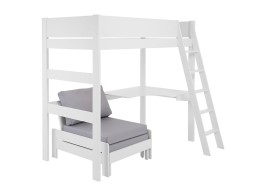
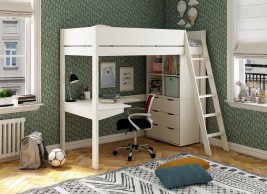
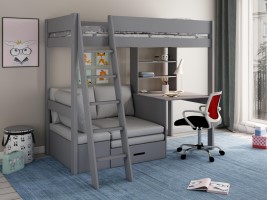
What sits underneath is where your money goes. Open shelving with a desk uses the least timber and it's the first thing to date, because a nine-year-old's homework corner isn't a fifteen-year-old's. Built-in wardrobe units and drawer runs cost more. Pull-out futons buy a sleepover and spend the storage to pay for it.
Every frame below carries a score, and it'll get ten down to three before running out of road. Guard-rail specification, platform stability and the width of the ladder opening decide the last three, and none of them survives a photograph. Nor does a score know your room. Somewhere in this category, there's a listing photograph without fairy lights on the guard rail, and I've never seen it.
10 products compared from live retailer data. Scored under our published rubric; curated by Giselle Green. Corrections via our corrections policy.
Browse categories
Browse all brands
- Bodyshape
- Dunlopillo
- Emma Mattress
- Ergomotion
- Eve
- Flaxby
- Furniture Village
- Harrison Spinks
- Horizon
- House Beautiful
- Hyde & Sleep
- Hyde and Sleep
- Hypnos
- iGel
- Jay-Be
- Julian Bowen
- Little Big Dreams
- Luna
- Millbrook Beds
- Relyon
- Rest Assured
- Romantica
- Sealy
- Silentnight
- Simba
- Simply Bensons
- Sleepeezee
- Sleepmasters
- Sleepmotion
- SleepSoul
- SleepyTime
- Slumberland
- Snooze
- Sophie Conran
- Staples & Co
- Tempur
- The Dream Team
- The Dreams Workshop
- TheraPur
- Welcome
- WIEMANN
- X Rocker
- healthopaedic
- birlea
- hypnos
- sareer
- orignal-bedstead-company
- nora
- intex
- symple-stuff
- visco-therapy
- house-additions
- home-loft-concept
- clima-control
- kally-sleep
- viva
- healthbeds
- clima-comfort-latex
- feather-and-black
- sleep-science
- spink-and-edgar
- hypnia
- dreamcloud
- revived
- airsprung-beds
- bestway
- disney
- h-living
- bodyshape
- bed-butler
- sprungland
- stompa
- protect-a-bed
Did you know?
Putting your phone down an hour before bed helps you fall asleep faster and wake up less.
Will it fit under your ceiling?
Do the arithmetic yourself, because there isn't a published minimum anywhere. Take your ceiling height, subtract the platform height from the frame's specification, then subtract the mattress depth. What's left is the gap between your child's head and the ceiling when they sit up.
Say your platform sits at 198 cm under a 240 cm ceiling. Add a 15 cm mattress and about 27 cm is left, which is nobody's idea of sitting up in bed. Sloped ceilings take headroom off one side only, so measure where the bed will stand, not mid-room. Radiators, light switches and curtain tracks disappear behind a raised platform, where a floor plan won't warn you.
Six and over is a warning, not a recommendation
Retailers write the age line as a recommendation, though the standard doesn't. It carries a warning instead, because a compliant high bed is marked not suitable for children under six years.
On a bunk bed a parent can put a younger child on the bottom bunk instead. High sleepers haven't got a bottom bunk, so that warning carries the whole age question. If you're shopping for a five-year-old, you want something lower down in kids' beds.
Past six, it's whether your child is confident going up and down the ladder with nobody watching. Whatever minimum the manufacturer states on the listing beats any general figure, including that one.
What do the 1987 regulations measure?
Gaps, at or above the height of any part of the sleeping surface. Under those regulations a bunk bed has to be built so there's no reasonable possibility of any part of the body of a child under six years of age becoming wedged or trapped in the structure.
Those regulations name the risk as death or serious personal injury, including strangulation, suffocation or injury to the neck or spinal column. That's the duty. Everything below is how that's tested.
In the sleeping surface, a permissible gap is one of not more than 75 mm. Everywhere else at that height, a permissible gap is not less than 60 mm and not more than 75 mm. Gaps are measured by advancing a prescribed cone into them to a force of 100 newtons.
The ladder opening is a width the law sets
One exception is written for exactly this category. Where a gap in the retaining structure at the side of the sleeping surface is there to give access to that surface, the regulations allow it, provided it is at least 300 mm wide. So the hole you climb through is a regulated dimension rather than a design flourish, the one part of the guard rail that's meant to be open.
Which side does the ladder go?
Check the listing, then check the diagram, because handedness is the specification that'll surprise you when the boxes arrive. Desk left, desk left or right, ladder left, ladder at the end: retailers filter on all of that, then write nothing about it.
Two things decide it in your room. Which way the door opens, since a ladder in a door's swing is a shin every morning. And where the window and radiator sit, because a desk under a window gets light and one against a radiator cooks a monitor.
Some frames are handed at assembly and some in the factory, so the instructions will tell you what the listing won't.
What goes under the platform
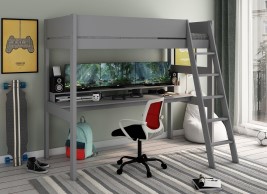
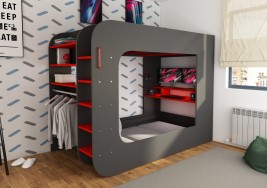
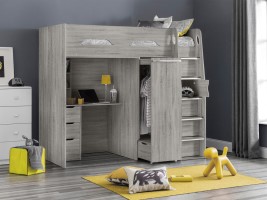
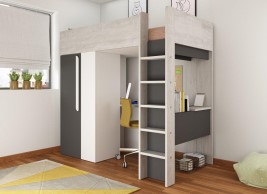
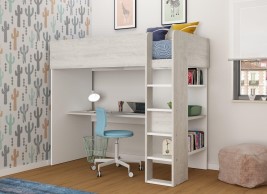
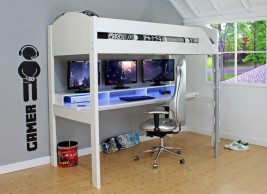
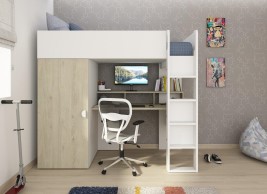
Desk, chest of drawers, bookcase, wardrobe unit, futon, or a gaming setup with a monitor shelf and a cable cut-out. Most frames commit to one of those permanently, so there's no changing your mind later. That's the difference between this and a bed you can rearrange around. Freestanding pieces cost more floor because they buy that freedom back.
One thing that won't fit anywhere under a platform is a bedside table. Work out now where a lamp, a glass of water and a charger live, because a high sleeper has no surface at mattress height.
Does a gaming build cost your teenager sleep?
It might, and nobody's going to promise otherwise. Gaming high sleepers put a monitor, a console and a desk permanently inside the room where somebody sleeps. Reviewing 67 studies, Hale and Guan found screen time linked with worse sleep outcomes in 90 per cent of them, mostly shorter sleep and later bedtimes.3 Their review covers fixed screens as well as handheld ones, which is why it's the one that reaches a bolted-on monitor.
That's association rather than proof, and none of those studies looked at bedroom furniture. Buy the layout for the cable management, which beats consoles and controllers spread across your carpet. Then treat the sleep side as a trade-off you're choosing, not one you can rule out.
Sleepwalking rules this bed out
NHS guidance on sleepwalking lists it under things not to do: do not let your child sleep in the top of a bunk bed if they sleepwalk.4 High sleepers are bunk beds under the definition above, so that instruction reaches them directly. Worse here than on a bunk bed, too, because a fall from a top bunk lands on a mattress while a fall from a high sleeper lands on a desk, a chair or a monitor.
That guidance also says sleepwalking is more common where other family members sleepwalk, so ask both sides before ordering. It sends you to a GP where sleepwalking is disrupting sleep, where you're worried about accidents or injuries, or where other symptoms have turned up alongside it.
How do you make a bed at shoulder height?
Badly, for the first few weeks. Your duvet has to be lifted and shaken out above your own shoulder, from a ladder or a chair, and it's the regret this category generates most reliably. Weight decides it more than anything else, which is why a rolled foam single goes up a ladder in one arm and a sprung one doesn't.
Fitted sheets go on faster if you can pull the mattress halfway off and push it back, so leave room at the foot end. Pillows go up in one arm, the duvet takes two. Warm air also collects near the ceiling, which is why a lower tog duvet is worth trying up there. Nothing has ever measured that in a bedroom, and I'd still do it.
Boxes, bolts and the wall fixing
Expect several long heavy boxes, a two-person build and assembly in the room it'll stand in. Once it's up, a high sleeper won't come back out through a doorway. Measure your stairwell and the turn on the landing first, the way you'd do for a wardrobe. Where the design needs it, the frame carries an instruction to fix it to a wall.
Those same 1987 regulations prohibit supplying a bunk bed in kit form without full and clear assembly instructions, and the bed built to those instructions has to comply. Assembly is a condition of supply here, not an upsell, so a retailer offering to do it isn't selling compliance, it's selling convenience.
When a high sleeper is the wrong buy
Under-sixes, first, and that's the marking on the frame rather than an opinion. Two children in one room is the job bunk beds were built for, so if you're housing a pair, that's your page. Low ceilings and loft conversions beat you on the arithmetic long before style comes into it.
And if your child is the one who'll be stripping the bed, a standard single on a wooden frame with a chest beside it is a quieter life for the whole house.
Common questions
Is a high sleeper the same thing as a loft bed?
Yes, and loft bed is the American term for it. UK retailers say high sleeper for a raised single platform with clear space underneath, while loft bed turns up mostly in imported listings and American search results. Neither one is defined in law, so they don't decide anything. What decides which rules apply is the height of your sleeping surface: at 800 mm or more above the floor, the entrapment regulations treat the bed as a bunk bed whatever the page calls it. Mid sleepers and cabin beds sit lower and are usually built for a younger child.
What is the weight limit, and can an adult climb up there?
Whatever maximum user weight the frame states, and it's the manufacturer's figure rather than any general rule. Find it on the listing or in the instructions, then check it again if you're planning to sit up there reading at bedtime or to strip the bed from the platform. BS EN 747-1:2024 is written around one occupant per bed, so two people on a platform sits outside what it assumes. Its own test loads aren't something a buyer gets to see, so work from the figure your frame gives you.
Can a rolled mattress go on a high sleeper?
Usually, though it's depth that decides it rather than format. Rolled singles have to expand to less than the maximum thickness marked on your frame, so check the fully expanded depth on the mattress listing and not the boxed one. Give it the stated expansion time lying flat on the platform before anybody sleeps up there, which is awkward on a raised bed and worth planning around. Lightness is the other argument for one, because you'll be hauling it up a ladder every time you strip the bed.
Has anybody at BedBoy been up one of these?
No. Nobody here has climbed a ladder, tightened a bolt or leant on a guard rail, nor has anything on the site ever carried a tested badge, because no such badge exists. Ranking runs off published specifications, retailer listing detail and the review text buyers leave once a frame is standing in a bedroom. The scoring method is published in full. Compliance isn't something an aggregator can settle for you: the marking on the bed is the evidence, and your listing either quotes it or it doesn't. Errors get logged on the corrections page.
What happens when a child outgrows one?
Nothing tidy. Most high sleepers don't convert into anything else, and the few that come apart into something usable say so on the listing. Keep the instructions and the fittings bag from the day it goes up, because a frame that still has both is worth something to the next household. Without them it's a safety product nobody downstream can check. Budget for it lasting one child rather than two.
References
- 1. UK Statutory Instruments, ‘The Bunk Beds (Entrapment Hazards) (Safety) Regulations 1987’, legislation.gov.uk (1987) <https://www.legislation.gov.uk/uksi/1987/1337/made> [accessed 9 August 2026].
- 2. British Standards Institution, BS EN 747-1:2024 Furniture. Bunk beds and high beds. Safety, strength and durability requirements (2024).
- 3. L Hale and S Guan, ‘Screen time and sleep among school-aged children and adolescents: a systematic literature review’, Sleep Medicine Reviews, vol. 21 (2015), pp. 50–58, doi:10.1016/j.smrv.2014.07.007.
- 4. NHS, ‘Sleepwalking’, nhs.uk <https://www.nhs.uk/conditions/sleepwalking/> [accessed 9 August 2026].