
Metal bed frames
BedBoy earns a commission on outbound retailer links. Editorial scoring is independent of commission rates. How this works →
Last updated:
Steel is what a metal frame's made of, which is the least useful line on the listing. What decides whether yours stays rigid is the wall thickness of the tube, so 1.2 mm behaves nothing like 0.8 mm at the same bolted joint. You won't find the figure printed, and a customer-services chat rarely produces it either. You're left reading shipping weight, slat count and price as stand-ins for a number the seller has and won't print.
Everything that goes wrong with one of these frames goes wrong at a joint.
Each joint is a bolt through a bracket, two coated faces pressed against each other. Put your weight through a few thousand cycles of getting in and out of bed and the bolt works loose. So re-torque the frame after a fortnight, then again around six months. Ten minutes, with the key that came in the box. These frames don't usually fail at the tube, they fail there, and the joint's where I'd want your money spent.
None of it is cosmetic. One research group modelled the mattress and the base beneath it as a single load-bearing system, then came within about 12 mm of the spine's measured position.1 Bases were the subject there, not frames, so read it as the reason slat spacing and centre support belong on your shortlist.
Squeak's probably what brought you here, and it deserves better than the denial a retailer will hand you. Noise through the night has a measured cost, a stress response and a worse next day among them, though the studies behind that measure traffic and aircraft rather than beds.2
It's also the objection I'd naturally rank lowest, which makes me the wrong person to rank it. A creak you sleep straight through is a creak that wakes whoever's beside you.
Height you can settle before anything's delivered. Sit on the edge of the bed you've got now, feet flat on the floor, then work out what the new frame plus your mattress depth does to that. Put a 28 cm mattress on a tall frame and you gain a usable half-metre of storage while losing the sit-down. Where getting in and out is already awkward, NHS falls guidance is better reading than any product page.3
I'd take powder coat over chrome plate every time.
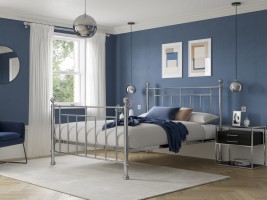
Powder coat's baked on thick and shrugs off a hoover clattering into a leg, where chrome is a bright skin that chips at the corners and pits wherever damp settles. Photographs flatter chrome. Bedrooms don't.
The argument for metal is the flat you'll leave in two years. A bolted frame's built to come apart, where the glued cam-lock joints on a budget wooden frame often won't manage a second build. Move often and that's worth more to you than the finish is.
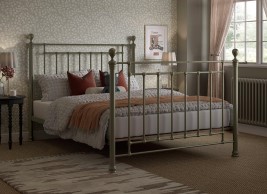
Reading in bed is the other side of that bargain, the side nobody selling a metal frame will raise with you. You get bars or a thin panel, cold against your shoulders in January, which no arrangement of pillows turns into a backrest. If that's how your evenings go, a floorstanding headboard or an upholstered frame is the better spend. The cards below each carry a BedBoy Score to thin a long list quickly, though it settles none of this for you.
16 products compared from live retailer data. Scored under our published rubric; curated by Gary Ferguson. Corrections via our corrections policy.
Browse categories
Browse all brands
- Bodyshape
- Dunlopillo
- Emma Mattress
- Ergomotion
- Eve
- Flaxby
- Furniture Village
- Harrison Spinks
- Horizon
- House Beautiful
- Hyde & Sleep
- Hyde and Sleep
- Hypnos
- iGel
- Jay-Be
- Julian Bowen
- Little Big Dreams
- Luna
- Millbrook Beds
- Relyon
- Rest Assured
- Romantica
- Sealy
- Silentnight
- Simba
- Simply Bensons
- Sleepeezee
- Sleepmasters
- Sleepmotion
- SleepSoul
- SleepyTime
- Slumberland
- Snooze
- Sophie Conran
- Staples & Co
- Tempur
- The Dream Team
- The Dreams Workshop
- TheraPur
- Welcome
- WIEMANN
- X Rocker
- healthopaedic
- birlea
- hypnos
- sareer
- orignal-bedstead-company
- nora
- intex
- symple-stuff
- visco-therapy
- house-additions
- home-loft-concept
- clima-control
- kally-sleep
- viva
- healthbeds
- clima-comfort-latex
- feather-and-black
- sleep-science
- spink-and-edgar
- hypnia
- dreamcloud
- revived
- airsprung-beds
- bestway
- disney
- h-living
- bodyshape
- bed-butler
- sprungland
- stompa
- protect-a-bed
Did you know?
Putting your phone down an hour before bed helps you fall asleep faster and wake up less.
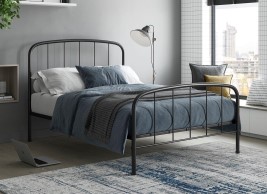


Why does a metal bed squeak?
Friction, in three places at once. Bolted joints where two coated steel faces rub as the frame flexes under you. Slat ends shifting inside their plastic housings. And the underside of your mattress sliding across bare tube.
Timber soaks a lot of that movement up before you hear it. Steel passes it along the rails as noise, which is why the category carries the reputation and wooden frames mostly don't.
Work the fixes in order rather than all at once. Tighten every bolt first, since that alone quiets most frames. Then isolate whichever joint still talks, with a nylon washer or a felt pad. Last, check your centre leg's standing on the floor taking load rather than hanging 5 mm clear of it on a rug that's crept.
Which finish lasts longest?
Powder coat, comfortably. Sprayed on dry, then baked into a shell thick enough to take a knock. Chrome plate's a bright film by comparison, chipping at the corners and pitting wherever moisture has been left to sit. Paint's the cheapest of the three and marks first, usually along the top rail your duvet drags over twice a day.
Colour won't tell you which of the three finishes you're getting. Black, white, cream, gold, bronze and nickel all turn up in every finish, so read the description rather than the swatch. If a listing gives you a colour and no process, assume paint.
Does it come with a centre rail and a centre leg?
At king width and above, ask. The rail runs the length of the bed under your slats and the leg drops from it to the floor, so the load goes straight down. Without both, a wide frame throws its load out to the side rails and works those joints every night you spend on it.
Some ranges fit the pair as standard from 150 cm across and print it in the specification table. Plenty don't, and the listing rarely says either way.
It's the specification I'd chase down before I'd pay a penny more for a nicer finish. It goes missing on exactly the frames where you need it most, the cheap ones at the widest sizes.
Slat gap and the warranty clause nobody reads
Metal frames often ship with slats spaced further apart than your mattress will tolerate. Foam and hybrid warranties commonly set a maximum gap around 7 to 8 cm, because unsupported foam sags into the spaces and the ridged dip that follows isn't something a maker pays out on. That number's a warranty term set by manufacturers rather than a research finding, so the document in your mattress bag beats this page.
Measure the air between two slats rather than centre to centre, because the difference between those two readings is the width of a slat. Sprung slats curve and give a little, which suits a pocket-sprung mattress and adds a softness under memory foam you probably didn't want. Solid slats and a divan platform top never raise the question at all.
How long does one take to build?
About an hour, with two of you, if it's your first. Head and foot ends on to the side rails, centre rail next where there's one, slats last so they're not in your way while you line up bolt holes. Leave every bolt a quarter turn loose until the frame stands square, then go round and pull them up.
Nobody has ever enjoyed that hour.
Taking it apart again
Undo the bolts in the reverse of the order you did them up. Keep every fixing in one bag taped to a side rail, because a replacement Allen key in the right size is harder to find than it sounds.
Threads are the weak point on a rebuild, since an over-tightened bolt strips its bracket and a stripped bracket won't square up again. Hand-tighten with the key rather than a power driver and you'll mostly avoid it.
Day beds, bunks and triple sleepers
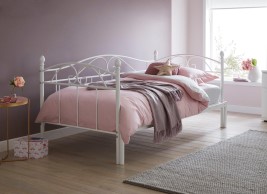
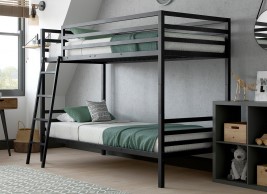
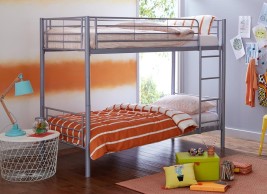
Metal does the awkward shapes cheaply, which is why so many of them are metal. Day beds carry rails on three sides and sit against a wall as a sofa until somebody stays over, usually with a trundle underneath. Bunks and triple sleepers stack the same tubing, so gauge counts for more there than anywhere.
Anything for a child changes the rules.
Bunk beds and high beds sold in the UK fall under BS EN 747-1 and BS EN 747-2, covering guard rails, permitted gap sizes, entrapment, ladders and structural strength.4 American guard-rail figures circulate online and aren't the UK requirement, so ignore them. Ask which standard a frame's built to before you buy one of the metal bunks in the kids listings, and treat a vague answer as an answer.
Skip metal if any of this is you
Buy something else if you read in bed, if your bedroom's damp enough to rust a bicycle, or if you want the bed to be the thing people notice about the room. Metal gives you three finishes and a silhouette, and the styling argument runs out about there. An ottoman or a velvet base gives you fabric, which is where the style variation in bed frames really sits.
Weight's the other limit here, and this one belongs to us rather than to you. Nobody writing this sits in the heavy load band, so the heavier sleepers shortlist is built from published specifications and review volume rather than experience. When a retailer feed has us wrong, you'll find it put right on the corrections page.
Common questions
How much weight will a metal bed frame take?
Most listings quote one. It's the figure on a metal-frame listing I trust least. No common test sits behind it, so one maker's 200 kg and another's 250 kg weren't arrived at the same way. Read the construction instead: tube wall thickness where anybody publishes it, whether the side rails are box section or rolled from sheet, how many slats span the width, and whether a centre rail and leg are fitted at king and above. Those four tell you more than the headline does.
Can you stop a metal bed squeaking for good?
No, and treat any product page promising silence as marketing. A bolted frame has parts rubbing against each other by design, so the target's quiet for months at a stretch rather than quiet for ever. Tighten every bolt, slip a nylon washer or a felt pad into any joint still making a noise, check the centre leg's bearing weight, and put a thin non-slip pad between your mattress and bare tube. Then put the next check in your calendar, because you won't remember it on your own.
What sizes do metal bed frames come in?
Six. Small single 2'6" (75 x 190 cm), single 3'0" (90 x 190), small double 4'0" (120 x 190), double 4'6" (135 x 190), king 5'0" (150 x 200) and super king 6'0" (180 x 200). Super king is the scarce one, so check what's listed before you commit. Frames sit 5 to 10 cm wider and longer than the mattress, because of the rails. That's the measurement that decides whether your bedroom door still opens.
Will a metal frame rust in a damp bedroom?
It can. Rust needs moisture standing on bare or broken finish, so it starts at chips, at bolt threads and at the feet where metal meets a cold floor. Keep your bed off an outside wall and wipe condensation away rather than leaving it to sit. Never take an abrasive to a mark, since scratching through the powder coat is what lets water in. When it does rust, the room is the thing to sort out, for reasons well beyond the bed.
Are these frames tested before they are ranked?
Not one of them, and there's no badge here saying otherwise, now or ever, because nobody runs a testing programme that could award one. Ranking comes out of manufacturer specifications and owner reviews gathered from every retailer listing a given frame, with the workings on the scoring page. That limit bites harder on a frame than on a mattress. Owners write their review in the fortnight after the build, so what you get is whether the bolt holes lined up. There's no review from year three.
References
- 1. V Verhaert and others, ‘Modeling human-bed interaction: the predictive value of anthropometric models in choosing the correct bed support’, Work, vol. 41, no. S1 (2012), pp. 2268–2273, doi:10.3233/WOR-2012-0450-2268.
- 2. D Halperin, ‘Environmental noise and sleep disturbances: a threat to health?’, Sleep Science, vol. 7, no. 4 (2014), pp. 209–212, doi:10.1016/j.slsci.2014.11.003.
- 3. NHS, ‘Falls’, nhs.uk <https://www.nhs.uk/conditions/falls/> [accessed 9 August 2026].
- 4. BSI, BS EN 747-1 and BS EN 747-2 Bunk beds and high beds: safety, strength and durability requirements and test methods.