
Orthopaedic mattresses
BedBoy earns a commission on outbound retailer links. Editorial scoring is independent of commission rates. How this works →
Last updated:
Orthopaedic is a word manufacturers put on the firmer models in their own range, which is less of a sceptic's reading than it sounds. It's what the National Bed Federation says on its own consumer site, along with two things the aisle would rather you skipped. One is that the term doesn't automatically mean a bed has been professionally assessed or recommended by anybody. The other is that a hard bed for a bad back is no longer generally accepted, because it can do more damage than good.1
So the word tells you where a model sits inside one maker's line-up, and that's the whole of its job. There's a literature on firmness and it doesn't back what the aisle sells you. Researchers writing in the Journal of Orthopaedics and Traumatology worked through 39 studies graded on the European firmness scale, then settled on medium-firm for comfort, sleep quality and spinal alignment.2 An orthopaedic surgery journal, asked the orthopaedic question, came back with the middle of the scale rather than the top of it.
Side sleepers, first. I'd keep you out of this filter before you open a single product page. On that side, the shoulder and the hip carry your whole width, so a surface built not to give won't let either of them in. Soft-medium is where I'd start you, then work up only if you need to.
Back and front sleepers are who the aisle was drawn around. Lying flat puts your weight over the largest area any sleeping position gives you, so the surface underneath has less to do at any one point. Front sleeping asks for the firmest version of that, which is why the front sleeper shortlist starts closer to your answer than this filter does.
I read the word as positioning rather than specification. It gets chosen a long way upstream of the mattress, by people deciding where a model should sit against the ones either side of it, with nothing tested before it goes on the label and nothing to test it against if anybody wanted to. Which is what makes it the cheapest badge in bedding.
Watch what the word does across a shelf and you'll see the problem. In the set on this page it clusters at firm without staying put, because models carrying it also turn up on the medium label. So treat it as a direction of travel rather than a guarantee you can hold anyone to. Two beds wearing the same word can sit a full grade apart, which you won't know until you're on them.
It's a good word, orthopaedic. Four syllables, all of them reassuring.
There's a BedBoy Score on every product here, which is worth one pass down the list and no more than that. It ranks what retailers publish, which isn't the same as what you'll feel. This word has never been a published measurement. If pain is the reason you're shopping, that's a job for a clinician before it's a job for a filter.
30 products compared from live retailer data. Scored under our published rubric; curated by Monika Sharma. Corrections via our corrections policy.
Browse categories
Browse all brands
- Bodyshape
- Dunlopillo
- Emma Mattress
- Ergomotion
- Eve
- Flaxby
- Furniture Village
- Harrison Spinks
- Horizon
- House Beautiful
- Hyde & Sleep
- Hyde and Sleep
- Hypnos
- iGel
- Jay-Be
- Julian Bowen
- Little Big Dreams
- Luna
- Millbrook Beds
- Relyon
- Rest Assured
- Romantica
- Sealy
- Silentnight
- Simba
- Simply Bensons
- Sleepeezee
- Sleepmasters
- Sleepmotion
- SleepSoul
- SleepyTime
- Slumberland
- Snooze
- Sophie Conran
- Staples & Co
- Tempur
- The Dream Team
- The Dreams Workshop
- TheraPur
- Welcome
- WIEMANN
- X Rocker
- healthopaedic
- birlea
- hypnos
- sareer
- orignal-bedstead-company
- nora
- intex
- symple-stuff
- visco-therapy
- house-additions
- home-loft-concept
- clima-control
- kally-sleep
- viva
- healthbeds
- clima-comfort-latex
- feather-and-black
- sleep-science
- spink-and-edgar
- hypnia
- dreamcloud
- revived
- airsprung-beds
- bestway
- disney
- h-living
- bodyshape
- bed-butler
- sprungland
- stompa
- protect-a-bed
Did you know?
Putting your phone down an hour before bed helps you fall asleep faster and wake up less.
Is orthopaedic a regulated word?
No. There's no legal definition of it in UK bedding, no certifying body behind it and no test a mattress has to pass before the word goes on the label. Manufacturers apply it to the extra firm end of their own range, which is exactly what the trade body quoted above says they're doing. What the word can't do is tell you how one maker's version compares with anybody else's.
Where the word came from
Orthopaedics is the branch of medicine dealing with the skeleton and the joints. That part is fine. What isn't straightforward is the leap from a medical speciality to a mattress, and it happens entirely on the label. A bed named after a discipline arrives sounding as though somebody qualified has been over it, though nothing in the build's changed to justify that. So the word arrives carrying an authority that nothing in the factory has given it.
Does that mean you should buy a medium-firm?
Not quite. Blame the scale. Those studies grade mattresses on a European laboratory measure rather than on the word printed on a UK price ticket, so medium-firm in a paper and medium-firm in a shop are two different objects. Take the direction rather than the grade, because the grade won't travel. Research points at the middle of a range, and where the middle of any one range falls is something you'll only settle by lying on the things.
What's the difference between firm and supportive?
Support holds your hips level with your ribs, while firmness is only what your skin meets in the top few centimetres. They come from different parts of the build, which is why the two words aren't interchangeable however often a listing swaps them. One holds you up while the other cushions you, which is a distinction most listings never make. Support is the spring unit underneath.
Firmness is whatever has been laid over the top of it, which is usually a few centimetres of foam or fibre. A cheap mattress can feel rigid under your hand and it'll still let your middle drop, because a thin hard pad above a weak core supports nothing at all.
Reflex foam, and why it fills this aisle
Reflex foam is the one build in here I'd turn down flat, because it resists where memory foam contours and body heat does nothing to it, so the surface feels the same at six as it did at midnight. Good underneath. Trouble on top.
Lie on your side and there's nowhere for a shoulder to go. Put a memory layer over a spring unit and you get the support this label promises, which is most of what a hybrid is.
How firm is too firm?
When your shoulder stops sinking. From that point your neck bends sideways through the night to close a gap the surface won't close for it, while your hip takes load your waist should have been sharing. That's the pattern the side sleeper shortlist is built to avoid.
Another tell is how often you turn over. Rolling is how a sleeping body gets out from under pressure it can't spread, so a sharp rise in it means the surface has run out of give. Both answers arrive inside a week, which is longer than any shop will give you and shorter than most trials.
Two firmnesses in one bed
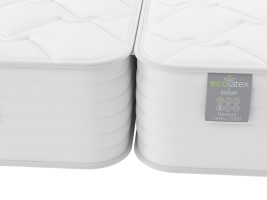
Zip and link is two single mattresses fastened together down the middle, ordered and priced as one bed. Two 90 cm halves make a 180 cm super king, six feet across, which is how one side of a bed ends up firm while the other sits at soft-medium. Where this filter suits you and the person beside you wants nothing to do with it, that's the way out.
The catch is the seam. Sleep up the middle and you'll feel it. Both halves have to be ordered together as a matched pair, or a centimetre of difference in depth turns into a ridge you can't ignore.
The conditions this word gets sold against
Back pain, scoliosis, osteoporosis, arthritis, joint pain, recovery from an injury. That's the filter set here. That demand isn't imaginary either, since low back pain reached 619 million cases worldwide in 2020 and is now the largest single cause of years lived with disability.3
None of which turns a mattress into a treatment for a single one of them. No mattress on this site is a medical device and none of this is medical advice, which is why the back pain shortlist is a place to start rather than an answer.
Should you speak to somebody before you buy?
Yes, if pain is what brought you here. A physiotherapist can watch what your back does under load, which isn't something a product page has ever managed. In many areas you can refer yourself to an NHS community musculoskeletal service without going through a GP first, so it's easier to get than most people expect. Go sooner than that if pain wakes you, travels down a leg, or brings numbness or weakness with it.
The claim I can't back up
Heavier sleepers get pushed into this aisle harder than anyone, though I can't find a trial behind it. More weight does need more underneath before the middle gives way, and that's mechanics rather than marketing. Nothing I've read tests a firmness grade against a body weight and reports what happened, so the heavier-sleeper shortlist gets built from construction instead. Somebody should run that trial.
Common questions
Are orthopaedic mattresses hard?
Firmer than average, usually. Beyond that, the word tells you nothing reliable. Nobody regulates it, so each manufacturer sets its orthopaedic models wherever it likes inside its own range, which is how one brand's version ends up feeling like another brand's medium-firm. Which is why the safe read is firmer than the rest of that maker's line-up, and nothing at all beyond that. Shop the firmness grade and what the mattress is built from. The name is decoration.
Is there such a thing as a medium orthopaedic mattress?
Yes. You'll find them on this page. Published category guidance contradicts itself on whether a medium qualifies at all, which is an argument nobody can win, because there's no standard behind either side of it. Nobody polices the word, so a maker whose range stops in the middle can hand the label to its firmest model, while a maker who builds harder puts it further up. What's moved between those two is the grade underneath, not the word above it. For the middle of the scale, go at it through the medium filter rather than through the name.
Can an orthopaedic mattress make back pain worse?
It can leave you sorer than you were, which isn't quite the same claim. On a surface that's too hard for your build, the shoulder and hip stop sinking, so the spine bends sideways to make up the difference and pressure gathers at those two points instead of spreading out. That's discomfort rather than damage. You'll know inside a fortnight. Mattresses don't cause back conditions and they don't cure them, so if the pain was there before the bed arrived, it's a clinical question and always was.
Has anyone at BedBoy slept on these mattresses?
No, and there's no tested badge on this site suggesting otherwise. There never was one, though an old version of our methodology page described a testing tier that never rendered on a single product. That came out in August 2026. What we do instead is compare published specifications, prices and aggregated customer reviews against the rubric on how we score. It's a different job from sleeping on a mattress for a fortnight. We'd rather say so than blur the two.
How long before a new firm mattress stops feeling uncomfortable?
Give it two to four weeks before you decide. Your body's settled into whatever you slept on before, so a change of surface registers as wrong for a while after it's stopped being wrong. Adjusting isn't the same as putting up with it, though. Persistent soreness at the shoulder or hip after a month means the bed's too firm for you and no amount of waiting will mend it. Check the trial terms before you order, because some of them only apply if you buy a mattress protector at the same time.
References
- 1. National Bed Federation, ‘FAQs’, Bed Advice UK <https://bedadvice.co.uk/faqs/> [accessed 9 August 2026].
- 2. G Caggiari and others, ‘What type of mattress should be chosen to avoid back pain and improve sleep quality? Review of the literature’, Journal of Orthopaedics and Traumatology, vol. 22, no. 1 (2021), pp. 51, doi:10.1186/s10195-021-00616-5.
- 3. GBD 2021 Low Back Pain Collaborators, ‘Global, regional, and national burden of low back pain, 1990-2020, its attributable risk factors, and projections to 2050: a systematic analysis of the Global Burden of Disease Study 2021’, The Lancet Rheumatology, vol. 5, no. 6 (2023), pp. e316–e329, doi:10.1016/S2665-9913(23)00098-X.