
Mattress in a box
BedBoy earns a commission on outbound retailer links. Editorial scoring is independent of commission rates. How this works →
Last updated:
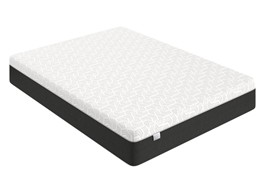
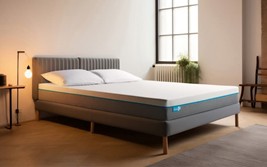
Width is what makes a mattress hard to deliver: a super king runs 180 cm across, or 6 ft in the old money. Rolled and vacuum packed, that same mattress becomes a cylinder you can stand upright in a lift, which is the whole reason this category exists. The box is a delivery format, and it won't tell you much about the bed folded up inside it.
Most of what arrives boxed is all-foam, because foam compresses further than a spring unit does and then recovers on its own. That's a manufacturing constraint rather than a recommendation. Listings still present it as though it were a category, so you're left sorting a delivery method as if it were a construction.
I'd want a pocket unit under that foam. Rolled hybrids and rolled latex come off the same compression machine as the plain foam slab next to them in your results, so neither is hard to find. If you sleep on your side at the lighter end of the scale, a surface that only yields under a heavy body will leave your shoulder about where it started, with your neck bent sideways for the rest of the night.
The cooling badge on a boxed foam mattress is the first thing I'd read past. Foam that's wrapped round you at midnight is still wrapped round you at four, whatever the ticket says. What you want from a surface is that it sheds the moisture you've put into it, rather than feeling cold for ten minutes and then giving up.
Firmness labels are the maker's steer about where a bed sits in their own range, which is useful right up to the point where you compare two brands. A boxed firm from one factory and a boxed firm from another can be two different beds under your hip. You won't know which until you're lying on it. Comfort-layer depth in centimetres tells you more, though it isn't printed on half of them.
Rolling a mattress cuts the space it takes on a lorry, so each journey carries more of them. Whether any of it reaches the price on the ticket is the seller's call, and you won't often see it passed on. Where it does, I'd spend it on the spring unit rather than on a deeper foam top. Every single time.
One thing separates this from every other way of buying a bed. Once the plastic is off it doesn't go back on, because you can't re-roll a mattress in a bedroom, so a change of mind turns into a collection problem. Whatever trial you were shown at checkout is only as good as its clause about who's carrying the thing back down the stairs.
Where I stop being useful to you is worth saying out loud. I can't tell you how a boxed all-foam mattress copes under a heavier body, or under somebody who sleeps face down, because that's neither my weight band nor my position. Both of those shortlists, heavy sleepers and front sleepers, get written from evidence rather than from anybody's own night.
There's a whole genre of video online of people opening these with a kitchen knife, and I've watched more of it than I'd care to write down.
Scores on the cards below come from the published rubric, so they'll sort a long list for you. None of them can see through plastic. What settles it afterwards is the unit under the foam, how deep the top layer runs, and what the collection clause says about a mattress nobody can fold up again.
32 products compared from live retailer data. Scored under our published rubric; curated by Giselle Green. Corrections via our corrections policy.
Browse categories
Browse all brands
- Bodyshape
- Dunlopillo
- Emma Mattress
- Ergomotion
- Eve
- Flaxby
- Furniture Village
- Harrison Spinks
- Horizon
- House Beautiful
- Hyde & Sleep
- Hyde and Sleep
- Hypnos
- iGel
- Jay-Be
- Julian Bowen
- Little Big Dreams
- Luna
- Millbrook Beds
- Relyon
- Rest Assured
- Romantica
- Sealy
- Silentnight
- Simba
- Simply Bensons
- Sleepeezee
- Sleepmasters
- Sleepmotion
- SleepSoul
- SleepyTime
- Slumberland
- Snooze
- Sophie Conran
- Staples & Co
- Tempur
- The Dream Team
- The Dreams Workshop
- TheraPur
- Welcome
- WIEMANN
- X Rocker
- healthopaedic
- birlea
- hypnos
- sareer
- orignal-bedstead-company
- nora
- intex
- symple-stuff
- visco-therapy
- house-additions
- home-loft-concept
- clima-control
- kally-sleep
- viva
- healthbeds
- clima-comfort-latex
- feather-and-black
- sleep-science
- spink-and-edgar
- hypnia
- dreamcloud
- revived
- airsprung-beds
- bestway
- disney
- h-living
- bodyshape
- bed-butler
- sprungland
- stompa
- protect-a-bed
Did you know?
Putting your phone down an hour before bed helps you fall asleep faster and wake up less.
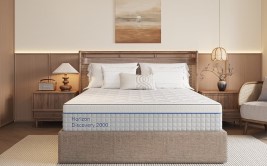

What happens when you want to send it back?
Somebody carries it back out whole. Delivered flat, a mattress goes back on the van the way it arrived, though yours won't if it came rolled. Re-rolling one in a bedroom isn't possible, so a return means a full-size mattress leaving through the same doorway your neat little parcel came in through.
Retailers write their own terms for that collection, which vary far more than the trial lengths they've put on the homepage. Read the collection clause before you read the number of nights, because that's the sentence that'll cost you money if you skip it.
Who should buy one delivered flat instead
Anyone set on extra firm. Compression asks a spring unit to lie flat and folded for as long as the box sits unopened, which a rigid unit resists harder than a soft one does. Whether the model in front of you was built to take that is a question for the retailer selling it, not a law of physics. I'd ask before I ordered.
If you've always got on better with a hard bed, start from the orthopaedic and firm shortlists, then check the delivery format product by product. Same again if you overheat and every boxed option in your budget turns out to be solid foam. Start from the hot sleeper shortlist instead.
Which builds survive the roller
Memory foam, reflex foam, latex, hybrids and open-coil units all get compressed and boxed. Pocket springs go through too, in units built with the roller in mind. So the question isn't whether your favourite construction can be rolled. It's whether the one in front of you was built to be.
Recovery is where they differ. Dense foam takes longer to reach full height than a spring-led build, then longer again in a cool room, because foam stiffens as it cools. Give yours warmth and a day before you decide it's a dud.
Where should you open it?
In the coolest, best-ventilated room you can get it into. Your leaflet will talk in hours, though hours are the one variable nobody's measured. Chamber testing of mattress textiles found that raising the temperature from 25 °C to 50 °C significantly increased formamide and other hazardous VOC emission rates.1 Polyurethane samples gave the highest mean N,N-dimethylformamide rate, at 2,940 µg per square metre per hour.
Those were fabric swatches in a laboratory rig, not a mattress in a British bedroom, so take the direction from it rather than the figure. Warm air draws more out of the material. Odour is on record with the National Bed Federation too, which says vacuum-packed foam can smell strongly when it first comes out of the wrapping.2 Its advice is to air a new mattress well before you use it, then regularly after that.
If it's leaving you headachy or wheezy rather than merely irritated, ring a pharmacist before you ring the retailer.
Why the cover stays zipped
There's a fire barrier inside every mattress sold in this country. BS 7177 specifies resistance to ignition for mattresses, mattress pads, divans and bed bases, which is why the barrier is in there at all.3 What it's made from almost never reaches a listing you'll read.
In a study sampling four newly bought mattresses in the United States, fibreglass made up over half of the inner sock layer in two of the covers, with up to 1% migrated into the fabric beside them and fragments running 30 to 50 µm across.4 Four mattresses, in another country. That tells you nothing whatsoever about any product on this page.
Exposure happens one way only: somebody opens the zip on the outer cover. So leave yours fastened, and follow the care label, because it's the cheapest instruction in this category.
Can one person get it up the stairs?
Up the stairs, usually. Onto the bed, often not. Compression takes out the volume and leaves the weight exactly where it was. A boxed super king still weighs what a super king weighs, only now it's packed into a shape your hands can't get round.
Where the format wins is the turn halfway up a staircase and a doorway 762 mm wide, which is 2 ft 6 in. That's the genuine win, and it isn't the one the photography sells you. Get the box into the room and onto the bed frame before you cut anything, because after the first slice you're handling a full-size mattress rather than a parcel.
How long can it stay in the box?
There's no answer to that, only conventions. No standard sets a limit, so a window printed on a box is the maker's own habit rather than a finding. That's how a number gets repeated until it starts to sound official.
What's certain is that a rolled mattress holds its own foam under load for every day it sits there. Take the maker's instruction for the one you're buying as your answer. Buy late rather than early if you're between houses, which is also the point where the under £500 shortlist starts looking sensible.
Nobody has published the comparison
The reassurance this whole category rests on is that compression doesn't harm the mattress. It's an assertion, and it might well be true. No published study sets a rolled example against a flat-delivered example of the same model. BS EN 1957:2012 tests durability and hardness, which isn't the same question.
That one stays open. You can judge the mattress instead: what's inside it, how deep the top layer runs, what the guarantee covers, and what all of that costs against the same build arriving flat on a van from the wider mattress list.
Common questions
Can you sleep on it the first night?
Yes, in most cases, and it'll carry on expanding underneath you while you sleep. Published expansion times disagree with each other, so there's no house figure to give you here. Nothing independent settles it either. What you're lying on that first night is a mattress still short of its finished depth, which isn't the same thing as its finished feel. Follow the leaflet in your own box, then judge the thing on its shape rather than on the clock for the first week.
Does anyone at BedBoy unbox and test these?
No. Nothing on this site has been unboxed, timed or slept on by anybody here, and there's no tested badge on any page. There never was one, whatever an older version of the site implied, and mistakes of that sort get logged on corrections as they turn up. The ranking runs on the published specification, the retailer's own terms and the aggregate of buyer reviews, scored the way the scoring page sets out. So the unboxing detail here comes from manufacturer instructions and published research, not from an afternoon with a kitchen knife.
Can a mattress in a box be rolled back up?
Not at home. A compression machine flattens the mattress, rolls it, then heat-seals it inside plastic with the air drawn out, and nothing about that is reversible with a strap and a willing neighbour. So work out your return route before you cut the wrapping: who collects, whether there's a charge for it, and where a full-size mattress is going to sit while it waits. That's the question this format raises and the one product pages answer least.
Is a boxed mattress cheaper than the same bed delivered flat?
Not reliably. The saving in the format is transport, and whether any of it reaches the ticket is the seller's decision. There's no rule about it. Most of that gap comes from what's inside instead: a plain foam block costs less to build than a pocket unit with a comfort layer over it, and boxed ranges lean towards foam. Compare construction against construction rather than box against van, then see what your money buys on the pocket-sprung list.
What if it never reaches full height?
Measure it. Depth is published in centimetres for every model, so hold a tape against the middle of yours and then against a corner and compare the two. If it's a centimetre or so short after the time on the leaflet, it's still settling. Several centimetres down, or a corner that never lifts, is a fault rather than slow recovery, and it's worth photographing against the tape before you contact anybody. Retailers handle a measurement far better than they handle a description.
Can a rolled mattress go on a bunk or a high sleeper?
Often, and it's the one place this format sells itself. Hoisting a full-size mattress up onto a top bunk is awkward, and it's a bit dangerous. A box you can carry up the ladder and open in place is neither. Depth counts for more than the packaging here, because a mattress sitting too high leaves the guard rail too low to do its job. Check the maximum depth your frame states before you order, then start from the bunk bed and high sleeper lists.
References
- 1. K H Kim and others, ‘Emissions of amides (N,N-dimethylformamide and formamide) and other obnoxious volatile organic compounds from different mattress textile products’, Ecotoxicology and Environmental Safety, vol. 114 (2015), pp. 350–356, doi:10.1016/j.ecoenv.2014.07.008.
- 2. National Bed Federation, ‘FAQs’, Bed Advice UK (2026) <https://bedadvice.co.uk/faqs/> [accessed 9 August 2026].
- 3. British Standards Institution, BS 7177:2008+A1:2011 Specification for resistance to ignition of mattresses, mattress pads, divans and bed bases (2011).
- 4. J Wagner, J Fowles and T Barreau, ‘Fiberglass and other flame-resistant fibers in mattress covers’, International Journal of Environmental Research and Public Health, vol. 19, no. 3 (2022), pp. 1695, doi:10.3390/ijerph19031695.