
Memory foam mattresses
BedBoy earns a commission on outbound retailer links. Editorial scoring is independent of commission rates. How this works →
Last updated:
Memory foam is viscoelastic polyurethane, which is a long way of saying it's a foam that softens as it warms, moulds around your shoulder and hip, then recovers once your weight comes off. That much is settled. Where it gets murky is the evidence, because every controlled trial worth citing compares firmness rather than material. None of them sets memory foam against pocket springs at matched firmness.
The biggest randomised trial of the question handed 313 adults with chronic non-specific low back pain either a medium-firm or a firm mattress and followed them for 90 days. At the end of it the medium-firm group reported less pain in bed and less disability. 1 Read the population before you read the result, though. These were people who already had a chronic complaint, so the finding doesn't travel neatly to a healthy back. What the trial varied was firmness, not what the firmness was made of.
Foam works through contact area. Weight spreads over a bigger surface, so peak pressure at your shoulder and hip drops. It's also why a partner turning over disturbs less of your side of the bed than a pocket-sprung or continuous-coil unit would, which is what puts foam high on the couples shortlist. Those are comfort and motion outcomes rather than treatments, and that's the line the back pain hub takes as well.
Not everyone should buy one. Side sleepers gain the most, because your shoulder and your hip need somewhere to go and foam gives it to them while still carrying your waist. That's the whole of it.
Sleep face down and you'll want close to the opposite. A deep soft layer lets your pelvis settle below your ribs, which arches your lower back and isn't where you'll want to spend eight hours. Medium-firm or firm is the better starting point, and the front-sleeper shortlist works from there.
Cooling is the upsell to watch. Gel beads, phase-change finishes and cooling covers get sold hardest to people who never wake up too warm, though you'd never guess that from the packaging. If that's you, they're a cost with nothing on the other side, so work out whether heat is your problem before you pay somebody to solve it.
Boxed mattresses arrive compressed, and the first thing most people notice when the plastic comes off is the smell rather than the feel. Don't judge it for a day, and give the room some air while you wait.
What you're judging after that is whether your shoulder drops far enough for your neck to sit level with your spine, which is easier to check with somebody else looking than it is to feel for yourself.
Every card below carries a BedBoy Score, which is there to narrow a long list quickly. It won't settle anything on its own. After that you're checking depth in centimetres and foam density in kilograms per cubic metre, and the second of those isn't on most listings.
104 products compared from live retailer data. Scored under our published rubric; curated by Monika Sharma. Corrections via our corrections policy.
Browse categories
Browse all brands
- Bodyshape
- Dunlopillo
- Emma Mattress
- Ergomotion
- Eve
- Flaxby
- Furniture Village
- Harrison Spinks
- Horizon
- House Beautiful
- Hyde & Sleep
- Hyde and Sleep
- Hypnos
- iGel
- Jay-Be
- Julian Bowen
- Little Big Dreams
- Luna
- Millbrook Beds
- Mlily
- Relyon
- Rest Assured
- Romantica
- Sealy
- Silentnight
- Simba
- Simply Bensons
- Sleepeezee
- Sleepmasters
- Sleepmotion
- SleepSoul
- SleepyTime
- Slumberland
- Snooze
- Sophie Conran
- Staples & Co
- Tempur
- The Dream Team
- The Dreams Workshop
- TheraPur
- Welcome
- WIEMANN
- X Rocker
- healthopaedic
- birlea
- hypnos
- sareer
- orignal-bedstead-company
- nora
- intex
- symple-stuff
- visco-therapy
- house-additions
- home-loft-concept
- clima-control
- kally-sleep
- viva
- healthbeds
- clima-comfort-latex
- feather-and-black
- sleep-science
- spink-and-edgar
- hypnia
- dreamcloud
- revived
- airsprung-beds
- bestway
- disney
- h-living
- bodyshape
- bed-butler
- sprungland
- stompa
- protect-a-bed
Did you know?
Putting your phone down an hour before bed helps you fall asleep faster and wake up less.
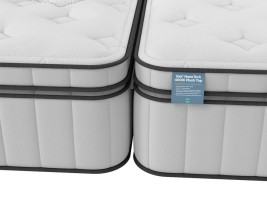
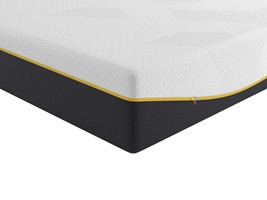
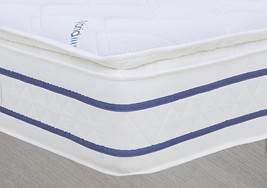
Underneath the memory layer
Buy something described as full memory foam and you're usually buying a stack of different foams. The memory layer sits on top, often only a few centimetres of it, while underneath sits reflex or high-density polyurethane doing the structural job. Viscoelastic foam on its own would bottom out under your hip, so it can't be the whole mattress.
Total depth is the number on the listing and the wrong one to shop on, because your shoulder cares about how far it can travel before it meets that structural layer. A 25 cm mattress carrying 3 cm of memory on top will stop it sooner than a 20 cm one carrying 6 cm, though that's the comparison nobody puts on a listing.
That split is rarely published, so you'll have to ask before you order. Hybrids solve the same problem with a spring unit instead of base foam.
How much sink is too much?
Enough that it can be measured. Hong and colleagues measured spinal curvature across three foam stiffnesses and computed the disc loading that followed, and against the medium sample the softest raised peak intervertebral disc loading by 49%. 2 Your torso does exactly that when its middle drops further than its ends. Their hardest sample went the other way, cutting lumbar lordosis distance by 10.6 mm while raising contact pressure, so neither extreme comes free.
That's the case for starting at medium or soft-medium and adjusting from there, rather than buying the softest option because it feels best in the half minute you're lying on it in a shop.
Does it sleep hot?
Warmer than a sprung unit, yes. On foam your body is surrounded by material rather than by air, and moving air is what carries heat away. That's why the builds that run coolest are the ones with space in the core.
Labels are a poor guide to how a surface behaves. Kräuchi and colleagues put 15 healthy young men through overnight polysomnography on two beds whose top 2 cm differed by roughly an order of magnitude in thermal capacity, about 47 kJ/°C against 5.4, and the high-capacity surface produced 16% more slow-wave sleep. 3
Fifteen men in a sleep laboratory isn't a household. A gel infusion doesn't move thermal capacity by anything close to that margin either. Watch the mechanism there: it's conductive heat loss across the whole night, not a surface that feels cool under your hand in a showroom. Nobody in UK retail publishes a thermal figure, so a cooling badge is a claim rather than a measurement. Hot sleepers do better changing the core than the label.
Density is the specification that decides how long it lasts
Foam density is quoted in kilograms per cubic metre, and there's a published method behind it, ISO 845, so a retailer who quotes you a density figure has handed you something they can be held to. More polymer per litre means more resistance to the permanent dent that forms where your hip sits, though it costs more to make, which is why you won't often see it advertised.
Almost no UK listing prints it. Density is the one specification worth chasing before you buy. Ask the retailer for the comfort-layer figure before you ask about the warranty, because the warranty you get is written around a depth of impression that density largely sets.
Which firmness suits which sleeper?
Position sets the direction and your body mass sets the amount. Put a heavier body on the same mattress and it'll read softer, since more weight compresses more of the comfort layer, which is how a medium that's carrying a heavier back sleeper can leave a lighter side sleeper down on the base foam.
Side sleepers in the lighter bands generally do best on soft or soft-medium, while back sleepers usually want a notch up from there. Your height changes it as well, and that's easy to miss. Shorter frames put your shoulder and hip closer together, so there's less spine to sag between them and a firmer surface stays workable.
Cold rooms change the feel
Softening with body heat is the definition of the material, so an unheated bedroom in February hands you a firmer bed than the same mattress gave you in July. It softens once you've been lying on it a while, and the delay is the bit people notice. February bedrooms aren't pleasant for a dozen other reasons either. If your room runs cold and you want the sink straight away, latex responds to pressure rather than temperature and doesn't care what month it is.
What is the new mattress smell?
Volatile organic compounds leaving the foam. That release is inherent to polyurethane rather than a sign of a bad batch, so open a window and give the room a few days before you judge the feel. Baking soda in a bowl is folklore.
Ventilation and time are the only two interventions with an obvious mechanism behind them. Look for a CertiPUR or OEKO-TEX STANDARD 100 certificate on the listing, which caps emissions, though it isn't a regulator.
Can you turn a memory foam mattress over?
No. Bonded layers make it a one-sided product, so turning one over puts structural foam against your body and the soft layer against the base. You'd be sleeping on the wrong half. Rotate yours head to foot every few months instead, which spreads the wear along the length rather than parking your hip in one spot for years.
Doing it when the clocks change is easier to remember than a date you've written in a diary.
Where the money goes
Density first, then depth, then the cover. Denser comfort foam keeps its thickness for longer under the same load, which is what you're paying for. Extra depth needs more of everything, while a removable washable cover adds a zip, a panel and a laundry cycle the core can't have. Brand sits on top of all three and it's the one component with no physical property attached to it.
On a fixed budget, the under £500 and under £1,000 shortlists apply the same rubric to a narrower slice. Specifications on the cards you see come from retailer feeds that change through the day, so anything we've got wrong goes on the corrections page.
Who should look at something else
Anyone who sleeps face down, anyone who wakes up damp, and anyone who was told the foam is hypoallergenic. It isn't. No mattress core is, because a foam slab can't be washed. Allergen control is something you'll do with a protector and the washing machine.
Spring cores and latex are no different on that point, whatever you're told in the shop. Heavier bodies usually want the support a spring unit gives, which is what the heavier sleepers shortlist covers.
What the NHS says about mattresses and back pain
Nothing, and that's the useful part. NHS guidance on back pain recommends staying active and taking painkillers if you need them, while recommending no mattress type at all. 4 Firmer isn't a treatment and softer isn't a treatment, whatever the word orthopaedic is doing on a label. The trial evidence cited above concerns a firmness band in one population, not a prescription for anybody.
Everything on this page is general information rather than medical advice. If your back pain isn't improving after a few weeks, that's a question for a GP or a physiotherapist rather than a shopping one. Go sooner with fever, numbness or weakness in both legs, loss of feeling around the genitals, or a change in bladder or bowel control.
Common questions
Are memory foam mattresses good for side sleepers?
Generally yes, though the reason is geometry more than material. Lying on your side puts most of your weight through two narrow points, the shoulder and the hip, so a surface that lets both drop while still carrying your waist keeps your spine level between them. Foam does that by deforming instead of pushing back. What you're checking is how deep the soft layer is, because a shallow comfort layer over firm base foam stops your shoulder before it's finished sinking. That's the first thing to look for on the side sleeper shortlist.
Do memory foam mattresses sleep hot?
Yes, though the mattress is only part of it. A quilted protector, a thick duvet and a warm bedroom all sit inside the same heat budget, and each one's cheaper to change than a bed. Start with those. If you're still waking up damp afterwards, no cover is going to fix the core, and a hybrid or pocket-sprung build with air moving through it is the honest next step. It's worth settling whether you overheat at all before you pay for a cooling finish.
What sizes do memory foam mattresses come in?
The UK ladder runs small single (2ft 6in, 75 x 190 cm), single (3ft, 90 x 190 cm), small double (4ft, 120 x 190 cm), double (4ft 6in, 135 x 190 cm), king (5ft, 150 x 200 cm) and super king (6ft, 180 x 200 cm). King and super king gain 10 cm in length as well as width, which is the difference if your feet already reach the end of what you've got. European sizes turn up on boxed brands at 200 cm long and a slightly different width, so read the centimetres rather than the name before you buy fitted sheets.
Does a memory foam mattress need a particular base?
It needs continuous or near-continuous support underneath. Foam has no internal frame, so it takes the contour of whatever it lies on, and wide slat gaps let the underside sag until the sleeping surface follows. Most foam warranties set a maximum slat gap for that reason. The figure lives in the warranty document rather than on the listing, so read it before you order a bed frame. Solid platform tops and divan bases don't raise the question at all, while adjustable bases need foam or latex, because a rigid sprung unit can't bend with the mechanism.
How reliable are the ratings on this page?
They're a synthesis rather than a test. Scores get built from published specifications and from reviews pooled across every retailer selling that product, and the workings sit on the scoring page if you want them. We don't sleep on these, and there's no badge or tier anywhere on the site that says otherwise, because there's no testing programme behind one. Timing is the other limit. Reviews get written when a mattress is new, so they catch first impressions and they're poor at the body impression that turns up years later.
References
- 1. F M Kovacs and others, ‘Effect of firmness of mattress on chronic non-specific low-back pain: randomised, double-blind, controlled, multicentre trial’, The Lancet, vol. 362, no. 9396 (2003), pp. 1599–1604, doi:10.1016/S0140-6736(03)14792-7.
- 2. T T Hong and others, ‘The influence of mattress stiffness on spinal curvature and intervertebral disc stress’, Biology, vol. 11, no. 7 (2022), pp. 1030, doi:10.3390/biology11071030.
- 3. K Kräuchi and others, ‘Sleep on a high heat capacity mattress increases conductive body heat loss and slow wave sleep’, Physiology & Behavior, vol. 185 (2018), pp. 23–30, doi:10.1016/j.physbeh.2017.12.014.
- 4. NHS, ‘Back pain’, nhs.uk (2026) <https://www.nhs.uk/conditions/back-pain/> [accessed 9 August 2026].