
Upholstered bed frames
BedBoy earns a commission on outbound retailer links. Editorial scoring is independent of commission rates. How this works →
Last updated:
Fabric bed frames take up more floor than the mattress inside them, and the listing won't tell you by how much. Your double mattress measures 135 × 190 cm, sold as 4'6", which is the figure every retailer quotes at you. Add a buttoned or winged headboard and you're looking at another 10 to 20 cm (4 to 8 in) of length, before you count a foot end or side rails. Measure the alcove, not the bed.
Upholstered beds get sold as fabric beds too, though it's the same product wearing a different word. Under the cloth there's a timber or particleboard carcass wrapped in foam or fibre padding, with the headboard built in rather than bolted on afterwards.
That padding is the whole point. A rail wrapped in foam doesn't ring when your heel catches it, and a padded headboard won't knock the wall when you sit up to read.
Noise is where fabric wins outright. I don't think it's close. Metal joints work loose inside a couple of years, then start announcing every turn, which counts for more than it sounds if you're a light sleeper sharing a bed. Read the metal listing next to this one before you decide, because the price gap doesn't run the way you'd expect.
I used to call these frames warm. I've stopped, because a padded side rail feels warm under your palm and leaves the temperature you sleep at exactly where it was. Heat reaches you from the mattress, the duvet and the room, so a frame isn't anywhere in that chain. That's why the hot sleepers shortlist works from the mattress up. When I call a velvet bed warm, that's my taste talking rather than an argument you should act on.
Fabric is where most of your money goes and where nearly all of the regret lives.
Colour charts sell this category, though what you'll live with afterwards is cleanability. Upholstery usually carries a manufacturer's cleaning code: W, S, WS or X, which decides whether a spill can be met with water, solvent, either or nothing but a vacuum. Find that code before you find the colour, because it's printed on the label and it isn't a matter of taste.
Money moves in a particular order here, though it isn't the order the photographs suggest. Your first few hundred pounds buy heavier cloth and a sturdier carcass, while everything above that's paying for headboard height, buttoning and a name.
Buttoning is the detail I'd think hardest about, because a button is a dip that collects dust and pet hair. Set a plain panel in a mid tone against a tufted one in pale linen and you'll get more years out of the plain one, with the gap widest on a budget. Start with the £500 shortlist, or £1,000 if your mattress is coming out of the same money.
Under your mattress there's a platform top, sprung slats or solid slats. That choice isn't decoration, because the base changes what the mattress above it can do. I'd take the sprung slats every time. Curved slats flex under your shoulder where a rigid platform can't, so on a firm mattress that flex is the only give you'll get.
There's a BedBoy Score on each card below. Use it to shorten your list, then put it down, because what separates two fabric beds is footprint, cleaning code and slat gap, none of which photographs well. In every fabric-bed photograph somebody has folded a throw across one corner at exactly forty-five degrees that nobody has ever slept under.
126 products compared from live retailer data. Scored under our published rubric; curated by Giselle Green. Corrections via our corrections policy.
Browse categories
Browse all brands
- Bodyshape
- Dunlopillo
- Emma Mattress
- Ergomotion
- Eve
- Flaxby
- Furniture Village
- Harrison Spinks
- Horizon
- House Beautiful
- Hyde & Sleep
- Hyde and Sleep
- Hypnos
- iGel
- Jay-Be
- Julian Bowen
- Little Big Dreams
- Luna
- Millbrook Beds
- Relyon
- Rest Assured
- Romantica
- Sealy
- Silentnight
- Simba
- Simply Bensons
- Sleepeezee
- Sleepmasters
- Sleepmotion
- SleepSoul
- SleepyTime
- Slumberland
- Snooze
- Sophie Conran
- Staples & Co
- Tempur
- The Dream Team
- The Dreams Workshop
- TheraPur
- Welcome
- WIEMANN
- X Rocker
- healthopaedic
- birlea
- hypnos
- sareer
- orignal-bedstead-company
- nora
- intex
- symple-stuff
- visco-therapy
- house-additions
- home-loft-concept
- clima-control
- kally-sleep
- viva
- healthbeds
- clima-comfort-latex
- feather-and-black
- sleep-science
- spink-and-edgar
- hypnia
- dreamcloud
- revived
- airsprung-beds
- bestway
- disney
- h-living
- bodyshape
- bed-butler
- sprungland
- stompa
- protect-a-bed
Did you know?
Putting your phone down an hour before bed helps you fall asleep faster and wake up less.
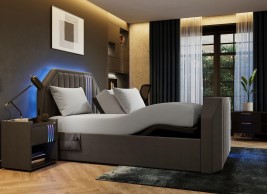
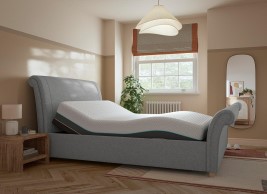
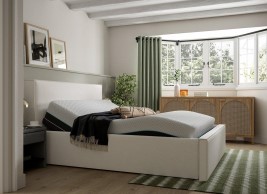
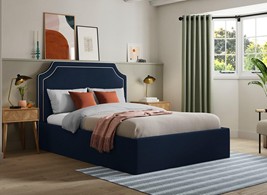
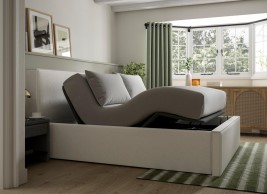
Mattress sizes are fixed. Frames aren't
Small single runs 2'6" (75 × 190 cm), single 3'0" (90 × 190), small double 4'0" (120 × 190), double 4'6" (135 × 190), king 5'0" (150 × 200) and super king 6'0" (180 × 200). Those six are the whole ladder. A buttoned headboard, a deep foot end or a sleigh curve each add centimetres of their own, and you won't find the total on any listing. Build the figure yourself before you shortlist anything.
How much floor will it want?
More than the ladder suggests. Give a king's 200 cm length another 20 cm of headboard and the bed wants 220 cm, or 7 ft 3 in, which isn't the room you thought you were measuring. Retailers quote the mattress size because that's what you typed into the search box. TV beds in fabric put a lift housing at the foot end and take more length again, so you'll want to measure those twice.
Fabric, and what it costs you to live with
Velvet is a pile fabric that shades and crushes wherever a shoulder or a cat has leant on it, though those marks will brush out rather than wash out. Crushed velvet gets round it by having the crush designed in, which is why it survives a household.
Bouclé loops snag. One claw, one zip or one ring pulls a loop proud of the weave, and you can't put it back. Chenille and linen-blends pill along the top rail, because that's where your duvet drags over them every morning. Flat woven cloth is the dullest thing on this page and it's the one that ages best.
Pale colours, and the bill nobody attaches to them
Pale upholstery gets recommended constantly and costed never. Blush and beige photograph beautifully under showroom lighting, then they'll show every mark of a house with a dog, a toddler or a habit of reading in bed with tea. That's a maintenance decision dressed up as a colour one, and you're the one doing the maintenance.
Can you clean a spill without ruining the fabric?
Only if the code lets you. W means a water-based cleaner and S means solvent only, while WS takes either and X means a vacuum with nothing wet at all. Dab rather than rub, because rubbing a pile fabric drives the stain into the base cloth and lifts the nap while it's at it. Read the code on the day you buy, not on the evening you've spilled something.
Does vacuuming the frame do anything?
It does, for a few weeks. Upholstery dust carries house dust mite allergen in amounts you can measure, and in homes that started high, one intensive vacuum and one dry-steam clean each cut it significantly.1 It wears off, though: in carpet, vacuumed levels had climbed back inside four weeks, while steam held to eight. Use the soft brush head rather than the bare nozzle.
That study measured sofas, armchairs and carpet, not bed frames. No research compares frame materials for allergen load either, so your weekly vacuum is sound advice for a reason the retailers giving it don't state.
The label sewn into the seam
Fire-safety labelling is a legal requirement on upholstered furniture sold in the UK, under the Furniture and Furnishings (Fire) (Safety) Regulations 1988.2 Regulation 14 covers the display label at the point of sale, and Schedule 7 sets the permanent one stitched into the piece. Look for both. Second-hand frames and direct imports without a permanent label are either non-compliant or unverifiable, and you can't tell which from a photograph.
Upholstered bases carry an ignition standard of their own, BS 7177, graded by end-use risk with domestic bedrooms at the lowest tier. You'd never think to ask until somebody points at the label.
Ottoman or drawers underneath?
Ottoman, if you can work it. Lifting raises the whole mattress platform on a gas piston, so effort scales with the weight on top. Drawers ask less of you and give back less, since a drawer reaches only as far as its runner and won't open at all without side clearance.
Lift effort is where I'd push hardest here. An empty lid tells you nothing about a loaded one, and latex or a natural-fibre build is the heaviest thing you could put on it. Struts weaken the more that lid goes up, and you won't find a cycle count published anywhere. Compare the ottoman and divan listings before you commit.
Does the base change how firm your mattress feels?
Yes. Researchers model the base and the mattress as one thing, so stiffening the base alone changes the spinal alignment the model predicts.3 Platform tops get sold as the support upgrade, which is a firmer surface being described as a better one.
Firmer isn't where the trial evidence points: controlled trials pooled in a systematic review put medium-firm at the optimum for comfort and spinal alignment.4 Those trials tested mattresses, not bases, so taking the finding down to a base is a guess rather than a result.
Check your slat gap while you're in there, because wide gaps let foam sag between the slats and void some mattress warranties.
When fabric is the wrong call
Anyone who wants to wipe a frame down should buy something else. Keep a dog on the bed, a toddler at the milk stage or a bedroom that doubles as a drying room, and wooden or metal frames will serve you better. A damp cloth does the whole job.
Redecorators should think twice too, because you can't change the cover for the life of the frame. Put a divan base under a strutted headboard and you'll get much the same look, with a headboard you can swap on its own. Floorstanding ones move house with you. Take a tape to your landing before you take one to the bedroom.
Common questions
Will an upholstered bed frame get up the stairs?
The carcass will, because it arrives flat and goes up a panel at a time. Everything hangs on the headboard. It ships as one rigid upholstered piece that can't be folded or split, so the narrowest turn on your landing is the measurement that decides your purchase. Take it across the diagonal, then check it against the headboard's boxed dimensions rather than the assembled bed size. You won't always find that figure on the listing. If your turn is tight, a strutted headboard on a divan base goes up in pieces you can carry.
Can the cover be taken off and washed?
On a fixed frame, almost never, and hardly any listing states it either way. Ask before you order, because it's the one detail that decides what your next ten years look like. Where the cover does come off you get a laundry cycle instead of a spot-clean, so a spilt glass of wine isn't permanent any more. Sealed covers leave you cleaning to the manufacturer's care code for the life of the bed, and a code of X leaves you with a vacuum and not much else.
What does a Martindale rub count tell you?
Abrasion resistance, and nothing beyond it. Testing follows BS EN ISO 12947-2, which counts the rubbing cycles a fabric specimen takes to break down. High figures tell you the weave survives friction from a duvet, a dressing gown or a dog. They won't tell you about pile crush, light-fastness, pilling or whether a spill will come out, so treat the number as one input among several rather than a durability score. Bed listings don't publish it nearly as often as sofa listings do.
How many people does it take to build one?
Two, for the same reason a wardrobe takes two. Carcass panels are wide rather than heavy, and an upholstered headboard is awkward to hold square while somebody else drives the bolts home. Budget an hour or two, clear the floor first and open the fittings bag before you start, because these arrive flat and the instructions assume you've already worked out which panel is which. One person can manage it. Expect more swearing.
Where does the ranking on this page come from?
Not from anybody at BedBoy lying on one. Nothing here has been assembled, sat on or taken apart in an office, there's no tested badge on the site and there never was. What sets the order is a manufacturer's own specification and what owners write after living with a frame, run through the rubric on the scoring page. This is the category where that method is weakest, because a photograph and a swatch name are most of what you'll get from a listing. Where a claim above is borrowed from research on sofas or on mattresses, it says so in the sentence.
References
- 1. P J Vojta and others, ‘Effects of physical interventions on house dust mite allergen levels in carpet, bed, and upholstery dust in low-income, urban homes’, Environmental Health Perspectives, vol. 109, no. 8 (2001), pp. 815–819, doi:10.1289/ehp.01109815.
- 2. UK Statutory Instruments, ‘The Furniture and Furnishings (Fire) (Safety) Regulations 1988’, legislation.gov.uk (1988) <https://www.legislation.gov.uk/uksi/1988/1324/contents/made> [accessed 9 August 2026].
- 3. V Verhaert and others, ‘Modeling human-bed interaction: the predictive value of anthropometric models in choosing the correct bed support’, Work, vol. 41, no. S1 (2012), pp. 2268–2273, doi:10.3233/WOR-2012-0450-2268.
- 4. A Radwan and others, ‘Effect of different mattress designs on promoting sleep quality, pain reduction, and spinal alignment in adults with or without back pain; systematic review of controlled trials’, Sleep Health, vol. 1, no. 4 (2015), pp. 257–267, doi:10.1016/j.sleh.2015.08.001.