
Divan beds
BedBoy earns a commission on outbound retailer links. Editorial scoring is independent of commission rates. How this works →
Last updated:
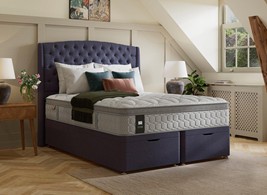
A divan base has no legs, no slats and no visible frame. It's a fabric-covered box built round a timber frame, with your mattress sitting straight on the top of it, on castors or on feet. Sized to the mattress footprint, a double base measures 135 x 190 cm and takes up exactly the floor your mattress covers.
The solid deck is the whole difference. Slatted frames carry your mattress on battens with air between them, so the load arrives in stripes and foam sags into the gaps. That's why foam guarantees carry a slat-gap clause at all, whereas a divan top gives the foam nowhere to go and spreads the wear across the whole underside rather than gathering it above five or six lines.
Platform top or sprung base is the choice I'd spend longest on here. I'd take the platform every time, even under a pocket-sprung mattress, where the trade pairs a sprung base with it as a matter of course.
Rigid decks firm up whatever you lay on them. So choosing the deck is part of choosing your firmness, which happens to be the one variable in this subject with a proper trial behind it.
313 adults with a long-standing back complaint were put on one of two firmness grades for ninety days. By the end the medium-firm group was ahead of the firm one on pain in bed and on disability.1 Read the population before you take that home, because everyone in it arrived with a chronic problem already. Nobody's yet run the same experiment on the base underneath. Back pain that wakes you or won't settle is a question for your GP rather than for a bed base.4
One study I keep coming back to treats the base as half of the mattress. It only got there by treating the mattress and the base as one thing that bends together. On that footing it predicted the sideways curve of a sleeper's spine to a root-mean-square error of 11.9 mm.2 That's a model rather than a measured comfort outcome, and it's still why I'd stop thinking of the thing under your mattress as furniture.
My own reading is least useful to you right here. I sit mid-way through the load band mainstream mattresses are built around, so a stated medium reads as a medium to me. Put that medium on a platform and it comes up a notch. If you're lighter it comes up further, since you never compress deep enough for anything underneath to soften it.
My instinct under-calls how firm a bed feels to you if you're light. It always will.
Divan bases aren't interesting-looking objects, and they've never pretended to be. What they carry is the deck your mattress feels through, the drawers you'll open twice a day and a fabric you'll be looking at for a decade.
If under-bed clearance is the point of your purchase, buy something else: a high-clearance slatted frame or an ottoman base will serve you better. Every card below has a BedBoy Score on it, ranking what owners reported. It can't pick the fabric you'll be living with in ten years.
21 products compared from live retailer data. Scored under our published rubric; curated by Gary Ferguson. Corrections via our corrections policy.
Browse categories
Browse all brands
- Bodyshape
- Dunlopillo
- Emma Mattress
- Ergomotion
- Eve
- Flaxby
- Furniture Village
- Harrison Spinks
- Horizon
- House Beautiful
- Hyde & Sleep
- Hyde and Sleep
- Hypnos
- iGel
- Jay-Be
- Julian Bowen
- Little Big Dreams
- Luna
- Millbrook Beds
- Relyon
- Rest Assured
- Romantica
- Sealy
- Silentnight
- Simba
- Simply Bensons
- Sleepeezee
- Sleepmasters
- Sleepmotion
- SleepSoul
- SleepyTime
- Slumberland
- Snooze
- Sophie Conran
- Staples & Co
- Tempur
- The Dream Team
- The Dreams Workshop
- TheraPur
- Welcome
- WIEMANN
- X Rocker
- healthopaedic
- birlea
- hypnos
- sareer
- orignal-bedstead-company
- nora
- intex
- symple-stuff
- visco-therapy
- house-additions
- home-loft-concept
- clima-control
- kally-sleep
- viva
- healthbeds
- clima-comfort-latex
- feather-and-black
- sleep-science
- spink-and-edgar
- hypnia
- dreamcloud
- revived
- airsprung-beds
- bestway
- disney
- h-living
- bodyshape
- bed-butler
- sprungland
- stompa
- protect-a-bed
Did you know?
Putting your phone down an hour before bed helps you fall asleep faster and wake up less.
Will a divan get up your stairs?
Probably. That's the category's best trick. From a double upward the box comes in two halves rather than one piece, each about 67 cm across on a standard double, which is narrow enough to turn a half-landing that a one-piece frame jams on.
Measure the narrowest point on the route before you order. The pinch is nearly always the diagonal at a turn rather than a doorway, so a tape held flat across an opening won't tell you much. One-piece metal and wooden frames have to make that turn whole.
Platform top against sprung base
A platform top is a rigid deck, usually hardboard over a timber frame with a thin pad under the cover. Sprung bases hold a spring unit of their own, so the base flexes with your mattress instead of staying still underneath it.
Pair a sprung base with a pocket unit and the two spring layers work as one, which gives a softer feel and more give at the edge. Put memory foam on a rigid deck and it'll read firmer than the same mattress on slats, because none of the give is coming from below.
That thin pad under a platform cover does less than the listing photograph suggests. Its job is to stop the board edge printing through the ticking, so I wouldn't let it move your mattress choice by a grade.
Two spring units in your bed also mean two things ageing at different rates. Your mattress goes first. When it does, you're laying a new one on a deck that's been flexing under you for a decade.
Which storage layout suits your room?
Whichever one lets every drawer you paid for open. Storage comes as two drawers, four drawers, continental drawers, a foot-end ottoman, or none at all.
Full-size drawers sit one or two per side and pull out to about their own depth, so the strip of floor you need clear beside the bed matches the drawer itself. Order four for a room with one side against a wall and you've bought two drawers and two handles.
Continental drawers are the layout nobody defines. They're four shallower drawers, two per side, cut short enough to miss your skirting board or the pipe running to a radiator.
Foot-end ottoman decks lift on gas struts and swallow more than every drawer put together. It's the layout I'd be slowest to recommend, because I'd never feel the problem myself.
Lifting a deck with a heavy mattress strapped to it takes leverage you might not have, and the heavier that mattress the more of the lift is yours rather than the strut's. If you're light, or you'd be doing it alone, try the action in a shop before you commit.
Castors, glides and what your carpet does
Castors roll, glides slide, fixed feet do neither. On hard flooring a castor runs well and in deep pile it digs in, whereas glides suit carpet and mark laminate. Fixed feet mean lifting rather than sliding whenever you're hoovering behind the bed.
Deep pile is where this goes wrong, and the drawers aren't at fault.
Your base sits low and the pile lifts the carpet into the drawer's swing, so the front catches on the way out. On a thick underlay the answer is usually taller feet rather than a different base, so ask whether the maker sells them before you decide your drawers are faulty.
How high will the bed be once the mattress is on?
Higher than a slatted frame, usually. Base height and mattress depth get printed in two different places, so you're left to add them up yourself.
Stack 30 cm of mattress on a drawer base and your sleep surface ends up well above where a low platform bed would sit. Put a tape between the floor and the back of your knee. Where the surface sits well above that, getting out in the morning is a slide rather than a step. It'll count for more with a stiff hip than it does at twenty-five.
Deep mattresses swallow the bottom of the headboard too. Buy a thick one and the lower third of a strutted headboard disappears behind it, so check the stated drop against whatever you're putting on the base.
The parts nobody selling one will lead with
Under-bed clearance is gone. Not reduced. Whatever boxes you keep under there now won't fit anywhere on a divan without a drawer in it. There's no headboard in the box either, since the bolt holes for one sit in the base's back panel rather than on any frame.
The airflow question is the one to be straight with you about. Solid decks give your mattress less air underneath than slats do, which is a fact about how the two are built, and nobody has published anything on whether it changes what you'd notice.
So it's unproven in both directions. Push back on any figure you're quoted, because there's nothing published behind one.
There's a related point that has been measured, though it's about beds in general rather than divans. Dust mite allergen has been measured in the dust from beds and upholstery, so how much sits in a home's soft furnishings is at least a known quantity.3 Your divan is the biggest single piece of upholstery in the room, and nobody has put one up against a slatted frame.
Can you zip and link two divan bases?
Yes. It's the one thing this category does that a bed frame can't match.
You buy two single bases, each carrying its own mattress at its own tension, zipped together and linked so they don't drift apart. Couples who disagree about firmness by two grades end up with one bed and two answers.
I sleep alone, so I've no stake in this and no feel for it, though the mechanics aren't complicated. Two 90 x 200 cm bases make a 180 x 200 cm super king, with the join running down the centre line where anyone sharing a duvet will feel it.
Ask whether the linking bar and the connecting strap come in the box, because they often don't. Where firmness is the argument in your house rather than the frame, start from the medium-firm band and work outward.
How long a divan base lasts
Nobody knows. No study on it has ever been published, by anyone.
Retailers quote ten years and more, which is plausible enough as engineering, since there are no hinges to loosen, no slat fixings to pull out and nothing that flexes under you every night. I'd read ten years as convention, because that's all it can be until somebody measures it.
What you can check is more useful than what you can't, so look for a stated weight limit and notice how many makers don't publish one. Anyone in the heavier load bands should treat a missing figure as an answer in itself.
Ask what your deck is made of, since hardboard over timber and chipboard over timber don't age the same way. Find out whether the drawer runners are metal or plastic, because runners are what fails first on a base that's otherwise sound. Then look at the fabric, which is the part you'll live with longest, since ten years is a long time to spend on something you picked from a photograph.
Common questions
Do the two halves stay together?
Mostly, though it's a fair thing to check before you order. Linking clips or a bar bolted through both frames hold them in line. Makers treat that hardware differently: some put it in the box, some sell it separately, some leave your mattress and the headboard bolts to do the whole job. Where nothing but the mattress is holding them, a base on castors will creep apart on a hard floor over a few months. Ask the retailer what ships with it, because the listing rarely says.
What is a continental drawer?
Four smaller drawers rather than two big ones, two down each side of the base. They're shallower front to back and shallower top to bottom, which is the whole point of them. That short front clears a skirting board, a pipe or a bedside table leg that a full-size drawer would catch on. Shops use the term constantly and they don't define it. In a room that's tight down one side, this is usually the layout that still opens fully.
Does a solid platform stop the mattress breathing?
There's nothing published either way. Slats with gaps between them plainly pass more air than a solid platform, which is just how the two are built. What nobody has measured is whether the difference changes moisture, temperature or how long a mattress lasts. Retailers and review sites state it as fact in both directions and none of them cite anything. Turn or rotate the mattress on the schedule its maker specifies, air the room, and treat any number you're quoted on this as decoration.
Has anyone at BedBoy slept on these bases?
Nobody has, which is why there's no badge on the site claiming otherwise. You could never check it either way on a bed base, because nobody can see whether a deck has ever been loaded. An earlier version of our methodology page described a testing tier that never appeared on a single product, and it was removed on 9 August 2026. Underneath the ranking there's published specification, price and pooled customer reviews, scored against the rubric on how we score. Reading specifications is a different job from lying on a base, and we'd rather name that difference than blur it.
Do you need a headboard with a divan base?
Not unless you want one. All four sides are upholstered, so the base looks finished on its own and plenty of people leave it that way. Two threaded sockets sit in the back of it, though the spacing isn't standard between makers, so match a strutted headboard to your base rather than assuming it'll bolt on. Floorstanding headboards stand on the floor behind the bed and never touch it at all, which is the way round the problem if you've fallen for one.
References
- 1. F M Kovacs and others, ‘Effect of firmness of mattress on chronic non-specific low-back pain: randomised, double-blind, controlled, multicentre trial’, The Lancet, vol. 362, no. 9396 (2003), pp. 1599–1604, doi:10.1016/S0140-6736(03)14792-7.
- 2. V Verhaert and others, ‘Modeling human-bed interaction: the predictive value of anthropometric models in choosing the correct bed support’, Work, vol. 41, no. Supplement 1 (2012), pp. 2268–2273, doi:10.3233/WOR-2012-0450-2268.
- 3. P J Vojta and others, ‘Effects of physical interventions on house dust mite allergen levels in carpet, bed, and upholstery dust in low-income, urban homes’, Environmental Health Perspectives, vol. 109, no. 8 (2001), pp. 815–819, doi:10.1289/ehp.01109815.
- 4. NHS, ‘Back pain’, nhs.uk (2026) <https://www.nhs.uk/conditions/back-pain/> [accessed 9 August 2026].