
Bedside tables
BedBoy earns a commission on outbound retailer links. Editorial scoring is independent of commission rates. How this works →
Last updated:
Measure from the floor to the top of your mattress before you shortlist a single table. That one figure settles the choice. Get the tabletop level with the mattress, or a shade above it, and the glass of water sits where your hand already goes in the dark.
Width and depth look like the simpler numbers, right up until you line up two listings and notice they barely seem to describe the same piece of furniture. No standard fixes either measurement, which is part of why one description quotes the overhanging top while the next quotes the narrower carcass underneath it. Published guidance contradicts itself on what counts as usual, so I'd treat any general figure as convention and write down only the dimensions block from the listing in front of you.
Bed height's the part that moves. Under a shallow mattress, a low platform frame sits well below a divan carrying a deep pocket unit. An ottoman base stands taller again than whatever it replaced, so the table that suited your old bed won't sit right against your new one. I'd measure again on the day the new base arrives rather than trust a number written down last year.
Then work out what the table has to clear. Skirting holds a flat-backed carcass off the wall unless the back panel's recessed for it. Radiators want air around them rather than a cabinet pushed against the grille. Splayed bed legs eat into the width you measured at your skirting. That doesn't show in a product photograph, which gets shot square on and cropped tight.
Stability's the specification nobody prints. BS EN 14749 sets structural and stability test methods for domestic storage furniture, with an allowance for a unit standing on soft carpet or an uneven floor.1 Thick carpet under a tall, narrow table is that case exactly. Load the top drawer, pull it right out, and the weight ends up forward of the front legs.
You won't see any of that on a listing. Judge it from the photograph instead: a wide base, a low top drawer, a plinth rather than four thin legs.
Two drawers or three is the storage question worth your time. Two gives you deeper boxes that'll take a paperback lying flat, a charger and a box of tablets without stacking. Three splits the same carcass into shallow trays that sort better and hold less. I'd take the two deeper drawers, because the book that won't lie flat is the one you'll notice every night.
Dead batteries and foreign coins collect in the bottom drawer on their own, and nobody's ever emptied one.
There's a score on every card below, set against one published rubric, which shortens your list and won't tell you whether a runner still glides in year four.
Paying more mostly buys a heavier carcass, solid timber instead of veneer, a third drawer or a socket in the top. If you're fitting out the whole room, the wardrobes and chests of drawers pages are marked on the same basis.
26 products compared from live retailer data. Scored under our published rubric; curated by Giselle Green. Corrections via our corrections policy.
Browse categories
Browse all brands
- Bodyshape
- Dunlopillo
- Emma Mattress
- Ergomotion
- Eve
- Flaxby
- Furniture Village
- Harrison Spinks
- Horizon
- House Beautiful
- Hyde & Sleep
- Hyde and Sleep
- Hypnos
- iGel
- Jay-Be
- Julian Bowen
- Little Big Dreams
- Luna
- Millbrook Beds
- Relyon
- Rest Assured
- Romantica
- Sealy
- Silentnight
- Simba
- Simply Bensons
- Sleepeezee
- Sleepmasters
- Sleepmotion
- SleepSoul
- SleepyTime
- Slumberland
- Snooze
- Sophie Conran
- Staples & Co
- Tempur
- The Dream Team
- The Dreams Workshop
- TheraPur
- Welcome
- WIEMANN
- X Rocker
- healthopaedic
- birlea
- hypnos
- sareer
- orignal-bedstead-company
- nora
- intex
- symple-stuff
- visco-therapy
- house-additions
- home-loft-concept
- clima-control
- kally-sleep
- viva
- healthbeds
- clima-comfort-latex
- feather-and-black
- sleep-science
- spink-and-edgar
- hypnia
- dreamcloud
- revived
- airsprung-beds
- bestway
- disney
- h-living
- bodyshape
- bed-butler
- sprungland
- stompa
- protect-a-bed
Did you know?
Putting your phone down an hour before bed helps you fall asleep faster and wake up less.
What the carcass is made of
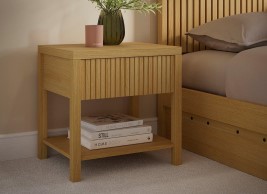
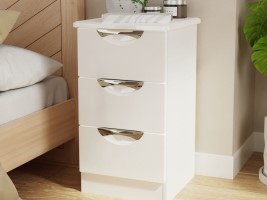
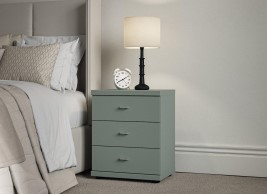
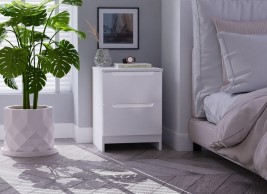
Solid timber, real wood veneer over chipboard, painted MDF, or a fabric-wrapped box. Those four age in completely different ways, though the listing photograph you're looking at flatters all of them equally.
Oak and pine mark, then sand back. Veneer looks identical on day one, chips along its edge in year three, with nothing underneath to sand into. Painted MDF takes a knock better than veneer does, though it'll show every scuff at ankle height. The same four run through the rest of your bedroom furniture, so a finish you like here you can usually get on a wardrobe.
Do the drawers run on metal or wood?
Metal, where you can find out which.
Side-mounted metal runners carry the drawer on a roller or a ball bearing, so your loaded drawer stays level all the way out. Wood on wood is a drawer sliding on a timber rail: quiet, traditional, inclined to bind once damp weather changes the fit. Almost no listing names the runner. Open one fully if there's a showroom near you, then look for a stop that catches before the box pulls clear of the frame.
Fabric sides, and the label to read
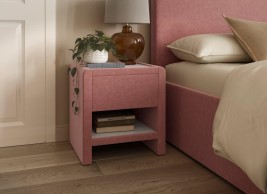
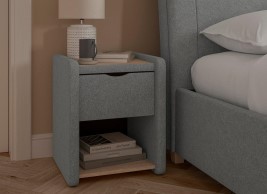
Velvet and faux leather bedside chests are a category of their own rather than a novelty, in the same fabrics you'll meet on a velvet bed frame. Where they carry filling material behind the cover, they fall under the Furniture and Furnishings (Fire) (Safety) Regulations 1988.2 Look for the permanent label stitched into the unit, because that's where the evidence sits and a product description hardly ever repeats it.
Whether any one table is in scope turns on how that unit's built, so it's a question for the label rather than for a category page. Fabric units nearly always arrive with a glass top and you'll be glad of it. Stand a wet glass on cloth once and you'll see why: cloth soaks up whatever reaches it, so a coaster isn't a plan.
Where does the charger cable go?
Out through the back, assuming the back's got a hole in it. Plenty of carcasses are a flat sheet of hardboard with no cut-out, so the plug holds the unit off the skirting while the drawer you push shut traps the lead.
Sockets and USB ports built into the top solve that, then date faster than the furniture around them. I'd take the cut-out over the built-in port, because a connector standard has a shelf life and a hole in a back panel doesn't.
Getting up in the night
Keeping a lamp and a glass within reach, rather than crossing a dark room for either, is the strongest practical argument for the furniture. The evidence behind it isn't as wide as furniture copy suggests. A Cochrane review of home fall-hazard reduction found the rate of falls dropped 38 per cent among people already assessed as at higher risk, and didn't drop at all in unselected adults.3
So it's a proven benefit for one group and unproven for everyone else, which makes reachable light a fair reason to keep your lamp where it is and a poor reason to buy a table. Getting up repeatedly in the night, or a fall at home, is worth raising with your GP.4
Are bedside tables sold in pairs?
Some are, and the listing's the only place that'll tell you. Prices sitting well under the rest of the page are usually one unit, while a price that looks steep is sometimes two.
Nothing else on this page changes what it costs to do both sides of a double bed frame by as much. Check the title and the dimensions block before you compare.
Does it arrive built?
Mostly flat-packed, though some ranges ship assembled. It's stated per listing rather than per category, so the retailer's own delivery page is where you'll settle it.
Flat-pack here is an evening rather than a weekend, since a small carcass has few panels and the drawers arrive as boxes needing only fronts and handles. The part that goes wrong is the back panel. It's thin hardboard pinned to the frame, it's the only thing keeping the carcass square, and it's the piece people skimp on when they're tired.
Is the cupboard door hinged on the right side?
Single-door units have a handing, though only some of them reverse. Hinge the door on the wrong edge and it swings into the bed, which leaves you leaning across it to reach the shelf.
Whether you can swap it depends on the carcass being drilled both sides, which the instructions state rather than the listing. Buy two for either side of your double and the handing decides whether you end up with a matched pair or a mirrored one.
When a table is not the answer
Narrow rooms first. Where your bed already reaches the radiator, a wall-mounted unit gives you the surface and keeps your floor. A shelf does much the same for less. A chair does it for nothing.
If it's storage you're short of rather than reach, a chest of drawers or a blanket box holds several times as much for the money. Your table only has to take a lamp, a glass and whatever you're reading.
Common questions
Is a bedside table the same as a bedside cabinet?
Close enough that the words get swapped, though there's a rough distinction behind them. Bedside table tends to mean an open or single-drawer unit on legs. Bedside cabinet or bedside chest usually means a taller carcass with two or three drawers, or a cupboard door. No retailer's consistent about it, so your search for one turns up the other. Ignore the noun and read the drawer count, the height and the depth, because those three decide whether it'll suit your room and your bed.
How much should you spend on a bedside table?
Less than the urge to match your bed frame suggests. Above the budget end, your money goes on a heavier carcass, solid timber rather than veneer, metal runners, a third drawer, or a socket built into the top. All of that's worth something and none of it changes what the table is for. Spending more makes better sense on a pair than on a single, since two units double a decision you'll only make once. Set your height first and let price sort out what's left.
How much weight will the top take?
More than a lamp, and less than you'd assume of a glass panel. Manufacturers don't often publish a figure for a bedside table, which leaves you nothing to compare between listings. What decides it in practice is the fixings under a glass top and the joint between the top and the carcass. Both work hardest when something heavy sits at the front edge instead of over a leg, so it's worth keeping your heaviest lamp toward the back of the top, away from the overhang.
What's behind the score on each card?
Owner reviews, measured against one published rubric. No badge on this site claims a hands-on test, and none ever did. Nobody here has assembled one of these units, pulled a drawer or stood a lamp on a glass top. So the score can't speak to any of that. What owners do write about is the part you'd notice in the first week: whether the panels lined up, whether the drawers stick, whether the finish matched the photograph. Board density and runner tolerance never reach a review.
What if you want a matching second one later?
Treat it as a bet on the range still being made. Ranges get retired on their own schedule, and a second unit you order a year on can arrive a shade off in a finish that's been reformulated since. Buying both at once is the only reliable way you'll end up with a matched pair. Failing that, stop trying: a deliberately different table in a plain finish reads as a choice, while a near miss on oak effect reads as a mistake.
References
- 1. British Standards Institution, BS EN 14749:2016+A1:2022 Furniture. Domestic and kitchen storage units and kitchen-worktops. Safety requirements and test methods (2022).
- 2. United Kingdom, ‘The Furniture and Furnishings (Fire) (Safety) Regulations 1988 (SI 1988/1324)’, legislation.gov.uk (1988) <https://www.legislation.gov.uk/uksi/1988/1324/contents/made> [accessed 9 August 2026].
- 3. L. Clemson, S. Stark, A. C. Pighills, N. J. Fairhall, S. E. Lamb, J. Ali and C. Sherrington, ‘Environmental interventions for preventing falls in older people living in the community’, Cochrane Database of Systematic Reviews, vol. 3, no. 3 (2023), pp. CD013258, doi:10.1002/14651858.CD013258.pub2.
- 4. National Institute for Health and Care Excellence, ‘Falls: assessment and prevention in older people and in people 50 and over at higher risk (NG249)’, nice.org.uk (2025) <https://www.nice.org.uk/guidance/ng249> [accessed 9 August 2026].