
How often to turn a mattress, and how to make it last
 Written by
Gary Ferguson
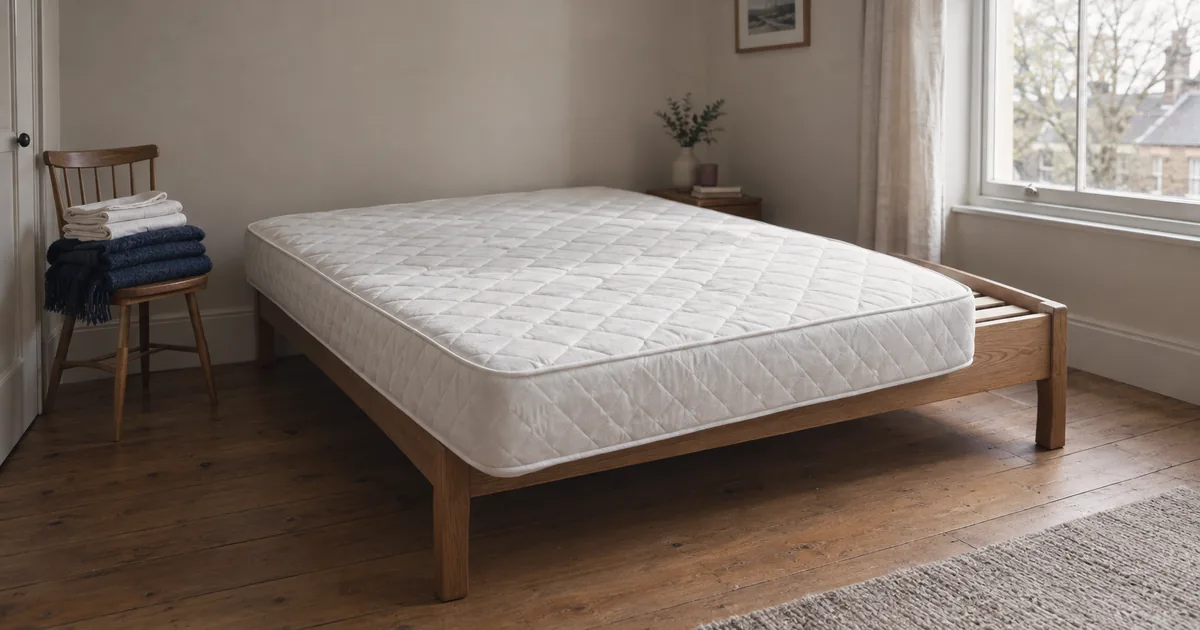
Rotate your mattress head to foot every week for its first three months and every month after that. Flip it over as well only if it has a sleeping surface on both sides. The fillings settle under the heaviest parts of you, your shoulders and hips, and moving the mattress round spreads that settling over the whole bed instead of letting it sink two hollows where you lie. If yours is one-sided, the job is a rotate, not a flip.
For stains and smells, go to how to clean a mattress.
Rotate or flip: what your mattress needs
Rotating means swinging the mattress round so the head end goes to the foot. Flipping, which the bed trade calls turning, means turning it over so the underside comes up. A two-sided mattress has quilted fillings on both faces and needs both jobs. A one-sided mattress, sold as no-turn, has its comfort layers on the top face only, so flipping it puts you on the base layer. Rotate it and leave it the right way up.
Not sure which you have? Look at the underside. Plain flat fabric or a non-slip base means one-sided. Quilting and tufts to match the top mean two-sided.
| Your mattress | Rotate head to foot | Flip over |
|---|---|---|
| Two-sided, quilted on both faces | Yes | Yes, alternating with each rotate |
| One-sided or no-turn sprung | Yes | Never |
| Memory foam, latex, or a hybrid with foam on top | Yes | Only if the label says both faces are for sleeping on |
| Pillow top | Yes | Never, the padding is stitched to one face |
| Zip-and-link or split tension | Zip-and-link: unzip and rotate each half on its own side. One-piece split tension: rotating swaps your sides, so follow the label | As the label says |
| Zoned springs or foam | Only if the zones mirror head to foot | As the label says |
The schedule in the bed industry's own care guide is weekly for the first three months while the new fillings bed in, then monthly. On a two-sided mattress you alternate, so it's a rotate one time and a flip the next. Some makers of natural-filled mattresses relax the second half: Hypnos asks for a weekly rotation for three months and then one with each season. Tie it to something you already do, such as the weekend you change the sheets.
A two-sided mattress gives the wear twice as much surface to spread over, and you pay for it in weight and effort every time you flip it. If that trade suits you, start with the double-sided picks.
How to turn a mattress without damaging it
Strip the bed down to the mattress first, protector included, so nothing snags. To rotate, pull the mattress a third of the way off the foot of the bed, swing it round on the frame and push it back. To flip, stand it on its long edge beside the bed, walk it over and lower it down with the other face up. Get a second person for any flip, and for rotating anything bigger than a double.
The handles on the border are for steering the mattress into place, never for lifting it. Sewn-on handles aren't built to take the mattress's full weight, and a handle torn out of the cover is a split in the fabric you'll be looking at for years. Grip the mattress itself, low down on the border.
Settling and dips: which ones are normal
A shallow impression where you sleep is normal on any mattress with fillings. The fillings on top of the springs take your shape, and maker care guides treat body impressions as normal wear. Regular rotating keeps them shallow. A pillow top shows deeper impressions than a flat top, because the padding there is deeper to start with.
The dip to worry about is the one you roll into. Strip the bed and press into the hollow with the flat of your hand. If you feel soft quilting all the way down, it's the fillings settling. If the springs underneath have gone lower than the springs round them, the support has failed, and that's what a guarantee is for. If your guarantee names a depth of dip it treats as a fault, lay a broom handle across the hollow and measure the gap under it before you ring anyone.
What goes under the mattress
The base under your mattress wears too, and an old one passes its sag straight up into a new mattress. Put a new mattress on an old sprung divan and the worn springs in the divan give way under your hips first. I'd replace a sprung divan with the mattress every time. A slatted frame stays as long as every slat is straight, whole and close enough together.
On a slatted frame, measure the gap between the slats before anything else. Hypnos sets the limit at 7.5 cm (3in) apart. Wider than that and the mattress sags into each gap, which wears the underside into ridges and leaves a sprung mattress with nothing under some of its springs. Measure your gaps with a tape. If they're too wide, add slats or fit a slat roll made for that frame.

An adjustable bed needs a mattress made to bend with it, so check the listing says so before you buy one for it. A mattress straight on the floor gets no air underneath and the underside can go damp, so give it a slatted frame or a divan as soon as you can. Every frame type is in the bed frame listings.
Moving a mattress
Never fold or bend a sprung mattress, not even for the length of a stair turn. Bending it damages the spring unit for good, and no guarantee covers that. Carry it flat or on its long edge, in a mattress bag to keep the cover clean, and stand it on its edge in the van so nothing gets stacked on top of it.
Before moving day, check it will go round the turn at the top of your stairs with the access checker. A mattress in a box was rolled once at the factory to make the trip, which is what it's built for. Once it's open, never roll it up again. Move it like any other mattress.
Protectors and air
Put a washable protector on before the first night. It keeps the cover clean, and some maker guarantees are void without one, so read yours.
Give the mattress air every day. Pull the duvet back when you get up and leave the bed unmade until after breakfast, so the moisture from the night has somewhere to go. On a wool or natural-filled mattress, go by the care label: where it says brush, use a soft brush and keep the vacuum off it, because the suction can drag loose fillings out of place.
How long a mattress lasts, and when to replace it
Replace a mattress when it stops supporting you, whatever its age. That said, I'd start checking it hard once it passes seven years, and any time you notice the signs below.
Is it time for a new one?
Two or more ticks and I'd start looking. There is some evidence a tired bed costs you sleep. In a 2009 study of 59 adults whose own beds averaged 9.5 years old, sleep quality improved and back pain fell after they moved to new medium-firm bedding. There was no control group, so read it as a pointer, not proof.
If a mattress fails well before its time, the maker's guarantee is one route and the retailer is another. Under the Consumer Rights Act 2015, goods have to be of satisfactory quality, and durability is one of the things that counts. The returns and refunds page sets out which of the two to go to first. When it is time for a new one, start with how to choose a mattress and then the mattress listings.
Turning questions
Can you flip a memory foam mattress?
Not unless the label says both faces are for sleeping on. A memory foam mattress is built in layers, with the soft memory foam on top and a firm support foam underneath. Turn it over and you're lying on the support foam with the soft layer under you, which feels hard and does nothing for the wear. Rotate it head to foot instead, on the same schedule as any other one-sided mattress.
Do you need to rotate a no-turn mattress?
Yes. No-turn only means you never flip it over. The fillings on the top face still settle under your shoulders and hips, and if the mattress never moves, the same spots take your weight every night until they dip. Rotating it head to foot puts those spots under your feet and lower legs for a while, where the load is lighter.
Is a dip in a new mattress a fault?
Usually not. Body impressions start in the first few weeks as the fillings take your shape, and they're deepest on pillow tops and on mattresses with a lot of wool or fibre. Rotate it weekly over those first months and the impression spreads out. It's a fault when the springs underneath have gone lower than the springs around them, or when the dip is deeper than any depth your guarantee names. Measure it before you claim.
Should you turn a mattress topper?
Rotate it whenever you rotate the mattress, since it settles in the same places for the same reason. Flip it only if both sides are the same, which is true of most plain foam and fibre toppers. A topper with a different top and bottom, such as a quilted face over a non-slip underside, stays the right way up. Give a fibre topper a shake when you rotate it, to plump the filling back up.
Can you put a new mattress on an old base?
You can, and you'll shorten the new mattress's life if the base is worn. A sprung divan has its own springs, and when they sag the mattress sags with them, right where you lie. A platform-top divan has a flat board, and a bowed or cracked board does the same damage. On a slatted frame, look for broken or bowed slats and gaps wider than your mattress maker allows, 7.5 cm (3in) in Hypnos's case. If the base is as old as the mattress you're replacing, replace both.
How long should a mattress last?
As long as it keeps supporting you, which depends more on how it's built and looked after than on a date. I'd give any mattress a proper look at seven years. A well-made sprung mattress that has been rotated on schedule and sits on a sound base often goes past that. A cheap foam one left in one position on worn slats can be done much sooner. Go by the signs in the checklist above.
My verdict
If you only do one thing, rotate it every week for the first three months. That's when the fillings are bedding in, and a mattress left alone through those weeks keeps the two hollows it made.
References
- Bed Advice UK: caring for your bed, rotating and flipping one-sided and two-sided mattresses. https://bedadvice.co.uk/bed-buyers-guide/caring-for-your-bed/
- Hypnos: your bed, seasonal rotation and slat spacing. https://www.hypnosbeds.com/uk/about-hypnos/your-bed
- Jacobson BH, Boolani A, Smith DB (2009). Changes in back pain, sleep quality, and perceived stress after introduction of new bedding systems. Journal of Chiropractic Medicine 8(1): 1 to 8. https://pmc.ncbi.nlm.nih.gov/articles/PMC2697581/
- Consumer Rights Act 2015, section 9: goods to be of satisfactory quality, including durability. https://www.legislation.gov.uk/ukpga/2015/15/section/9